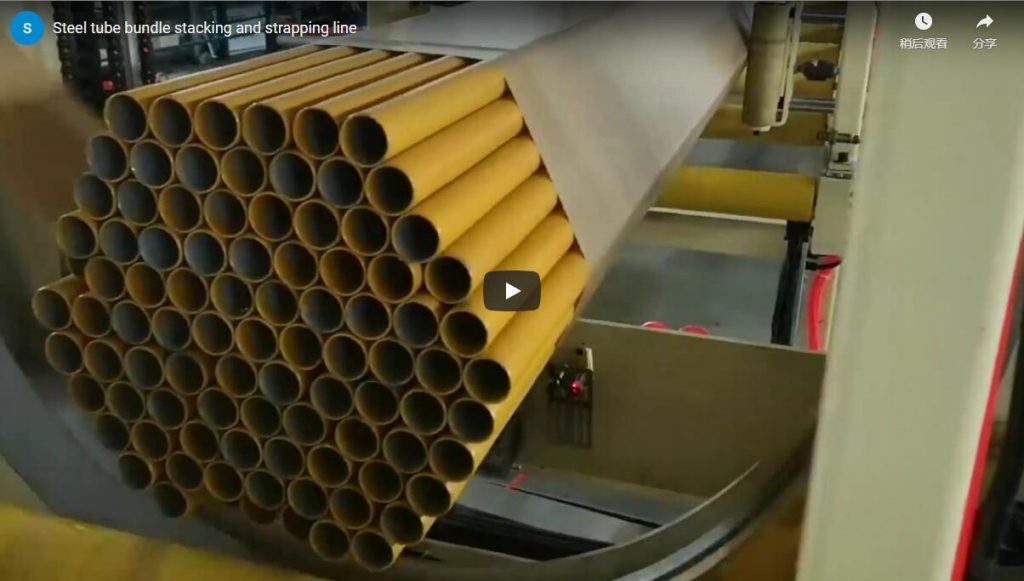
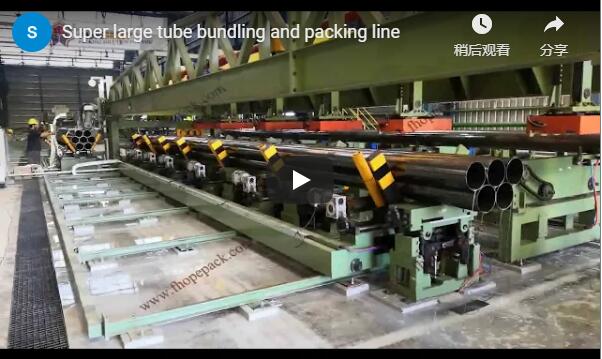
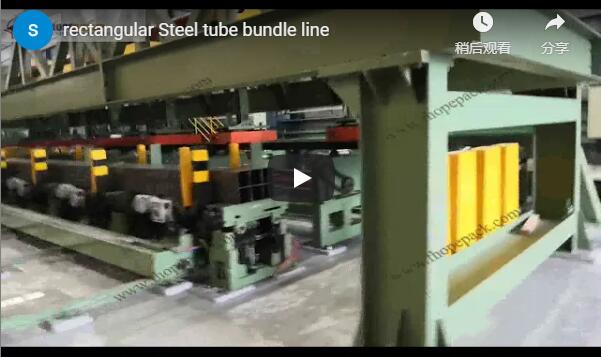
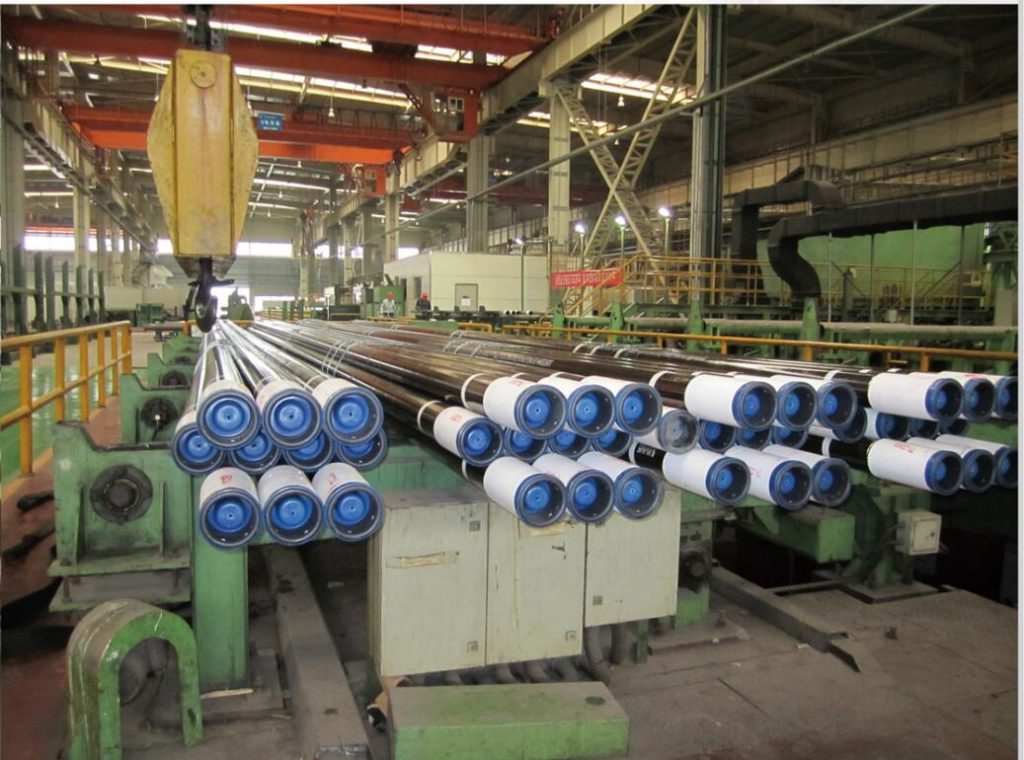
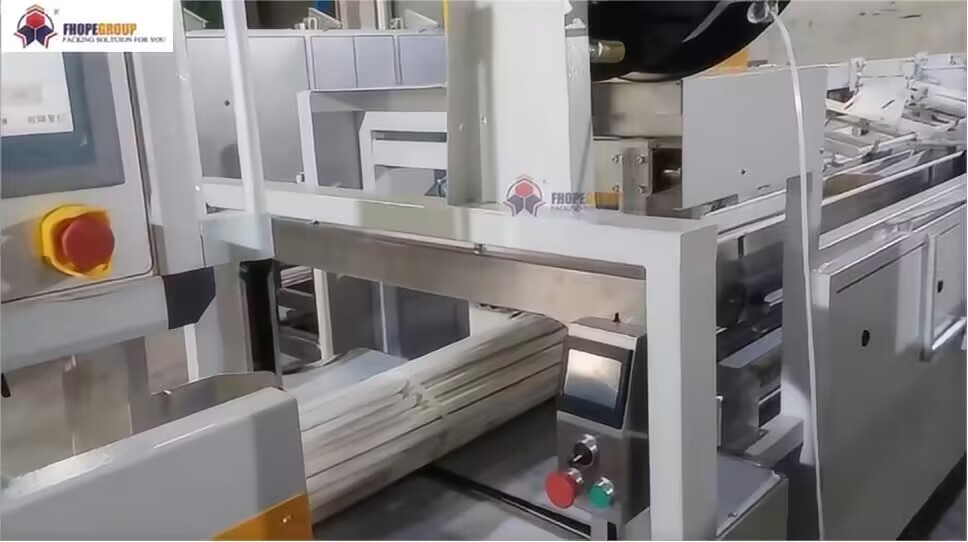
Executive summary A steel tube bundle packing line counts tubes into layers, forms the layers into a hexagon or square bundle, clamps it and straps it for shipping. Our clip, about 165 s long, walks along the line: tube storage, blue roller conveyors, a V-shaped forming station and a hexagon bundle being clamped. The line takes round tubes from 114.3 to 323.9 mm, plus square and rectangular tubes, and builds bundles of 4.5 to 16 m length up to 13,000 kg.
Table of Contents
- What the clip shows, in order
- Stations of a tube bundle packing line
- Line data
- Takt check
- Selection checklist for a tube bundle packing line
- Controls and safety
- Engineering FAQ
- Next step
- Related reading
- Sources
What the clip shows, in order
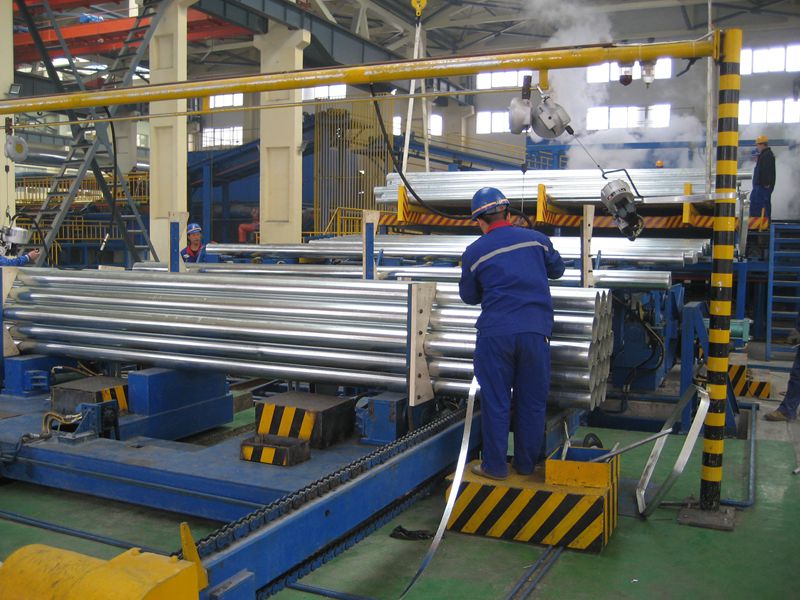
The line is built from blue steel frames with roller conveyors, yellow guides and stops, and hydraulic or pneumatic cylinders. A white control box with a red lamp stands on the floor by the line.
- 0 to about 15 s. Long silver tubes lie on racks on the left, and the blue line runs on the right. Workers in hard hats stand in the background.
- About 20 to 30 s. A large black tube is held on the upper beam of the line and moves to the right.
- About 35 to 50 s. The camera pans along the middle of the line: parallel rails, cylinders, yellow stops, and silver tubes fed into a row of rollers under a guide arm with yellow and black stripes.
- About 55 to 75 s. The view returns to the start, then tilts up to the roof lights for a few seconds.
- About 75 to 95 s. A wide view shows long dark tubes lying on blue supports along the line, with the yellow guides at rest.
- About 100 to 135 s. A tube bundle moves slowly along the roller conveyor toward the end of the line and into the V-shaped forming station.
- About 140 to 145 s. The bundle sits in the V station, ends toward the camera. Two workers in red hard hats work on the side plates, one crouching with a tool and one steadying the bundle.
- About 150 to 155 s. A worker pushes a hexagon stack of tubes into the clamp by hand, and the side arms start to close.
- About 160 to 165 s. With the clamp closed, a worker works at the end face of the bundle under a bright arc light.
Stations of a tube bundle packing line
Tubes leave the mill one at a time on a run-out roller conveyor. The line turns them into a tight, counted bundle that a crane or forklift can lift in one move.
| Station | What it does |
|---|---|
| Run-out conveyor and reject kicker | Takes tubes from the mill, sorts out rejects |
| Picking up and air blowing | Picks tubes one by one and blows them clean |
| Aligning and counting | Aligns tube ends and counts each tube into a layer |
| Layer forming | Builds rows with an electromagnetic chuck |
| Bundle forming bed | Forms the hexagon, square or rectangle, side stops hold the shape |
| Strapping | Full-auto steel strapping, 25 or 32 mm strap |
| Out-loading and stacking | Transverse conveyor, chain stacking of 5 bundles |
The forming device adjusts to each bundle shape. Once strapped, a lateral transfer stages the bundle on the unloading table.
Line data
| Steel tube bundle packing line | Specification |
|---|---|
| Product shape | Round, square and rectangular |
| Round tube | 114.3 to 323.9 mm |
| Square tube | 90 × 90 to 250 × 250 mm |
| Rectangular tube | 80 × 100 to 200 × 300 mm |
| Wall thickness | 3.0 to 12.7 mm |
| Hexagon bundle | 450 to 1,100 mm wide, 350 to 1,000 mm high |
| Square or rectangular bundle | 350 to 950 mm wide, 300 to 800 mm high |
| Tube length | 4.5 to 16 m |
| Bundle weight | up to 13,000 kg |
| Out-loading conveyor | about 43 m, with the strapping machine |
| Steel strapping | 25 mm and 32 mm automatic heads |
| Control | Touch-screen operator station |
Takt check
The bundle rate follows the mill. For an illustrative mill output of 10 tubes per minute and 60 tubes per bundle, a bundle fills every 60 ÷ 10 = 6 minutes, or 360 s.
Inside those 360 s each station, forming or strapping, has to finish its own cycle, because the stations run in parallel on different bundles. Strapping several bands on a long bundle is usually the longest step, so we place the strapping machine on the out-loading conveyor, where it works on one bundle while the next one forms. The chain stacking of 5 bundles gives the crane a buffer.
These figures are illustrative. We run the check with your mill speed, tube size and bundle count in the proposal.
Selection checklist for a tube bundle packing line
- Tube shape, size, wall thickness and length range.
- Bundle shape and size, tubes per bundle and bundle weight.
- Mill output in tubes per minute.
- Strap width, strap count and strap positions along the bundle.
- Out-loading, stacking and crane or forklift take-off.
- Floor length available for the out-loading conveyor.
Controls and safety
At about 140 to 155 s workers stand inside the forming station, adjust the side plates and push the tube stack into the clamp by hand while the side arms start to close. A hand or body between tubes and closing clamp arms is the move to design out. On our line the forming and clamping run from the touch-screen station, outside a fenced zone.
Stop, isolate and lock out the forming station before anyone enters it to adjust side plates, correct a layer or work at the bundle end. Any work at the bundle end, such as the arc work at about 160 s, happens only with the clamp locked and the conveyor isolated.
The standards that apply depend on the destination market. For CE markets, ISO 12100 sets the risk-assessment method and EN 415-10 covers general requirements for packaging machines, which fixes guarding and the stop arrangement.
Engineering FAQ
Q: Which tube sizes does the bundle packing line take? A: Round tubes from 114.3 to 323.9 mm, square from 90 × 90 to 250 × 250 mm and rectangular from 80 × 100 to 200 × 300 mm, 3.0 to 12.7 mm wall.
Q: How large can a bundle be? A: Hexagon bundles up to 1,100 mm wide and 1,000 mm high, 4.5 to 16 m long and up to 13,000 kg.
Q: How are the bundles strapped? A: With full-auto steel strapping heads for 25 mm and 32 mm strap, on the out-loading conveyor.
Next step
We size a tube bundle packing line in three steps:
- Submit your layout drawing with the tube range, bundle shape, tubes per bundle and mill output, to info@fhopepack.com.
- Receive a proposal within 48 hours, with the station list, the conveyor length and the takt check.
- Book a site survey so we confirm the mill run-out, the floor length and the crane access.
Related reading
- Automatic packing line for steel tube bundle and profile
- Automatic steel pipe bundling and packing line
- Steel tube strapping machine
- Steel slit coil packing line
Sources
- Line data and stations: automatic packing line for steel tube bundle and profile product page
- Clip timing: frame timings taken from our clip, 5 s between frames
- Line in action: our video on YouTube
- Standards scope: ISO 12100:2010, EN 415-10:2014
Last reviewed: 2026-10-05