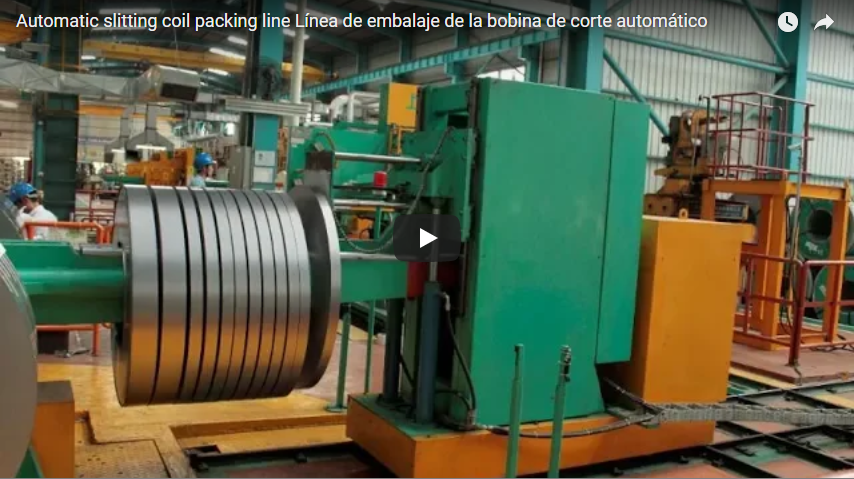
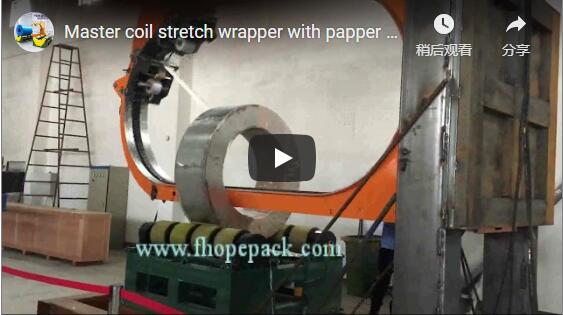
Executive summary: This review covers a manufacturer clip behind the article titled “Zero Surface Damage: How We Automated Our Stainless Steel Coil Packaging with Wrapping, Labeling & Stacking” — a stainless steel coil packaging line in a factory hall that stretch-wraps horizontal coils in soft clear film, applies coil labels, and stacks finished coils onto wooden pallets, with a laser-marking station and a liquid top-coat station visible along the line. Sampled every few seconds across the roughly 79-second clip (27 still frames), the footage repeatedly shows the wrapping and stacking operations and, in several frames, coils carrying “FHO PACKING SOLUTION” labels. Two honest qualifications matter up front. First, the brand text is inconsistent across the footage: nameplates and labels produced many different reads (FMO, HOPE, THO/www.tho.com.vn, HRO, EHO, FENG, FNC, FMS, and FHO on the coil labels), so no machine-brand claim is made; FHOPE appears only as the site hosting the article and the vendor behind this class of equipment. Second, the title’s “zero surface damage” promise is not something the footage can prove — there is no surface-inspection step, no damage measurement, and no transport test on camera, so that claim is flagged for verification rather than repeated as fact. The clip demonstrates stainless steel coils being wrapped, labeled, and pallet-stacked on a powered line; it does not prove a zero-damage guarantee, a rated throughput, or a fully unmanned operation.
https://www.fhopepack.com/Automatic-Coil-Packing-Line/
This review is written for plant engineers, finishing managers, and buyers who handle stainless steel or other surface-critical coils and are evaluating an automatic wrapping, labeling, and stacking line against manual wrapping, individual coil labeling, or outsourced packaging. It documents what this clip actually demonstrates frame by frame, what it conspicuously does not show, and the exact data and evidence to request from the supplier before quoting.
What the video shows
The footage is a factory-floor sequence of a stainless steel coil packaging line handling horizontal coils:
- Stretch-film wrapping is the dominant, repeated operation. Soft clear stretch film is applied to horizontal coils on roller conveyors and rotating platforms throughout the clip — the conveyor carries coils into a wrapping station where the film is wrapped around the coil body in the frames sampled.
- Labeled coils. Several coils carry labels reading “FHO PACKING SOLUTION”, and one section carries an “FMS” mark — evidence that product labels are applied to coils on the line, even though a dedicated label-print/apply head is not clearly confirmed.
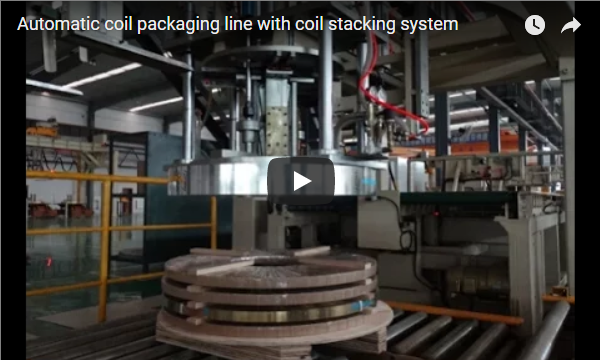
- Pallet stacking of finished coils. Frames near the end of the line show coils being stacked onto wooden pallets — the stacking/palletizing step the title names is genuinely visible.
- Laser marking and a liquid top-coat station. A laser-marking station appears on the roller conveyor (later frames show a coil passing under it in white film), and an adjacent station applies a liquid substance to the top surface of a coil — consistent with surface-marking and protective top-coat steps, though their purpose is not labeled on camera.
- Horizontal coil orientation throughout. Every coil in the sampled frames is horizontal (eye of the coil facing up or sideways on rollers), which is typical for stretch-film wrapping on a platform or conveyor.
- Factory-floor setting with a crane. The line sits in a factory hall with an overhead crane carrying a Chinese safety slogan (a phrase about self-alertness and accidents arising from carelessness), which places the footage inside the manufacturer’s own facility rather than at a named customer site.
- Operators are intermittent. An operator appears beside a control panel in some frames; many other frames show the line running with nobody in view.
The repeatable message of the footage is that a stainless steel coil packaging line stretch-wraps horizontal coils in soft clear film, applies coil labels, and stacks finished coils onto wooden pallets, with laser-marking and top-coat stations visible, in a factory-floor setting with inconsistent branding and no readable specification.
Direct observation notes
These points stay close to the visual evidence:
- Wrapping is clearly and repeatedly shown: soft clear stretch film applied to horizontal coils on conveyors and rotating platforms.
- Stacking/palletizing is visible: finished coils accumulate and are placed onto wooden pallets in later frames.
- Coil labeling is partial: “FHO PACKING SOLUTION” and “FMS” labels appear on coils, and a laser-marking station and liquid top-coat station are present; a dedicated label printer/apply head is not confirmed.
- The “zero surface damage” outcome is not demonstrated: no surface-inspection step, no measured damage data, and no transport/protection test appears in the footage.
- Branding is inconsistent across frames: nameplate and label reads include FMO, HOPE, THO with www.tho.com.vn, HRO, EHO, FENG, FNC/FMS, and FHO on the coil labels — so no machine-brand claim is made; FHOPE is named only as the site and vendor behind the article.
- No readable specification anywhere: no coil size range, wrap film type or count, speed, cycle time, PLC model, or capacity figure is legible in any frame.
- Staffing varies on camera: an operator is present at a control panel in some frames; other frames run unattended.
- All frames are stills sampled over a short clip: they prove the machine classes and operations present (wrapping, marking, top-coating, labeling, stacking), the horizontal coil orientation, the factory setting, and the varying staffing — not a zero-damage guarantee, a rated output, or a confirmed fully automatic sequence.
What the title claims vs what the footage proves
| Claim (title) | Visible in footage? | Verdict |
|---|---|---|
| Zero Surface Damage | None — no surface inspection, damage test, or protection measurement on camera | Not demonstrable — verify with supplier |
| Wrapping | Soft clear stretch film on horizontal coils, repeated throughout | Demonstrated |
| Labeling | Coil labels “FHO PACKING SOLUTION”/”FMS”; laser-marking and top-coat stations | Partially demonstrated; dedicated label head unconfirmed |
| Stacking | Finished coils stacked on wooden pallets | Demonstrated |
| Automated packaging | Powered self-running wrap and stack in the filmed shots; PLC panel present | Machine-powered run shown; PLC/full-automation not proven |
| Stainless steel coils | Horizontal metallic coils wrapped in film; material by article context | Product class by context; no material label confirmed |
| Any machine brand / model / capacity figure | None legible | Not shown — not repeated as facts |
The footage reliably demonstrates stretch-film wrapping, coil labeling in part, and pallet stacking of stainless steel coils on a powered line in a factory setting — but never the “zero surface damage” guarantee, a readable spec, a confirmed label-print head, or a fixed automation level.
What the video does not show
For a buying decision, the following are not observable in the footage and must be confirmed with the manufacturer:
| Missing information | Why it matters |
|---|---|
| Zero-surface-damage evidence | The title’s central promise; needs inspection/test data, not footage of wrapping |
| Machine brand and model | Nameplates read inconsistently (FMO/HOPE/THO/HRO/EHO/FHO on labels), so the maker is unconfirmed |
| Coil size and weight range | Whether your coil mix fits the line and the pallet stacker |
| Wrap film type, thickness, and film-per-coil | Wrap quality and per-coil consumable cost |
| Labeling method and data flow | Whether labels print from your ERP and apply automatically; only product labels on coils are visible |
| Laser-marking and top-coat details | Purpose, pattern options, and coating chemistry are unlabeled in the footage |
| Line speed, cycle time, and throughput | Capacity matching for your production volume |
| PLC and control integration | Automation level and connection to your line/MES |
| Operator staffing | Some shots show an operator, others are empty; real manning needs confirming |
The clip never shows a readable nameplate, a legible spec plate, a surface-damage measurement, or a consistent operator headcount. The zero-damage promise and any automation or throughput figures are supplier description, not confirmed by the footage; treat them as unverified until the manufacturer’s datasheet and test data confirm them.
How the filmed line works, as filmed
Reading the sampled frames in sequence gives a working picture: stainless steel coils in horizontal orientation travel on roller conveyors into a wrapping station, where soft clear stretch film is applied on a rotating platform or conveyor section; some coils pass a laser-marking station and a liquid top-coat station; labeled coils (carrying “FHO PACKING SOLUTION” and “FMS” marks) continue to the outfeed, where finished coils are stacked onto wooden pallets. Staff presence is intermittent on camera — an operator is at the control panel in some shots, while other frames run unattended. Because all frames are stills sampled over a short clip, the video proves the presence and visible classes of the stations, the horizontal coil orientation, the film, the labels on coils, the pallet stacking, and the factory setting — but not the wrap quality, the coating chemistry, the marking workflow, the line speed, the rated capacity, or the real operator count. Request a full-length, uninterrupted run (coil in to pallet-stacked out, with a visible clock), state your coil sizes, weights, daily volumes, surface-protection requirements, and labeling data needs, and ask the supplier to confirm the maker and model, datasheet, capacity and size range, wrapping speed and cycle time, film usage, the labeling method and ERP integration, the laser-marking and top-coat options, power and footprint, and the real operator staffing the line needs — plus the inspection and transport-test evidence behind the “zero surface damage” claim.
Where “Zero Surface Damage: …Wrapping, Labeling & Stacking” stands in the footage
The article title promises a stainless steel coil packaging line delivering zero surface damage via wrapping, labeling, and stacking. The footage supports three of the four named operations: wrapping is clearly shown, stacking onto wooden pallets is shown, and labeling is partially shown (labels on coils plus laser-marking and top-coat stations). The honest corrections are the bits the footage cannot confirm: “zero surface damage” is not demonstrable (no inspection, damage test, or protection measurement appears), no readable brand or model appears (nameplates and labels read differently across frames, so no machine-brand claim is made and FHOPE is kept only as site/vendor), no specification or control figure is legible (so any capacity, speed, or automation claims are dropped), and staffing varies on camera (so no fixed manning claim is made). This review therefore describes the wrapping, labeling (in part), and stacking operations, the horizontal coils, the factory setting, and the varying staffing accurately, does not claim a brand, a rating, a zero-damage guarantee, or a fixed automation level, and sends every technical, quality, and cost figure to the manufacturer’s datasheet.
Buyer’s verification checklist
Use this as a short pre-order checklist for a stainless steel coil wrapping, labeling, and stacking line:
- Ask the supplier for the inspection and transport-test evidence behind the “zero surface damage” promise — the footage shows no damage measurement.
- Confirm the maker, model, and datasheet behind the clip — nameplates read inconsistently, so no machine brand can be claimed from the footage.
- Confirm the coil size and weight range the line can wrap, label, and stack.
- Ask for the wrapping speed, cycle time, and coils-per-hour for your coil size.
- Ask which film types, thicknesses, and film-per-coil figures apply, and how they protect surfaces during transport.
- Confirm the labeling method: whether labels print from your data and apply automatically, and how the laser-marking and top-coat stations are configured.
- Ask for the control system (PLC brand, HMI) and line/MES integration options.
- Request power supply requirements and the line footprint.
- Confirm the real operator workflow and staffing for loading, supervising, and pallet removal.
- Request a full-length, uninterrupted run of one coil from infeed to pallet-stacked out with a visible clock.
- Compare total cost and throughput against manual wrapping and outsourced packaging for your coil volumes.
FAQ
Does the video prove “zero surface damage”? No. The footage shows wrapping, labeling (in part), and pallet stacking, but no surface inspection, damage measurement, or transport-protection test appears in any frame. The zero-damage promise must be verified with the manufacturer through inspection and test data.
What machine brand is in the video? No readable brand. Nameplates and labels gave many different reads across frames (FMO, HOPE, THO with www.tho.com.vn, HRO, EHO, FENG, FNC/FMS, and FHO on the coil labels). The reads are mutually inconsistent, so this review does not claim a machine brand and names FHOPE only as the site and vendor behind the article.
Is the line fully automatic, and how is it staffed? The filmed shots show a powered, self-running wrap and stack, with an operator at a control panel in some frames and the line unattended in others. Stills cannot prove a fixed staffing level or a fully PLC-driven automatic line; confirm the automation package and manning with the supplier.
What exactly does the footage show being stacked? Finished stainless steel (by article context) coils in horizontal orientation, wrapped in soft clear film and often carrying labels, being stacked onto wooden pallets at the outfeed, after passing wrapping, laser-marking, and liquid top-coat stations on the roller-conveyor line.
How does this review handle the labeling claim? Carefully. Labels reading “FHO PACKING SOLUTION” and “FMS” appear on coils, and laser-marking and top-coat stations are on camera, so “labeling is partially shown” is a fair statement — but a dedicated label-print/apply head is not confirmed, so the full labeling method is deferred to the supplier’s specification.
Related reading
- Automatic coil packing line
- Steel coil wrapping machine
- Coil packing machine
- Steel coil strapping machinery
- Coil upender and coil handling
Next step
If a stainless steel coil wrapping, labeling, and stacking line fits your packaging requirement, turn the clip into a verification conversation: send your coil dimensions, weights, daily volumes, surface-protection requirements, and labeling data needs, and ask the supplier to confirm the evidence behind the “zero surface damage” claim, the maker and model and datasheet, the coil size/weight range, wrapping speed and cycle time, film usage, the labeling and marking/coating options, the control integration, power and footprint, and the real operator staffing — then request a full-length run with a visible clock. Use the contact page to start that exchange and to arrange a live demonstration or factory visit, and verify every quality, schedule, and capability claim from the video with the manufacturer before you commit.
Published: 2026-09-19