Executive summary This guide walks through a slit steel coil line where one machine upends a horizontal coil to vertical, conveys it, and applies an eye-through wrap. You will see the actual sequence on video, what the footage does and does not prove, and the questions to confirm with the manufacturer before you commit to a layout or a purchase.
Why the upend-then-wrap sequence matters
Slit coils usually leave the slitting line lying flat, with the eye (the hollow center) facing up. Downstream operations — storage, stacking, transport, and most wrapping methods — work better when the coil stands on edge, eye facing horizontally. That is why the upending step exists: rotate the coil 90 degrees safely and repeatably, without a crane, without a forklift, and without an operator putting hands near a multi-ton rotating mass.
Once the coil is vertical on a roller conveyor, wrapping through the eye becomes practical. Eye-through wrapping gives full circumferential coverage in one continuous pass and produces a package that holds together during handling. Doing both steps — upending and eye-through wrapping — in one integrated line removes two manual touchpoints from your process.
What the video shows (the machine in action, step by step)
Based on the footage, the process runs in three phases:
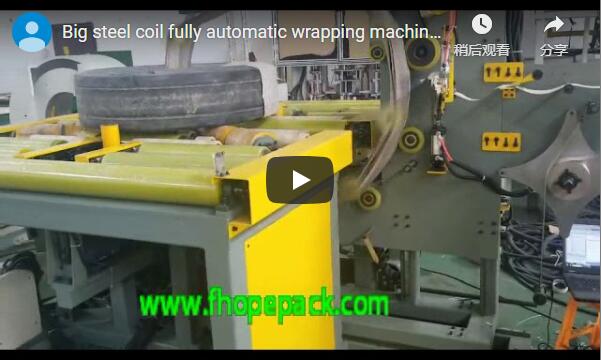
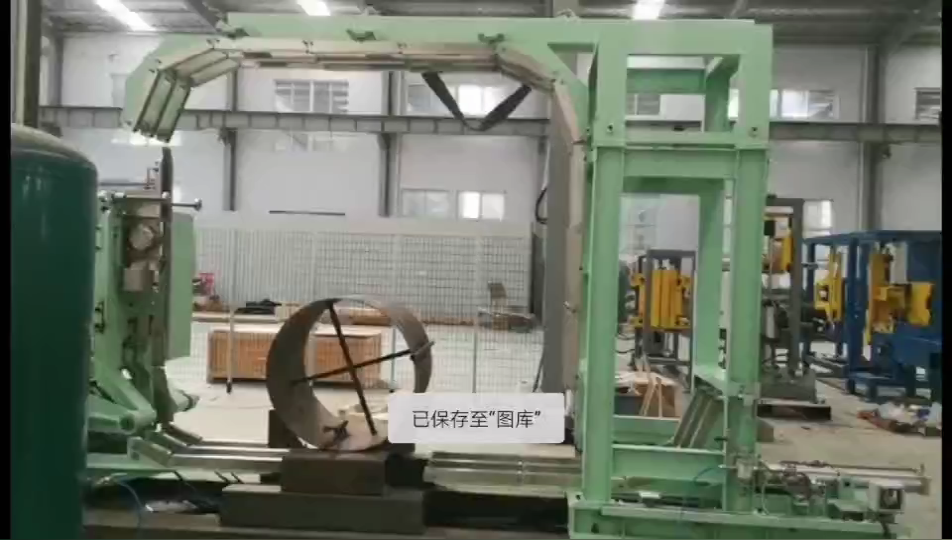
- Coil infeed (0–3 s). A large metal coil rests horizontally on the left side of the machine, held by a mechanical gripping structure. A worker stands nearby, away from the active mechanism. The upper structure of the machine starts to descend toward the coil.
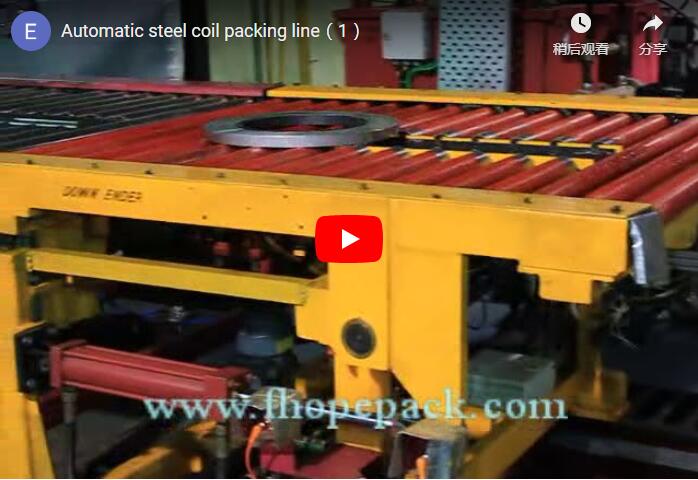
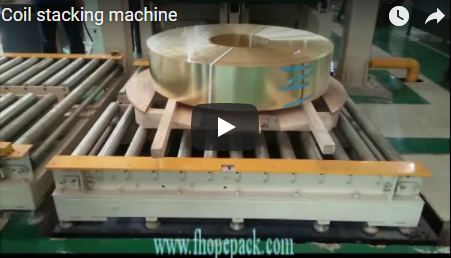
- Upending (3–9 s). The upper structure lowers fully, lifts the coil from the horizontal position, and rotates it to vertical. The coil is then set down steadily on a conveyor line made of yellow rollers. At this point the eye faces horizontally — the correct orientation for eye-through wrapping.
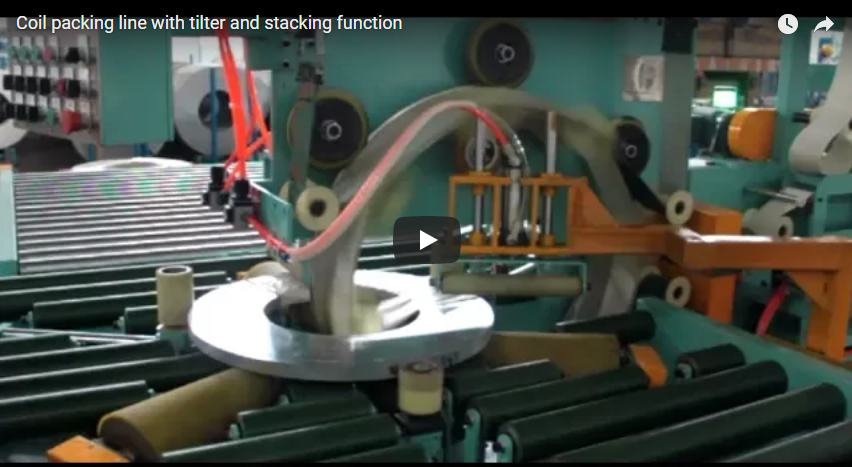
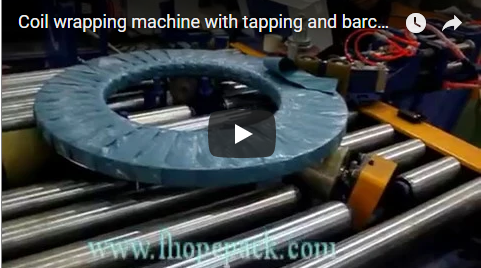
- Eye-through wrapping (9–27 s). A white band of wrapping material extends from the upper wrapping assembly and begins circling the vertical coil. The coil rotates slowly on the roller conveyor while the wrapping head moves above it, building up multiple layers until most of the coil surface is covered. The wrapped coil then travels along the conveyor toward the next stage.
Throughout the clip, a second worker operates other equipment in the background — a reminder that these lines are designed to run inside a normal, staffed plant, not in isolation.
Direct observation notes
- The machine has a blue painted steel frame with yellow safety guards, situated centrally in a factory floor.
- A large metal coil (silver-grey, smooth surface, disc-shaped — wide diameter, low height) is initially horizontal, held by a mechanical arm or clamp on the machine’s left side.
- The machine’s upper structure, a yellow movable arm/clamp, descends, lifts the coil, and rotates it from horizontal to vertical, placing it on a yellow roller conveyor.
- A grey control cabinet with a touchscreen sits on the right side of the machine. The screen shows a blue and green interface; specific text and icons are not legible. A green indicator light is lit steadily below the screen, and a red button (possibly an emergency stop) sits below it.
- From roughly the 9-second mark, a white band of wrapping material extends from the upper wrapping assembly and winds around the vertical coil. The coil rotates slowly on the conveyor while the wrapping head moves above it, applying multiple wraps until a full layer covers most of the coil surface.
- Warning markings observed: yellow triangular warning signs with a black exclamation mark on the yellow guard and on the control cabinet. A yellow warning line marks the floor around the machine; no physical fencing or light curtains are visible.
- A watermark reading “FHOPE PACKING SOLUTION FOR YOU” appears on the blue frame.
- After wrapping, the finished coil moves along the conveyor, ready for transfer to the next process step.
What the video does not show
The footage demonstrates the mechanical sequence clearly, but a production manager needs more than that before approving capital. The video does not reveal:
- Rated capacity — maximum coil weight and diameter the machine can upend and wrap.
- Exact machine dimensions (length, width, height) and floor-loading requirements.
- Cycle time for a complete upend-plus-wrap cycle.
- Model and serial number.
- Power and voltage requirements.
- Certification details (CE, ISO, or otherwise).
None of these appear on screen or in legible signage. Verify all of them with the manufacturer before shortlisting the equipment.
Fit assessment for your plant
| Fit factor | What the video supports | What to confirm |
|---|---|---|
| Coil orientation | Automatic horizontal-to-vertical upending | Coil weight and diameter range (verify with manufacturer) |
| Wrapping method | Eye-through wrap on a vertical coil, spiral wrapping motion | Material type, overlap, and number of layers |
| Operation | Touchscreen control cabinet with indicator lights and E-stop | Interface language, recipes, fault diagnostics |
| Footprint | Long, linear layout with front-to-back conveyor | Exact dimensions and conveyor length |
| Safety | Warning signs, yellow floor line, red E-stop button | Full risk assessment; fencing/light curtains not visible on camera |
The line suits plants handling slit steel or aluminum coils that currently rely on crane-assisted upending and manual wrapping. If your coils vary widely in size, ask whether clamps and roller guides are adjustable or require changeover — that is a derived observation, not a stated fact of the video.
Operating and safety points
- Keep personnel outside the marked warning line while the upender and wrapper run; the footage shows operators standing clear of the active envelope.
- Regularly check that the emergency stop button and warning signs remain functional and visible.
- No light curtains or hard guarding were visible in the footage — confirm the full safety concept against your local regulations with the manufacturer.
- The moving clamp handles the entire coil mass; never reach toward the coil during the upend phase.
Maintenance considerations
This class of equipment combines a lifting/clamping mechanism, a roller conveyor, and a rotating wrapping head. A sensible routine would cover:
- Inspection of the clamp/arm linkage and its moving joints.
- Roller conveyor condition and drive checks.
- Wrapping-head film or band path, tensioners, and cutting mechanism.
- Control cabinet indicators and E-stop function test.
The exact intervals and procedures are not shown in the video — request the maintenance schedule from the manufacturer.
FAQ
Does the machine handle both the upending and the wrapping? Yes — the footage shows one integrated line performing the horizontal-to-vertical rotation and then the eye-through wrap without manual transfer between the two.
What coil sizes can it handle? Not stated in the video. The coils shown are large-diameter, low-height metal coils. Confirm weight and diameter limits with the manufacturer.
How is the machine controlled? Via a touchscreen on a control cabinet at the right of the machine. The interface content is not legible in the footage.
Does wrapping happen through the eye or around the outer face? The white wrapping material circles the vertical coil from the upper assembly while the coil rotates — consistent with an eye-through wrap covering the circumference.
How fast is one full cycle? Cycle time is not shown or legible. Ask the manufacturer for measured cycle times at your coil specification.
What to verify with the manufacturer
- Maximum and minimum coil weight and diameter
- Machine overall dimensions and required floor space
- Complete cycle time at your coil spec
- Power supply requirements
- Safety package (guarding, light curtains, E-stop layout)
- Maintenance intervals and spare-parts availability
Related reading
- Steel coil wrapping machine
- Wire coil wrapping machine
- Stretch wrapping machine
- Semi-auto pallet wrapping machine
- Automatic pallet wrapping machine
Next step
If this upending-and-wrapping sequence matches your slit coil workflow, the fastest way to evaluate fit is to share your coil dimensions, weights, and line layout with the engineering team. Visit the contact page to request a specification review, cycle-time data, and a quotation.
Source and method
This article is based solely on the embedded video of the slit coil upending, handling, and wrapping process. Analysis was performed by a vision model on sampled frames of the footage. The video contains background music only — no narration or dialogue was analyzed. Observations are limited to what is visible; all capacity, dimension, and certification details must be verified with the manufacturer.
Published: 2026-09-04