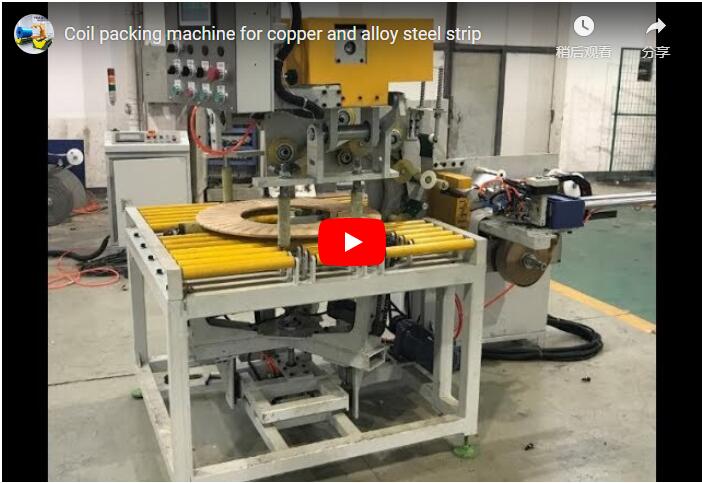
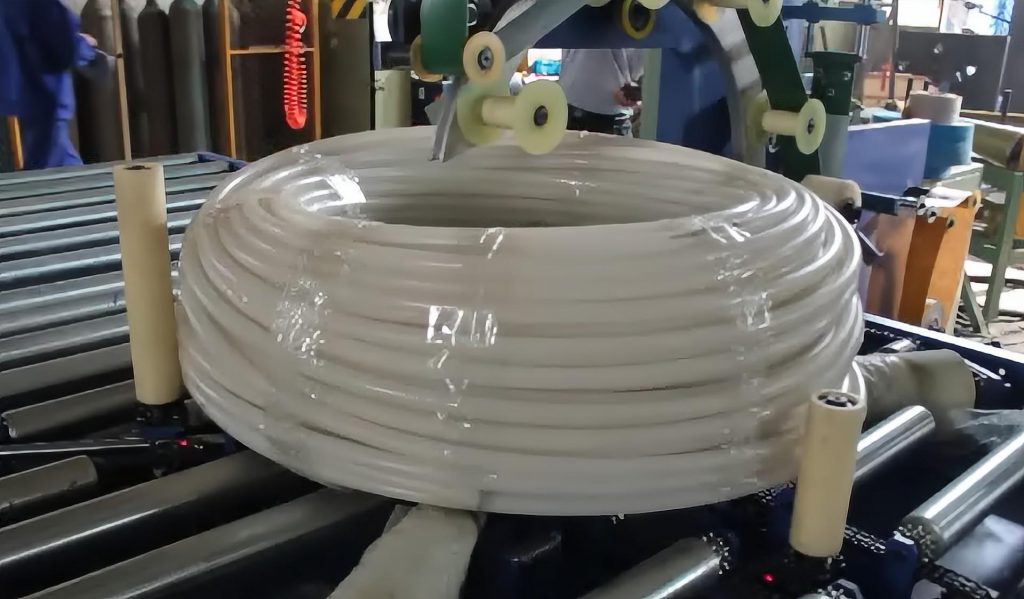
Executive summary: This 42-second clip is promoted as an automatic “Slit Steel Coil Packaging Line” that can “cut labor costs by 60%,” but the footage itself shows only the infeed/transfer stage of such a line: a flat steel coil traveling on a roller conveyor, an overhead device that helps guide and orient the coil, and a short inclined-transfer pass. No film wrapping, no coil upending, no strapping, and no stacking appear anywhere in the 43 sample frames I reviewed. The 60% labor-saving figure and the unloading–wrapping–strapping–stacking sequence in the title are line-marketing claims, not results this clip proves — verify them with the manufacturer before you build your payback math on them.
What the video shows
The clip opens with a wide steel coil lying flat on a roller conveyor; heavy machinery frames the scene and sits above the conveyor, but in the opening frames nothing is moving. A short sequence follows where the coil is guided by an overhead device and tipped into an inclined transfer position — the machine helps position and move the coil between stations, rather than packaging it. The final frames pull away from the workpiece to show equipment only, with no coil being processed.
That is the whole operation on screen: a coil feeder/transfer that moves the workpiece into position. Not the mechanical heart of a “unload, wrap, strap and stack” line that the page title promises — only the front end of it.
Direct observation notes
What follows is limited to what is visible — 42 seconds, 43 sample frames reviewed by per-frame inspection:
- The workpiece: a wide steel coil with a silver-grey metal face, lying FLAT on a roller conveyor for most of the clip. The coil stays horizontal; it is never stood up vertically.
- The machines: an overhead structure above the conveyor plus a separate tilting/transfer device. One frame sequence shows the coil being moved into an inclined position as it transfers between stations.
- The actions: positioning and transferring the coil. No rotation, no wrapping motion, no banding head, no stacking arm is seen in any sampled frame.
- The branding: no readable text, logo, or watermark appears in the sampled frames. Do not treat the absence of a visible brand as a spec sheet — ask the manufacturer which machine is being shown.
- What never appears: no film head circling the coil, no steel or plastic band being tensioned, no second coil stacked on the first, no pallet being built.
What it does not show
It does not show the “Unloading, Wrapping, Strapping & Stacking” sequence in its own title. The camera never captures a wrapping ring applying film, never shows a strapping head cinching a band, and never shows finished coils being stacked or palletized. If the line you are being quoted includes those stations, this 42-second clip will not help you evaluate them — you will need a longer demo that runs each station end to end.
There is a real takeaway here: a packaging-line video’s title usually describes the full line, while the footage demonstrates only one or two stations. Every stage that is not on screen is a claim to be demonstrated, not a fact established by the clip.
Where does the “60% labor cost cut” figure come from?
The page title and slug both promise a 60% reduction in labor costs. In the footage itself there are no operators counting, no before/after staffing diagrams, and no payback calculations — nothing to support or retest that number.
Treat it as a positioning claim that depends entirely on the line’s actual scope and the plant’s starting situation:
| Factor behind a labor-saving claim | Why it matters | Shown in this clip? |
|---|---|---|
| Line scope (which stages are automated) | Wrapping-only automation saves less than full wrap+strap+stack automation | Not shown — only infeed/transfer is on screen |
| Manual baseline being compared | 60% vs. manual handling, vs. semi-auto, vs. another machine change the number | No baseline data in the video |
| Operators per shift, pre vs. post | The real measure is people per shift, not a single percentage | No staffing data shown |
| Cycle rate and material flow | Faster cycle + fewer handlers drives the labor saving | No rates or flow data shown |
So the honest interpretation for an engineer: the video demonstrates that the machine exists and handles coil feeding/transfer automatically; the 60% figure is a target the manufacturer wants you to believe, and only a quoted line layout plus a staffing study for your own plant can confirm it.
What to Verify Before You Buy
Add these to your RFQ checklist — none of them can be answered by this footage:
- Full line scope: unload station, wrapping station, strapping station, and stacking/palletizing — each quoted and itemized, not bundled into one “fully automated line” price.
- The specific basis of any 60% labor-savings figure: which operations are compared, how many operators, and over what shift length.
- Coil envelope: OD range, coil width, and weight limits for the infeed/transfer stage shown here.
- Whether the coil must be upended (vertical) at any point in the real line, and if so, which upender is supplied.
- Film material, width, wrap count, and tension configuration per coil at the wrapping stage.
- Strapping material, band width, tension, and head location if a strapping station is in scope.
- A live demo or full-run video of the complete line, not just the front-end section seen here.
Confirmed by Footage vs. Confirmed by Manufacturer
| Item | Source |
|---|---|
| A flat steel coil travels on a roller conveyor; a transfer device tips it into an inclined position | Footage |
| Coil stays horizontal; no upending or vertical standing shown | Footage |
| No film wrapping, no strapping, no stacking appear in the clip | Footage |
| The line unloads, wraps, straps, and stacks automatically | Title of page/video (manufacturer claim) |
| The line cuts labor costs by 60% | Page title (manufacturer claim, no data shown) |
| Coil grade/weight, film spec, cycle rates, strapping tension, full-line layout | Not readable — verify with manufacturer |
Related reading
- Automatic Coil Packing Line
- Rotary Ring Stretch Wrapping Machine
- Steel Coil Strapping Machinery
- Coil Upender
- Automatic Packing Line
- Steel Coil Wrapping Machine
FAQ
Q: Does this video show a fully automatic slit steel coil packaging line? A: It shows the infeed/transfer stage: a flat coil on a roller conveyor being positioned by an overhead/tilting device. Wrapping, strapping, and stacking are advertised in the title but do not appear in the footage — confirm with the manufacturer.
Q: Is the 60% labor-cost reduction proven anywhere in the video? A: No. No staffing or cost data appears in the clip. Ask the manufacturer for the line scope, the manual baseline, and the operator count behind any percentage before you rely on it.
Q: Does the machine turn or upend the coil? A: No upending is shown; the coil stays horizontal throughout, with only a brief inclined transfer pass. Confirm whether upending is part of the line you are quoted.
Q: Can I evaluate wrapping and strapping from this clip? A: No — wrapping and strapping never appear on screen. Request a demo or full-run video of those stations before evaluating them.
Q: What is the coil material in this clip? A: A wide steel coil with a silver-grey surface. Coil grade and weight are not readable — verify specifications with the manufacturer.
Next step
Send this gap list to FHOPE Engineering: ask for the itemized line layout (unload, wrap, strap, stack), the staffing study that supports the 60% figure, and a full-run demo of every stage — then validate the numbers against your own coil dimensions and shift pattern.
If you want a second opinion on coil handling and wrapping machines in the same product family, start with the related reading above or contact the FHOPE sales team directly: https://www.fhopepack.com/videos/contact-2/
Published: 2026-09-11