Executive summary In an about-32-second factory clip, an automatic coil wrapping machine winds clear stretch film around a rotating pipe coil with no manual wrapping at all. The operator only positions the coil and monitors the cycle. The demonstration proves the wrapping concept, but it shows no rated capacity, cycle time, model, power draw, or safety certification — so those figures must be confirmed with the manufacturer before you buy.
What the video shows
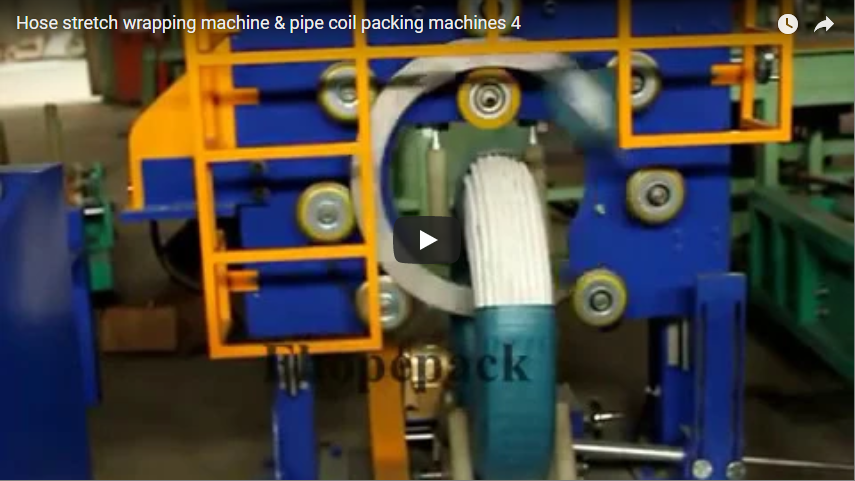
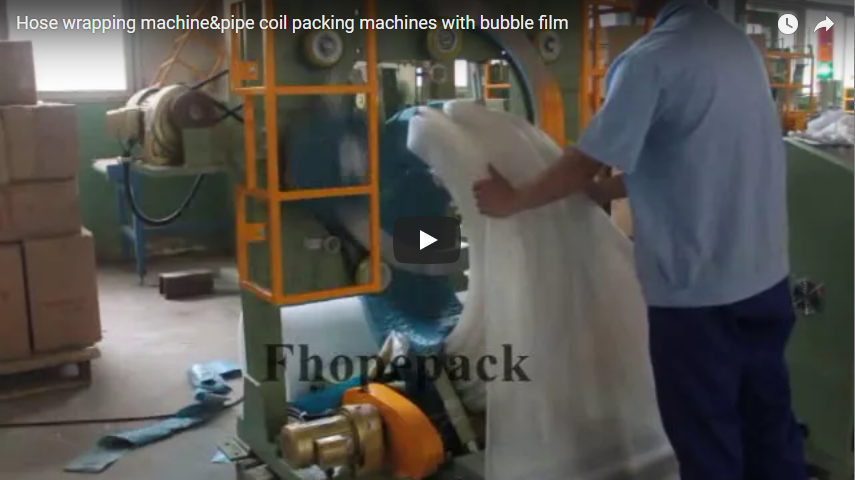
The video follows one pink pipe coil through a single wrapping cycle. The machine does the wrapping work; the operator mainly loads the part and watches.
| Time | What happens |
|---|---|
| 0:00–0:04 | The operator stands beside a large pink pipe coil placed on the machine. His hand holds the coil while the overhead wrapping head begins to move down. |
| 0:04–0:06 | The operator steps away. The coil starts to rotate on the support rollers and the clear film begins to wrap around it. |
| 0:06–0:14 | Wrapping runs automatically. The film layer spreads evenly across the rotating coil, covering more of its surface. |
| 0:14–0:24 | The cycle continues without the operator in frame. The yellow guard fencing and blue machine frame stay visible as the wrap builds up. |
| 0:24–0:32 | The operator returns, checks the machine, and stands at the control cabinet while the wrap continues. The clip ends with the coil still being wrapped. |
How the wrap happens. The coil is not spun by a turntable. Instead it turns in place on powered support rollers at the base of the machine. Meanwhile an overhead film-applying mechanism feeds clear stretch film around the rotating coil. The combination of coil rotation and moving film head builds a tight, even layer without anyone touching the product.
The sequence is simple: load → automatic wrap → monitor. No manual film application appears in any frame.
Machine structure at a glance
| Part | What is visible | What it does |
|---|---|---|
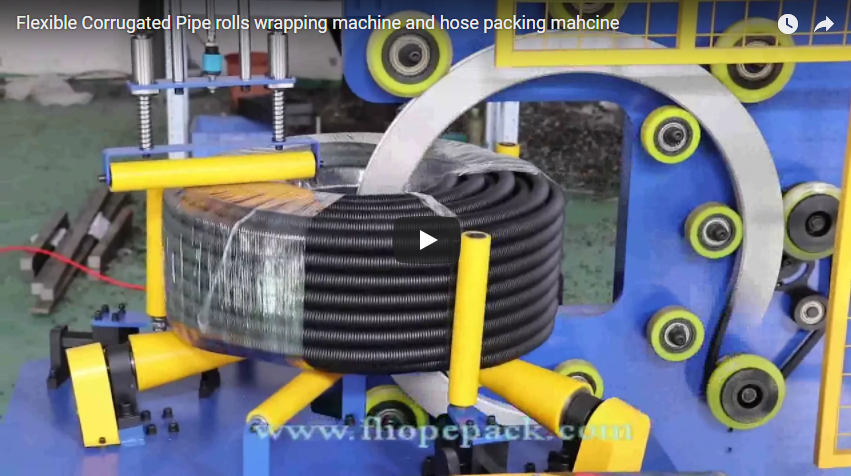
| Main frame | Blue and yellow painted metal | Carries all working parts; sits stably on the floor |
| Overhead wrapping mechanism | Moves above the coil | Feeds and applies the clear stretch film |
| Support rollers | At the base under the coil | Turn the coil during the wrap cycle |
| Film roll holder | At the top of the machine | Holds the film supply |
| Control cabinet | Right-hand side of the machine | Houses buttons and indicator lights for the operator |
| Guard fencing | Yellow panels around the working area | Separate the operator from the moving coil |
The layout is compact: a rectangular cell with the coil in the middle, the film head on top, the rollers below, and the control cabinet on the right. This is a single-station coil wrapper, not a multi-machine line.
Direct observation notes
The following notes describe the physical machine and the operation exactly as seen in the video frames. They are direct observations, not inferences.
Machine structure
- Frame: The main chassis is blue and yellow painted metal.
- Wrapping mechanism: An overhead assembly above the coil applies the film; guide tracks run along the machine sides.
- Support rollers: Rollers at the base support and rotate the pipe coil.
- Film holder: A film roll is held at the top of the machine.
- Control cabinet: Located on the right side; buttons and indicator lights include red and green elements.
Product
- Product type: A large pipe coil (pink/magenta tubing wound into a coil).
- Surface state: Smooth surface; the coil is gradually covered by clear film during the cycle.
- Orientation: The coil stays horizontal and rotates in place during wrapping; its orientation to the camera does not change.
Operation sequence
- The operator positions the pipe coil on the support rollers (0:00–0:04).
- The overhead wrapping head moves down to the coil (0:02–0:04).
- The machine starts wrapping automatically; the coil rotates while the film is applied (0:04 onward).
- The operator steps back and monitors; he returns near the end of the clip and operates the control cabinet (0:24–0:32).
Safety visible in the frames
- Yellow protective guard fencing surrounds the working area.
- No emergency-stop button, light curtain, warning sign, or interlock is visible in the sampled frames. This may reflect the short clip and camera angle rather than the machine’s actual configuration — confirm with the manufacturer.
What the video does not show
A 32-second demonstration cannot answer the questions that actually decide a purchase. None of the following appears in the footage:
- Rated capacity — no maximum coil weight, diameter, or width.
- Cycle time — no wraps per minute or seconds per coil.
- Machine dimensions — no overall length, width, or height.
- Model number or brand plate — none readable on the machine.
- Power draw and motor size — not stated anywhere.
- Certifications — no CE, UL, or ISO marks visible.
- Film parameters — film width, thickness, and pre-stretch ratio are not shown.
- End of the cycle — the clip ends while the wrap is still running, so the finished coil and unloading are not shown.
These gaps are normal for a demo clip. Treat any performance claim from the vendor as unverified until it is written down.
Controls and safety notes
- Control cabinet: Visible on the right side with red and green buttons and indicator lights. The legend of each button is not readable at this resolution — ask the manufacturer which functions they map to.
- Guard fencing: Yellow panels are clearly present around the coil cell. This is the main visible safety feature.
- Not observed in the clip: emergency stop, light curtain, and warning signage. Absence in the video is not proof of absence on the machine; request the safety feature list and CE declaration in writing.
What to verify with the manufacturer
Before purchase, confirm the following in writing. The video provides none of these numbers:
- Coil range: minimum and maximum coil outer diameter, inner diameter, width, and weight.
- Cycle performance: true cycle time and wrap count per minute for your part mix.
- Film system: supported film widths, thickness range, and whether pre-stretch is included.
- Electrical and pneumatic requirements: voltage, phase, air pressure, and compressed-air consumption.
- Safety package: emergency stops, light curtains, guarding certification, and CE/UL/ISO documents.
- Integration: ability to link with your infeed/outfeed conveyors or PLC.
Why automating coil wrapping matters
Manual stretch wrapping of pipe and hose coils is slow, tiring, and uneven. A worker must walk around the coil, pull the film by hand, and fight to keep tension consistent. Results vary from operator to operator, and long shifts add fatigue.
An automatic coil wrapper removes that variability. Every coil receives the same film tension and coverage. The operator no longer handles film during the cycle, which also means less film waste from over-wrapping. For plants that package many coils per day, the gain is more consistent packaging with the same headcount — a qualitative benefit the video supports, though no output figures are stated in it.
Applications this wrap suits
A machine of this type, wrapping a rotating coil with clear film, is well suited to:
- Pipe and hose coils (corrugated, hydraulic, and general tubing).
- Cable and wire coils that need dust and moisture protection.
- Plastic tube coils that risk unwinding in transit.
- Coils light or flexible enough to rotate safely on support rollers.
It is less obviously suited to very heavy steel coils, coils too large for the cell, or parts that must not rotate during wrapping. Match your actual part range to the machine’s rated limits before committing.
Frequently asked questions
Q: Does the machine wrap the coil completely by itself? A: In the video, yes — the film application is automatic once the operator positions the coil. The operator loads the part and monitors; no manual film winding appears in the footage.
Q: Which coil types can it handle? A: The clip shows one pink pipe coil on support rollers. General industry practice covers pipe, hose, cable, and tube coils, but the specific size and weight range must be confirmed with the manufacturer for your product.
Q: Is the wrap tension adjustable? A: The video does not show tension settings, and the control panel legends are not readable at this resolution. Ask whether tension and wrap count are programmable and how pre-stretch is controlled.
Q: How does it compare with wrapping by hand? A: The main difference is consistency and labor. The video shows a fully automatic wrap with the operator standing clear; manual wrapping typically requires a worker to move around the coil and apply film by hand.
Q: What should I check before ordering? A: Rated coil range, cycle time, film compatibility, electrical requirements, safety certification, and how the machine integrates with your existing lines. None of these appears in the 32-second clip, so all must come from the vendor.
Related reading
- https://www.fhopepack.com/Hose-packaging-machine/
- Pipe coil wrapping and strapping — complete guide
- Horizontal stretch wrapping machine for big objects
- Vertical steel coil wrapping machine — automatic coil packaging
- Economic horizontal orbital wrapper for pipe and tube
Source and method
This article is based on the YouTube video embedded above (about 32 seconds long). Sixteen frames were sampled at 2-second intervals. The frames were analyzed with a local vision-language model, and key frames were cross-checked against the raw images. A verification pass confirmed the manufacturer’s watermark www.fhopepack.com in the lower part of the frame.
The video contains background music only — there is no narration or speech, so no audio transcription was performed. All facts in the “Direct observation notes” and “What the video shows” sections come from visible frame content. Statements about applications, benefits, and typical ranges are general industry knowledge or taken from typical manufacturer spec sheets, not from the video. Rated capacity, cycle time, model, power, and certification should be confirmed with the manufacturer.
Next step
If this kind of automatic film wrapping matches your pipe, hose, or cable coil packaging, send your coil dimensions and weight to the FHOPE sales team to check fit and get the missing specifications. You can reach them through the contact page.
Last updated: 2026-09-02.