Executive summary Our FPC-200 coil wrapper stands the copper tube coil on rollers and passes woven belt, paper or film through the coil eye. It takes coils of 600–1,200 mm OD and 5–500 kg, with a wrap time of 23–50 s per coil. We size it from your coil OD, ID, width and the coils per shift you need.
Table of Contents
- How the coil wrapper works
- Does the coil fit
- Overlap at the OD
- Coils per shift
- Vertical or horizontal machine
- Materials and controls
- Utilities and safety
- Selection checklist
- Engineering FAQ
- Next step
- Related reading
- Sources
How the coil wrapper works
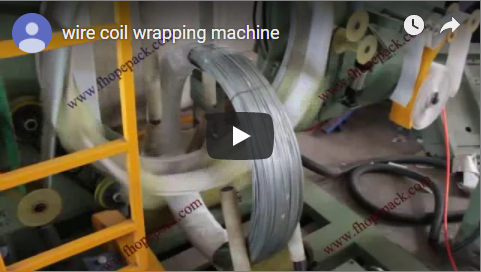
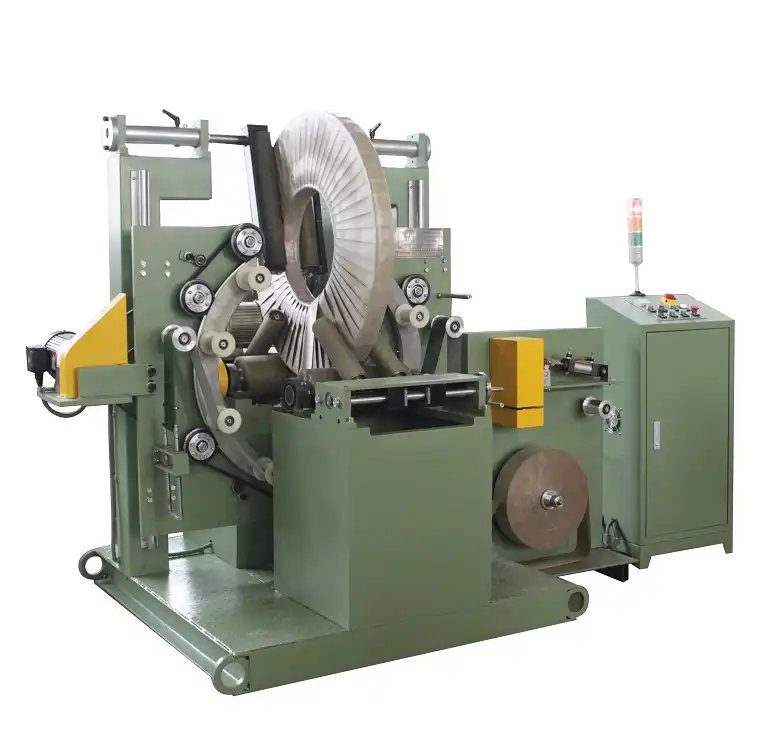
The coil stands upright on rollers, and the rotating ring passes through the coil eye. Rollers turn the coil, at 2–4 m/min on the standard setting, while the ring turns, so the wrapping material spirals through the eye and around the coil wall. The ring is moulded in anti-wear polyurethane, and the rollers are covered with wear-resisting rubber to protect the coil.
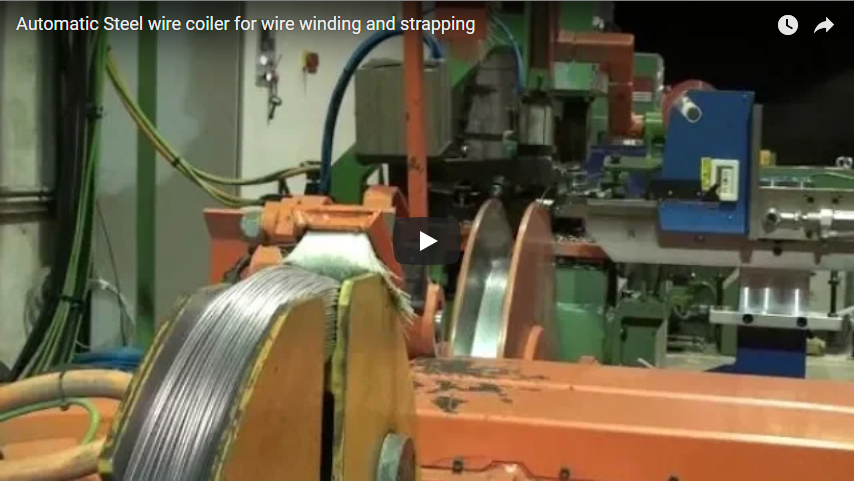
The support structure adjusts in height, by hand or automatically, for different coil ODs. In our video, a copper coil turns on the rollers as blue woven belt and clear film build up around it.
Does the coil fit?
| Parameter | FPC-200 |
|---|---|
| Coil OD | 600–1,200 mm |
| Coil ID | 300–800 mm |
| OD minus ID | under 800 mm (radial wall under 400 mm) |
| Coil width | 10–200 mm |
| Coil weight | 5–500 kg |
| Roller speed | 2–4 m/min |
| Wrap time | 23–50 s per coil |
| Ring speed | 10–100 r/min |
Illustrative examples: a 900 mm OD, 500 mm ID, 150 mm wide copper tube coil fits, with OD minus ID of 400 mm. A 1,200 mm OD coil on a 300 mm ID has OD minus ID of 900 mm, over the 800 mm limit.
Overlap at the OD
Overlap is adjustable from 20% to 90%. Set it at the outer diameter, where each wrap is spread widest. The coil makes one full turn on the rollers per wrap cycle, so the roller speed sets the wrap time, and the ring speed is matched to it for the overlap. Both speeds are set on the variable frequency drives (VFDs), and the PLC raises or lowers them together. Illustrative example for a 900 mm OD coil with 100 mm material at 50% overlap:
| Step | Value |
|---|---|
| OD circumference | π × 900 = 2,827 mm |
| Advance per wrap at the OD | 50 mm |
| Wraps per coil | 2,827 ÷ 50 ≈ 57 |
| Operating mode | Roller speed | One coil turn | Ring speed for 57 wraps |
|---|---|---|---|
| Manual, slowed by the operator for safety | 2 m/min | about 85 s | about 40 r/min |
| Automatic, mid setting | 4 m/min | about 42 s | about 81 r/min |
| Automatic, VFD set high | 5 m/min | about 34 s | about 100 r/min |
So a 34 s wrap is achievable when the PLC runs both drives above the standard 2–4 m/min setting, as our engineers confirm. In manual operation, operators often slow both down for safety, and the wrap takes longer. A heavier overlap needs a faster ring or a slower coil turn.
Coils per shift
Illustrative example with 30 s to load and unload, at two VFD settings:
| Step | 42 s wrap | 34 s wrap |
|---|---|---|
| Total cycle | 72 s | 64 s |
| Coils per hour | 50 | about 56 |
| Coils per 8 h shift | 400 | about 450 |
These are run-time figures before breaks and material roll changes. Wrapping one or two layers changes the wrap time, so we confirm the cycle on your coil.
Vertical or horizontal machine
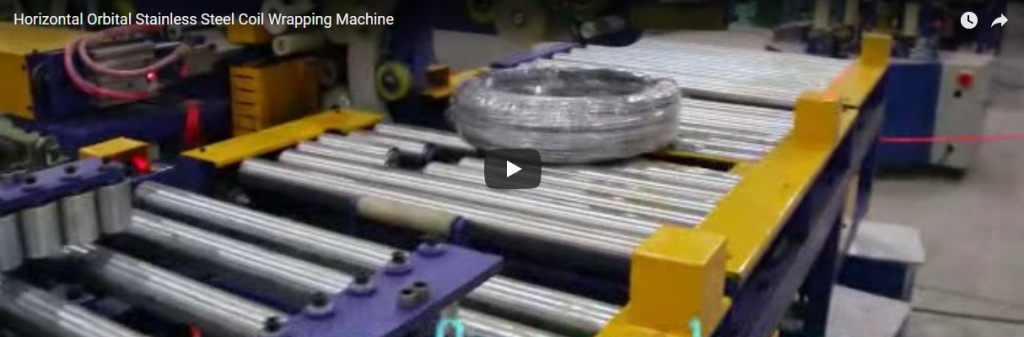
The FPC-200 is a vertical model. For copper tube coils laid flat, we also build a horizontal coil wrapper.
| Parameter | FPC-200 (vertical) | Copper tube coil wrapper (horizontal) |
|---|---|---|
| Coil OD | 600–1,200 mm | 600–1,200 mm |
| Coil ID | 300–800 mm | 500–800 mm |
| OD minus ID | under 800 mm | under 500 mm |
| Coil width | 10–200 mm | 10–300 mm |
| Coil weight | 5–500 kg | 50–300 kg |
| Wrap time | 23–50 s | 25–45 s |
| Ring speed | 10–100 r/min | 20–110 r/min |
The horizontal machine covers all contact surfaces with PU and can add a conveyor that moves wrapped coils on to stacking. Its ring returns to the start position after each coil.
Materials and controls
| Item | FPC-200 |
|---|---|
| Materials | woven belt, paper, stretch film |
| Material roll | core 50 or 76 mm, OD 150–450 mm, width 90–120 mm |
| Layers | one or two, with automatic cut-off |
| Tension | tension control system |
| Control | PLC, HMI optional, English and Chinese display |
| Fault display | errors listed on the control panel screen |
Indicator lamps in red, green and yellow show machine status. A high-table version is available for special requirements.
Utilities and safety
| Utility | FPC-200 |
|---|---|
| Power supply | 380 V, 50 or 60 Hz, 3 phase |
| Compressed air | required, pressure confirmed in proposal |
The standards that apply depend on the destination market. For CE markets, ISO 12100 sets the risk-assessment method and EN 415-10 sets general requirements for packaging machines.
Selection checklist for a copper tube coil wrapper
- Coil OD, ID, width and weight.
- Coil upright or laid flat.
- Woven belt, paper or stretch film.
- One or two layers.
- Coils per shift needed.
- Conveyor to stacking, yes or no.
Engineering FAQ
Q: What coil sizes fit the FPC-200? A: 600–1,200 mm OD, 300–800 mm ID, 10–200 mm wide and 5–500 kg, with OD minus ID under 800 mm.
Q: How long does one coil take? A: 23–50 s on the FPC-200, or 25–45 s on the horizontal copper tube coil wrapper.
Q: Where should we set overlap? A: At the OD, because each wrap spreads widest there.
Q: Can it wrap with woven belt instead of film? A: Yes. The FPC-200 takes woven belt, paper or stretch film.
Q: Will the machine mark the copper surface? A: The ring is anti-wear polyurethane and the rollers are rubber covered to protect the coil.
Next step
We plan your copper tube coil wrapper in three steps:
- Submit your layout drawing with coil OD, ID, width, weight and coils per shift to info@fhopepack.com.
- Receive a proposal within 48 hours, with the model, material and layout.
- Book a site survey to fit the wrapper to your line.
Related reading
- FPC-200 copper coil wrapper
- Copper tube coil packing machine
- Video: copper tube coil packing and shrinking machine
- Video: economic cable coil packing machine
- Video: hose wrapping machine and pipe coil packing machine
Sources
- FPC-200 data and features: FPC-200 copper coil wrapper page
- Horizontal machine data: copper tube coil packing machine page
- Machine in action: our copper tube coil wrapping video on YouTube
- Wrap-time speed range and VFD settings: FHOPE engineering team, 2026-10-04
- Standards scope: ISO 12100:2010, EN 415-10:2014
Last reviewed: 2026-10-04