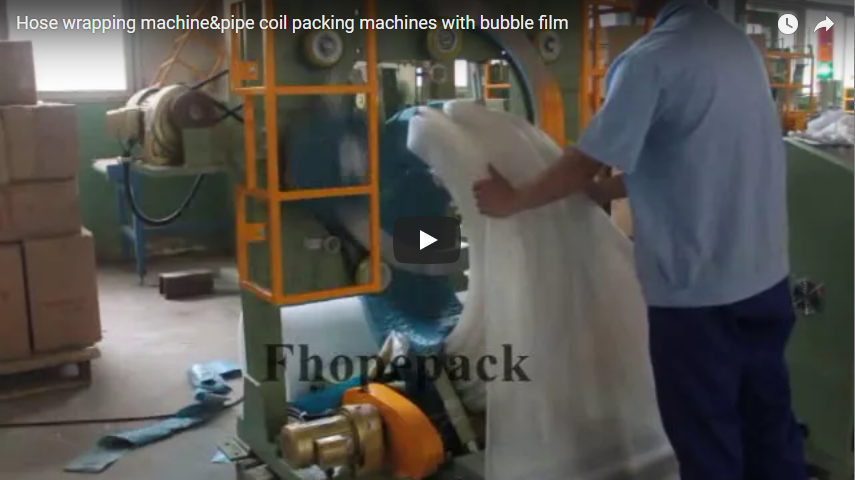
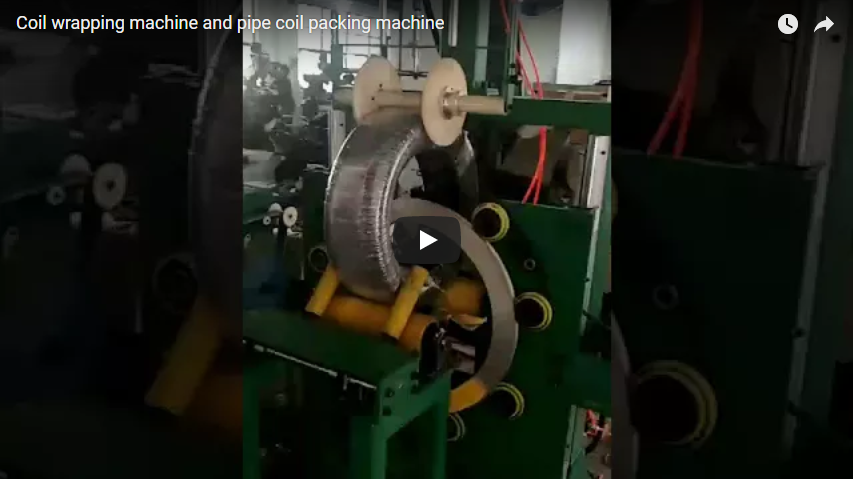
> **Executive summary**
> Our HDPE pipe coil wrapper passes film through the coil eye with a rotating ring while support rollers turn the coil. It handles coils of **5–100 kg**, 600–1,400 mm OD and 100–350 mm wide, in **12–30 s per coil**. The radial wall of the coil sets the limit, since OD minus ID must stay under 800 mm. Overlap and film width decide how many ring turns each coil needs.
Table of Contents
- How our HDPE pipe coil wrapper works
- HDPE pipe coil wrapper specifications
- Coil size limits: ring clearance and OD minus ID
- Ring turns and cycle time per coil
- Film use per coil
- Packing materials
- Controls and safety
- Selection checklist for an HDPE pipe coil wrapper
- Engineering FAQ
- Next step
- Related reading
- Sources
How our HDPE pipe coil wrapper works
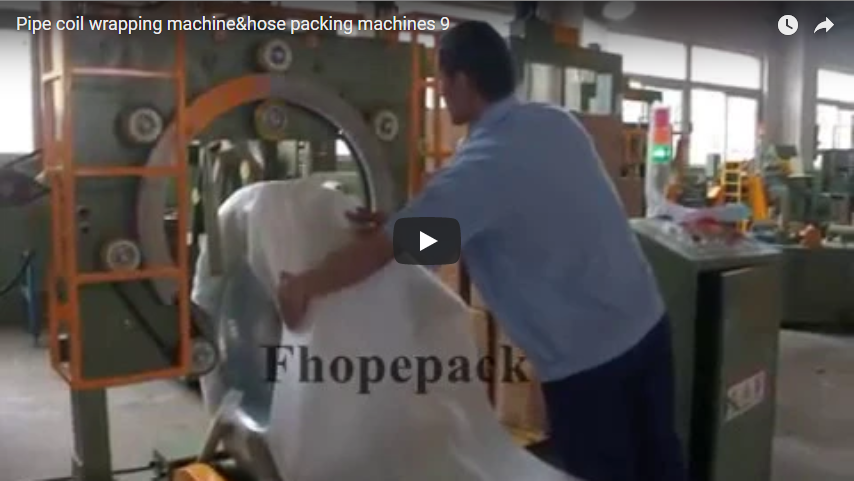
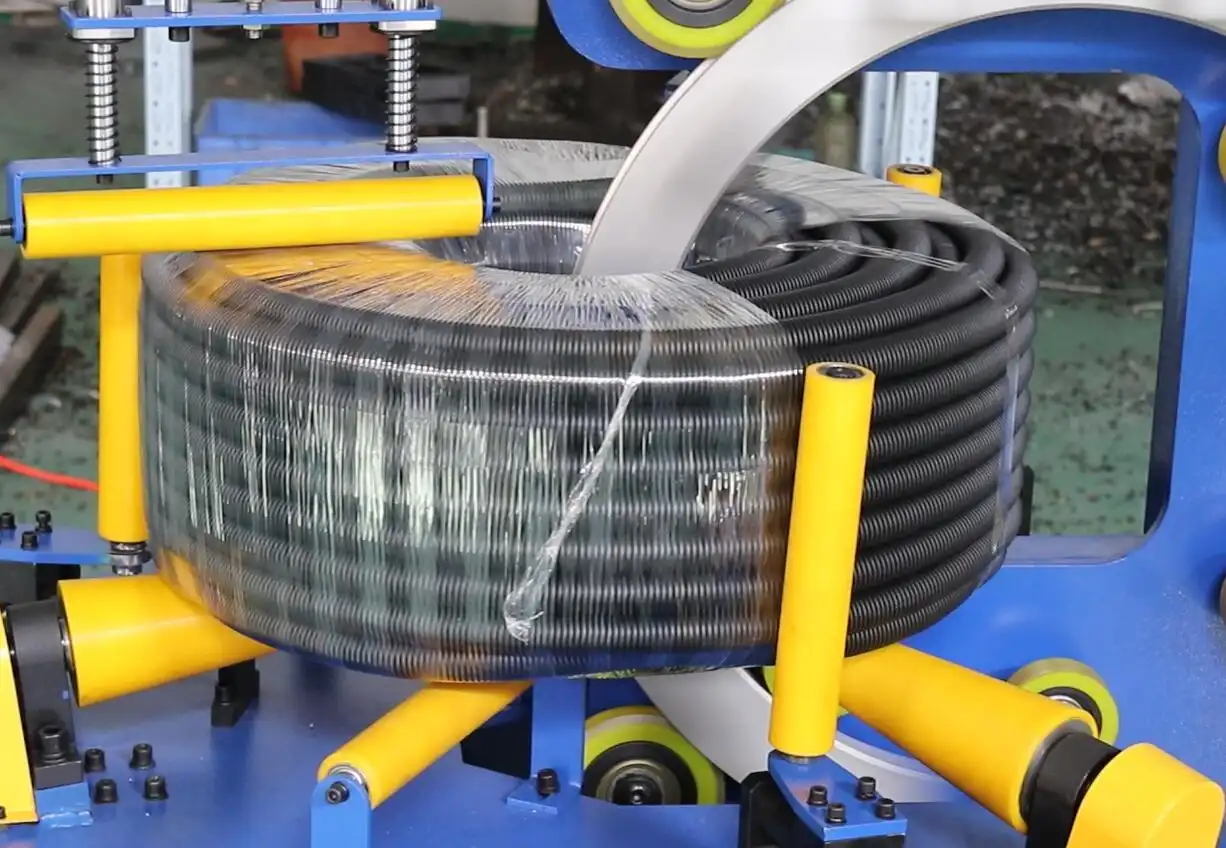
We built this eye-through coil wrapper for HDPE pipe and hose coils that stand upright, eye horizontal. The ring carries the film through the coil eye on every turn, while the coil is indexed on its supporting rollers. Guide rollers hold the ring in its track, so it stays centred in the eye at full speed.
The wrapping station has four working parts:
1. **Rotating ring.** A reinforced, solid cast-aluminium ring carries the film roll through the coil eye.
2. **Driving wheels.** Polyurethane rubber wheels drive the ring. A belt tension adjuster and screws set the friction between wheels and ring.
3. **Supporting rollers.** Motor-driven supporting rollers turn the coil so each ring pass lands next to the last one. Up/down protective rollers, set by a manual adjuster, keep the coil upright.
4. **Film brake.** A special brake device sets the film tension, so the film lies flat on the coil.
The ring and the rollers both run on inverters (variable frequency drives). Their speed ratio sets the overlap.

HDPE pipe coil wrapper specifications
| Parameter | Value |
|---|---|
| Coil weight | 5–100 kg |
| Coil width | 100–350 mm |
| Coil OD | 600–1,400 mm |
| Coil ID | 300–1,200 mm |
| OD minus ID | under 800 mm |
| Ring speed | 20–120 r/min |
| Wrapping time | 12–30 s per coil |
| Power supply | about 2.0 kW, 380 V, 50 Hz |
The OD and ID ranges cannot be combined at their extremes, because OD minus ID must stay under 800 mm. Overlap is adjustable from 10% to 90%. The machine draws about 2.0 kW at 380 V, 50 Hz.
Coil size limits: ring clearance and OD minus ID
The ring has to pass the coil's whole wall section on every turn. So the ring size limits the wall, not just the outer diameter:
- **Wall check.** OD minus ID must stay under 800 mm, which means a radial wall under 400 mm.
- **Example that fits.** A coil of 1,200 mm OD and 600 mm ID gives 600 mm, inside the limit.
- **Example that fails.** A coil of 1,400 mm OD and 500 mm ID gives 900 mm, over the limit. This coil needs a larger ring or a different wrapper.
Send us OD, ID, width and weight for every coil size you run. We check each one against the ring before we confirm the model.
Ring turns and cycle time per coil
Ring turns formula
The rollers turn the coil a little on each ring pass. The number of passes needed to cover the coil once is:
**Ring turns = outer circumference ÷ (film width × (1 − overlap))**
We size on the outer diameter, because the film spreads widest at the OD. Sizing on the mean diameter would leave less overlap than planned at the outside, where the coil touches floors and pallets. Overlap at the ID ends up denser.
Illustrative example for a 1,000 mm OD, 600 mm ID coil:
1. **Outer circumference** = π × 1,000 mm ≈ 3,142 mm.
2. **Advance per ring turn** with 100 mm film at 50% overlap = 50 mm.
3. **Ring turns** = 3,142 ÷ 50 ≈ 63 turns.
4. **Time** at 100 r/min ≈ 38 s, or about 31 s at the 120 r/min maximum.
So this coil at 50% overlap runs slower than the 12–30 s range. A lower overlap, wider film or smaller coil brings it back into range. Higher overlap gives more layers and better protection, but takes longer.
Film also narrows under brake tension, so the real advance per turn is a little less than the nominal width. We confirm the effective width in a trial with your film.
Film use per coil
Each ring turn wraps once around the coil's wall section. The film length per turn is about the perimeter of that section:
- **Perimeter** ≈ 2 × (width + wall). For a 300 mm wide coil with a 200 mm wall, that is 2 × (300 + 200) = 1,000 mm.
- **Film per coil** ≈ 63 turns × 1,000 mm ≈ 63 m, before stretch.
This is the figure we use to plan film rolls per shift. Film stretch and real overlap change it, so we confirm it in a trial with your coils.
Wrapping materials: stretch film, knit belt and compound paper
The wrapper takes several materials, chosen per shipment:
| Material | Typical use |
|---|---|
| LLDPE or PVC stretch film | Dust and moisture cover for storage and trucking |
| Knit belt | Tougher outer layer for rough handling |
| Compound paper | Paper cover where film is not wanted |
Film rolls for this machine have a 50 mm core, 100–200 mm OD and 100–120 mm width.
Controls and safety
The machine uses a Siemens PLC with Schneider inverters, switches and contactors, and Autonics sensors. A Siemens touch screen HMI is optional for programmed automatic operation. The ring has soft start and soft stop, ring jog and a packing position reset.
Guardrails surround the wrapping station, and a separate control cabinet keeps the electrics out of the work zone. The standards that apply depend on the destination market. For CE markets, ISO 12100 sets the risk-assessment method and EN 415-10 sets general requirements for packaging machines.
Selection checklist for an HDPE pipe coil wrapper
- [ ] OD, ID, width and weight for every coil size.
- [ ] OD minus ID for the largest coil, under 800 mm.
- [ ] Coils per hour needed, against 12–30 s per coil.
- [ ] Packing material: stretch film, knit belt or compound paper.
- [ ] Overlap or number of layers required.
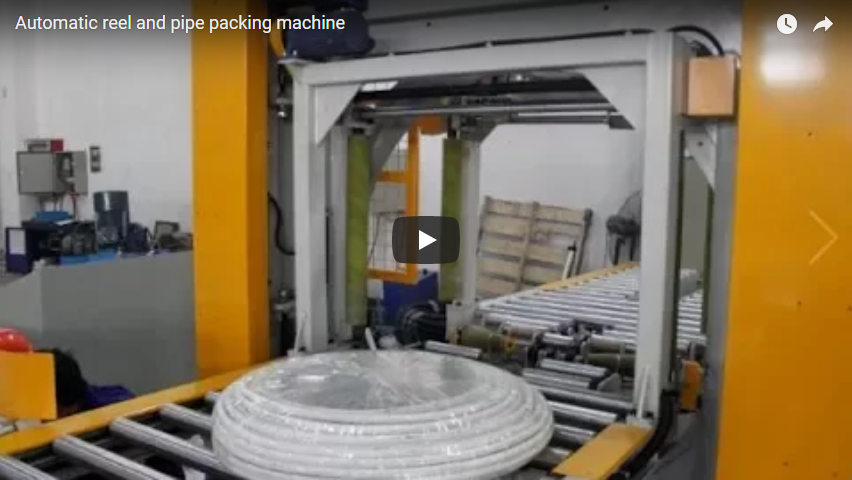
- [ ] Manual loading, or a link to your coiler line, as in our [automatic pipe coiling and wrapping machine for hose and plastic tubes](https://www.fhopepack.com/videos/automatic-pipe-coiling-and-wrapping-machine-for-hose-and-plastic-tubes/).
Engineering FAQ
Q: What coil sizes does the HDPE pipe coil wrapper take?
A: Coils of 5–100 kg, 600–1,400 mm OD, 300–1,200 mm ID and 100–350 mm wide, with OD minus ID under 800 mm.
Q: How long does one pipe coil take to wrap?
A: 12–30 s per coil. Film width, overlap and coil diameter set the exact time.
Q: Can the same machine wrap rubber hose and corrugated pipe?
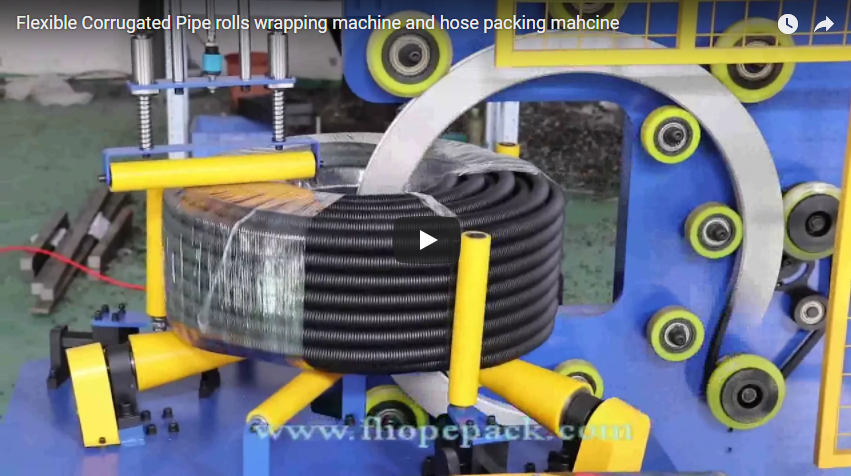
A: Yes, if the coil fits the size range. Hose, PE pipe and corrugated pipe coils all wrap the same way through the eye. See also our [flexible corrugated pipe rolls wrapping machine](https://www.fhopepack.com/videos/flexible-corrugated-pipe-rolls-wrapping-machine-and-hose-packing-mahcine/).
Q: How do I set the overlap?
A: From the control panel, or from the optional Siemens HMI, between 10% and 90%. The setting changes the inverter speed ratio between ring and rollers.
Q: How much film does one coil use?
A: About 63 m before stretch for a 1,000 mm OD, 600 mm ID, 300 mm wide coil at 50% overlap. We confirm it in a trial.
Q: What power supply does the wrapper need?
A: About 2.0 kW at 380 V, 50 Hz.
Q: What film rolls does it take?
A: Rolls with a 50 mm core, 100–200 mm OD and 100–120 mm width.
Q: How is the coil held upright while it is wrapped?
A: Motor-driven supporting rollers turn the coil, and up/down protective rollers, set by a manual adjuster, keep it upright. Guide rollers keep the ring centred in its track.
Next step
We match the wrapper to your coil range in three steps:
1. **Submit your layout drawing** with coil OD, ID, width, weight and output per hour to **info@fhopepack.com**.
2. **Receive a proposal within 48 hours**, with the model, ring size and cycle check.
3. **Book a site survey** to plan loading from your coiler.
Related reading
- [HDPE pipe coil packing machine](https://www.fhopepack.com/Pipe-packing-machine/HDPE-pipe.html)
- [Pipe packing machines](https://www.fhopepack.com/Pipe-packing-machine/)
- [Hose coil wrapping machinery FPH-400](https://www.fhopepack.com/Hose-packaging-machine/Hose-Coil-wrapping-machinery-FPH-400.html)
- [Hose coil packaging line](https://www.fhopepack.com/Automatic-Coil-Packing-Line/Hose-Coil-Packaging-line.html)
- [Video: hose wrapping with bubble film](https://www.fhopepack.com/videos/hose-wrapping-machinepipe-coil-packing-machines-with-bubble-film/)
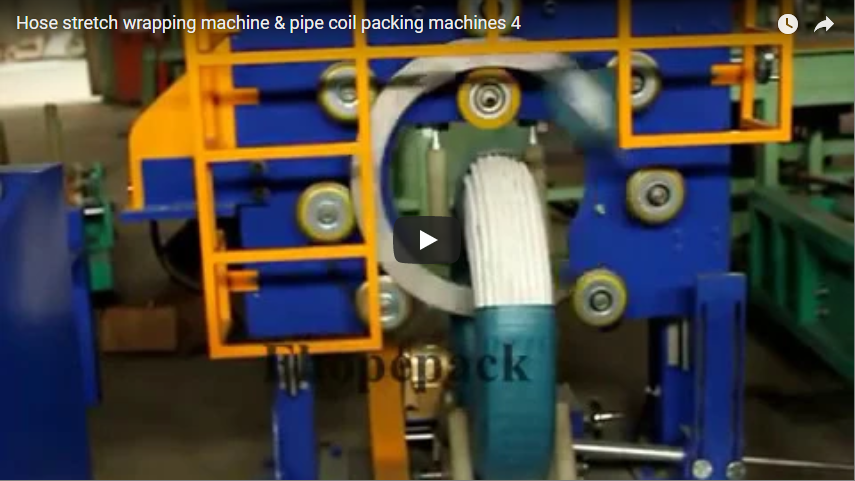
- [Video: hose stretch wrapping machine for pipe coils](https://www.fhopepack.com/videos/hose-stretch-wrapping-machine-pipe-coil-packing-machines-4/)
Sources
- Specifications, wrapping station parts, materials, controls: [HDPE pipe coil packing machine page](https://www.fhopepack.com/Pipe-packing-machine/HDPE-pipe.html)
- Machine in action: [our HDPE pipe coil wrapping video on YouTube](https://www.youtube.com/watch?v=clHxgqZDAtc)
- Standards scope: [ISO 12100:2010](https://www.iso.org/standard/51528.html), [EN 415-10:2014](https://www.nen.nl/en/nen-en-415-10-2014-en-191845)
Last reviewed: 2026-10-04