Executive summary Our hose stretch wrapping machine wraps a hose or pipe coil with film through its eye while rollers turn the coil. Two compact models cover light coils: the FPH-200N for 5–30 kg garden hose coils and the FPH-300N for 10–100 kg hose and pipe coils. Both wrap a coil in roughly 20–35 s, and film per coil depends on the coil size, the film width and the overlap.
Table of Contents
- How the hose wrapper works
- FPH-200N or FPH-300N
- Output per hour
- Wraps and film per coil
- Options
- Utilities and safety
- Selection checklist
- Engineering FAQ
- Next step
- Related reading
- Sources
How the hose wrapper works
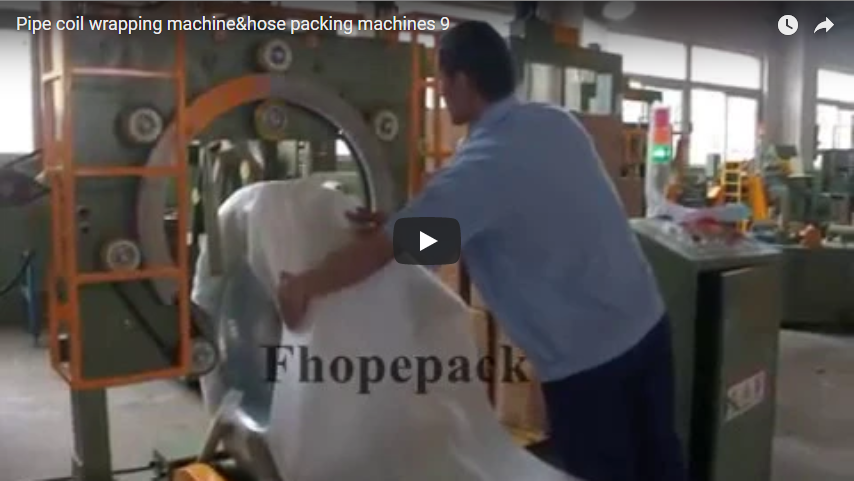
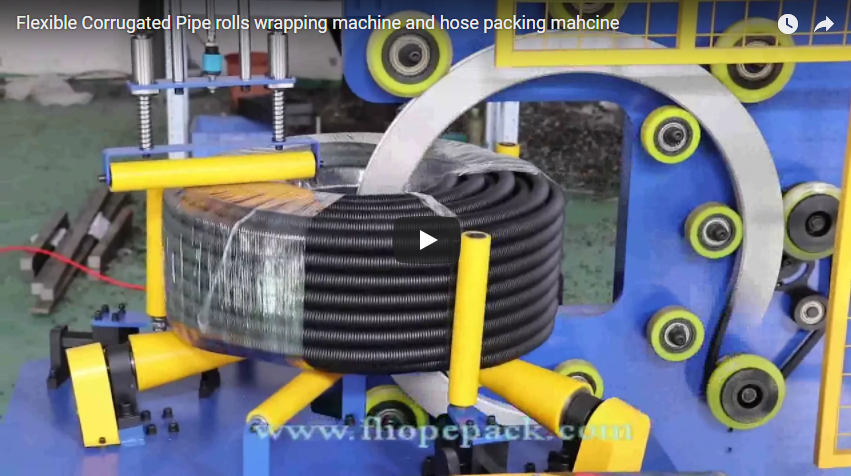
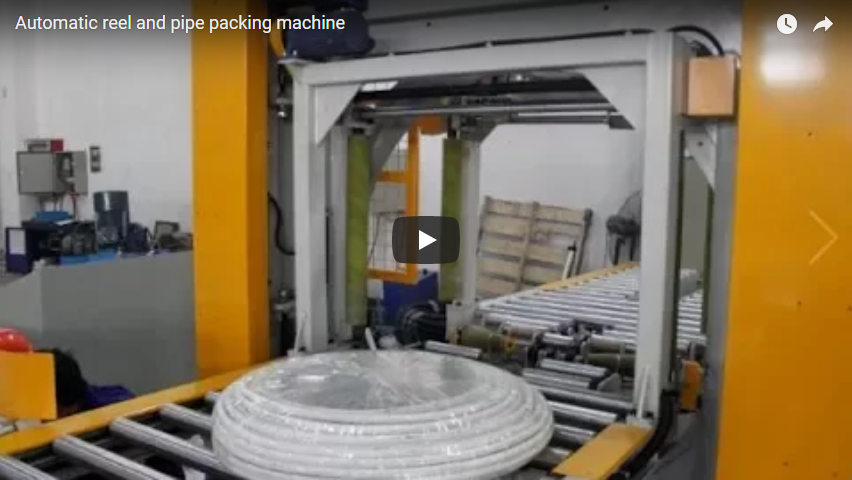
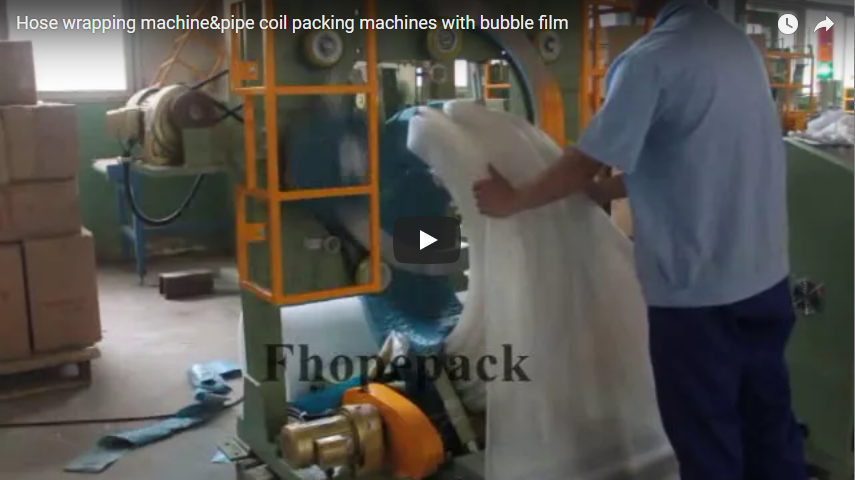
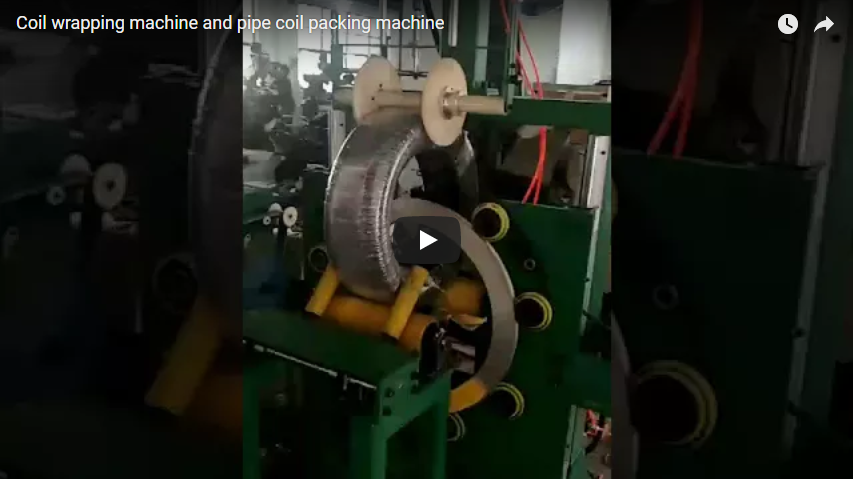
Our compact hose wrapper turns the coil on support rollers while the ring carries the stretch film through the coil eye. Ring speed and roller speed, both set by frequency converter, decide how far the coil advances per wrap, and so the overlap. In our video, a white hose coil stands on its edge in the wrapper. An orange guard frame covers the ring area, and the machine stops automatically when the wrap is complete.
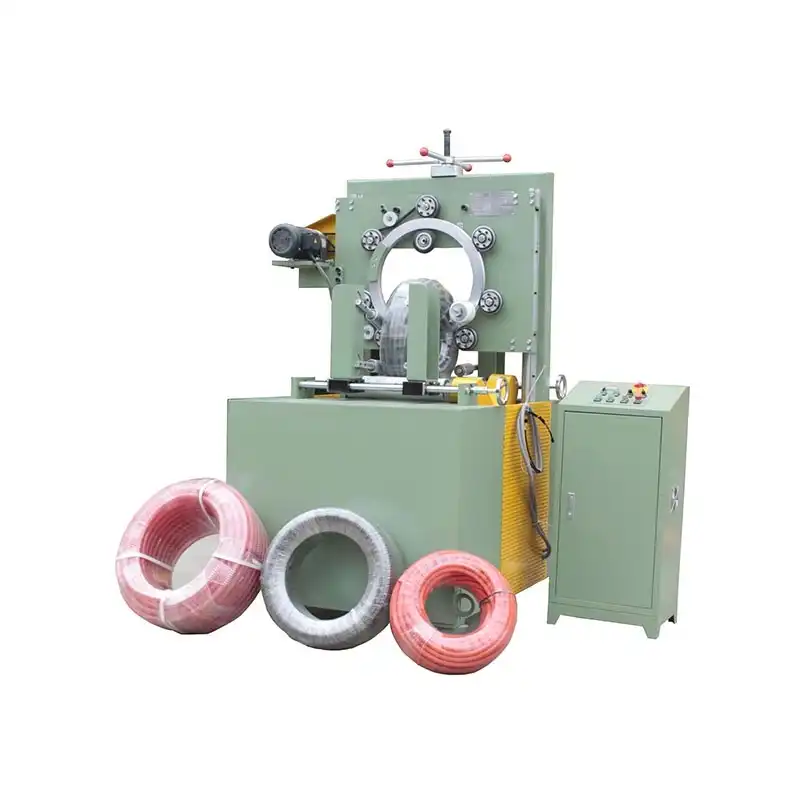
Both models switch between manual and automatic mode, and a reset function returns the ring to its start position for a fast change to the next coil.
FPH-200N or FPH-300N
| Parameter | FPH-200N | FPH-300N |
|---|---|---|
| Coil ID | 250–650 mm | 300–700 mm |
| Coil OD | 450–800 mm | 500–1,000 mm |
| Coil width | 120–280 mm | 100–300 mm |
| Coil weight | 5–30 kg | 10–100 kg |
| Wrapping time | 20–35 s per coil | 23–35 s per coil |
| Max. ring speed | 100 r/min | 120 r/min |
| Film width | 60–80 mm | 90–100 mm |
| Film roll OD | 100–140 mm | 100–180 mm |
| Film core ID | 50 mm | 50 mm |
| Power | 1.5 kW | 1.9 kW |
Illustrative example: a garden hose coil of 300 mm ID, 500 mm OD, 150 mm width and 8 kg fits the FPH-200N. A 60 kg coil, or one with 900 mm OD, needs the FPH-300N.
Output per hour
One hour has 3,600 s:
- FPH-200N: 3,600 ÷ 35 = about 102 coils per hour, up to 3,600 ÷ 20 = 180 coils per hour.
- FPH-300N: 3,600 ÷ 35 = about 102, up to 3,600 ÷ 23 = about 156 coils per hour.
These are machine cycle limits. Loading, positioning and unloading by hand add to each cycle, so we time the full cycle on your coils before we commit to an output figure.
Wraps and film per coil
The wraps fan out from the coil ID to the OD, so we size the wrap at the OD, where gaps would open first. For the 300 mm ID, 500 mm OD, 150 mm wide coil with 70 mm film on the FPH-200N:
- Outer circumference. π × 500 = about 1,571 mm.
- Wraps for 30% overlap at the OD. Each wrap advances 49 mm, so 1,571 ÷ 49 = about 32 wraps.
- Section perimeter. 2 × (150 + 100) = 500 mm, where 100 mm is the coil wall, (500 − 300) ÷ 2.
- Film per coil. 32 × 0.5 m = about 16 m of film as laid on the coil.
At the maximum ring speed of 100 r/min, 32 wraps take about 19 s of ring time. Film stretches under tension, so less comes off the roll. On a soft hose coil, too much tension can pull the coil out of shape, so we set the adjustable tension on a trial coil and measure the real film use. On the FPH-300N, the overlap can be set from 10% to 90%.
Options
The FPH-300N offers these additional functions:
- Logo tape applicator to brand the coil.
- Automatic film cutter and feeder.
- Light beam sensor.
- Wrapping station movement, so the station can move to the coil.
Paper and HDPE can replace stretch film on the FPH-300N, and paper on the FPH-200N.
Utilities and safety
| Utility | Requirement |
|---|---|
| Power | 1.5 kW (FPH-200N), 1.9 kW (FPH-300N) |
| Power supply | 380 V, 60 Hz, 3 phase |
A safety guardrail protects the coil and the operator, a special brake keeps operation smooth, and the wrapping tension is adjustable. The standards that apply depend on the destination market. For CE markets, ISO 12100 sets the risk-assessment method and EN 415-10 sets general requirements for packaging machines.
Selection checklist for a hose wrapper
- Coil ID, OD, width and weight, smallest and largest.
- Coils per hour.
- Film, paper or HDPE.
- Logo tape, yes or no.
- Manual loading, or a moving wrapping station in a line.
- Power supply at your site.
Engineering FAQ
Q: Which model fits garden hose coils? A: The FPH-200N, for coils of 250–650 mm ID, 450–800 mm OD and 5–30 kg.
Q: How many coils per hour can it wrap? A: The FPH-200N wraps in 20–35 s, a machine limit of about 102–180 coils per hour. Manual loading lowers this, and we measure it on a trial.
Q: How much film does one coil use? A: About 16 m as laid for a 300/500 mm coil, 150 mm wide, with 70 mm film at 30% overlap at the OD.
Q: Can it apply our logo? A: Yes. A logo tape applicator is an option on the FPH-300N.
Q: What if my coils weigh up to 100 kg? A: Use the FPH-300N, which takes 10–100 kg and coils up to 1,000 mm OD.
Next step
We size your hose wrapper in three steps:
- Submit your layout drawing with coil sizes and coils per hour to info@fhopepack.com.
- Receive a proposal within 48 hours, with the model, film and options.
- Book a site survey to fit the wrapper to your line.
Related reading
- Hose coil packing machine FPH-200N
- Hose wrapping machine FPH-300N
- Video: hose wrapping machine and HDPE pipe coil packing machines
- Video: automatic reel and pipe packing machine and hose wrapping machine
- Hose packaging machine range
Sources
- FPH-200N: hose coil packing machinery FPH-200N page
- FPH-300N: hose wrapping machine FPH-300N page
- Machine in action: our hose stretch wrapping machine video on YouTube
- Standards scope: ISO 12100:2010, EN 415-10:2014
Last reviewed: 2026-10-04