Executive summary Our flexible corrugated pipe rolls wrapping machine turns the roll through 360 degrees while the ring wraps film through its eye. Corrugated rolls are light but bulky, so the roll’s ID and OD decide the model more than its weight. Three models cover most rolls, from 300–500 mm OD on the FPCA-100 to 700–1,500 mm OD on the FPH-400W.
Table of Contents
- How the corrugated pipe wrapper works
- Three models by roll size
- Why corrugated rolls need roller support
- Overlap on a ribbed surface
- Cycle time
- Utilities and safety
- Selection checklist
- Engineering FAQ
- Next step
- Related reading
- Sources
How the corrugated pipe wrapper works
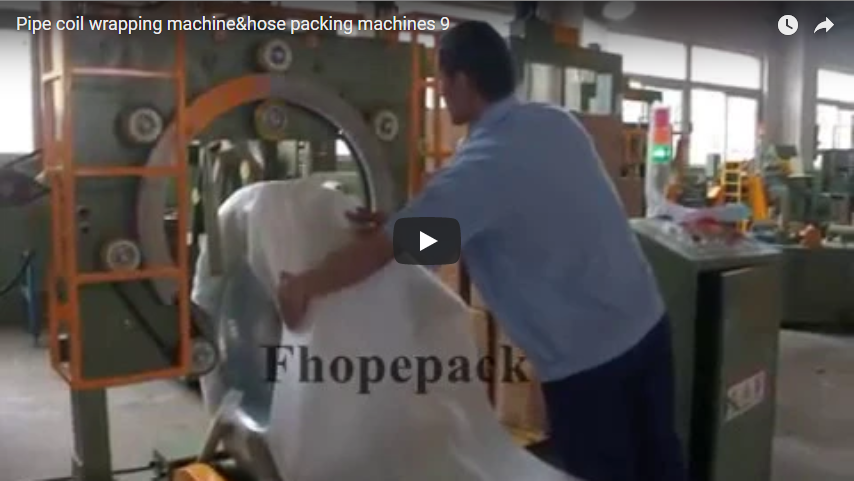
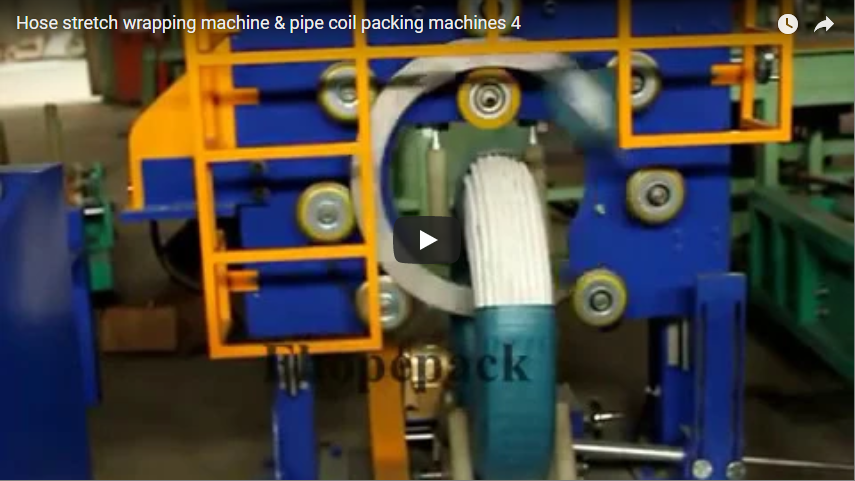
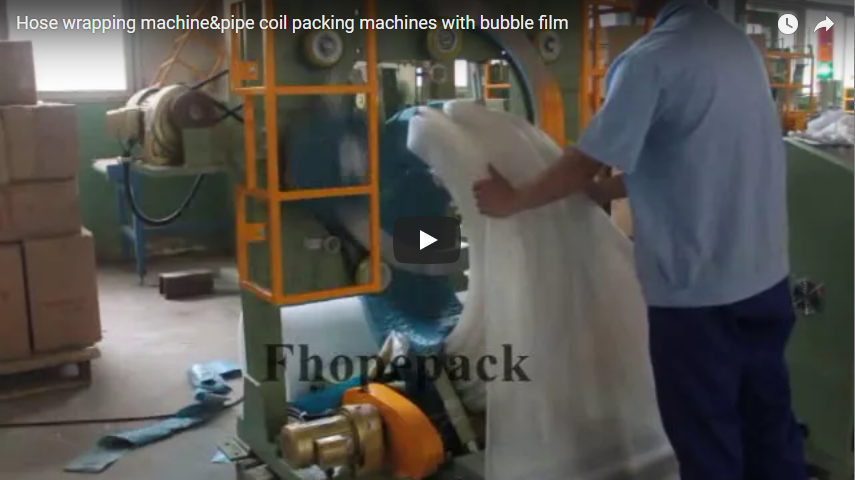
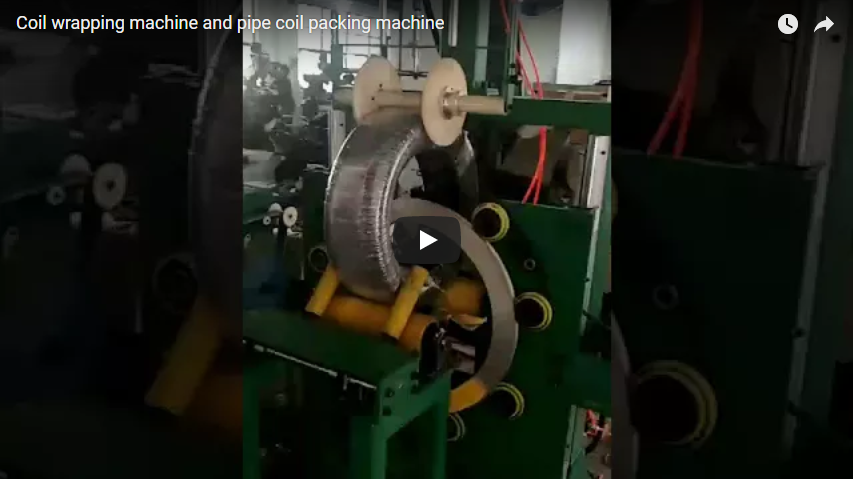
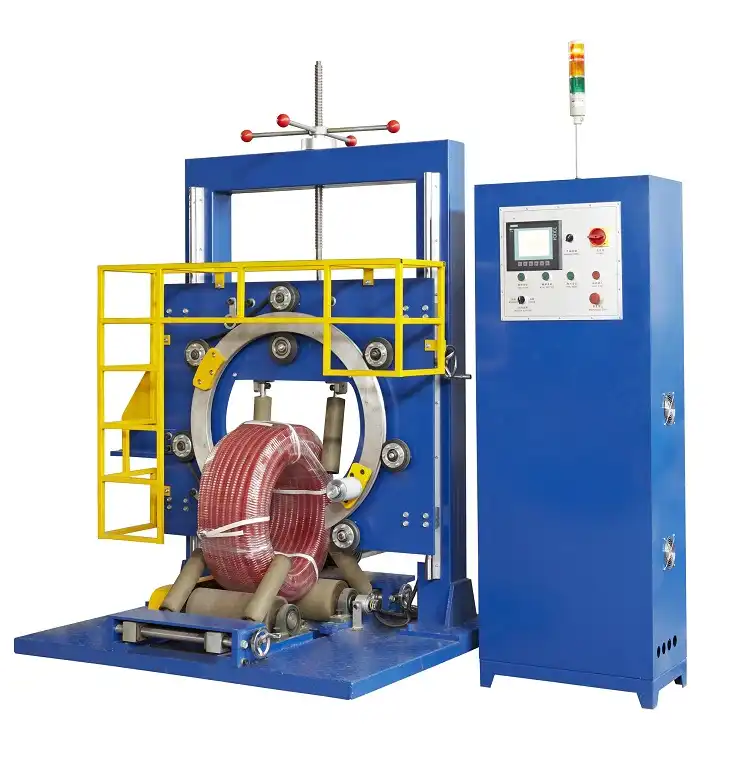
Our hose wrapper holds the roll between yellow support and guide rollers while the ring, fitted with the film roll, passes through the roll’s eye. The rollers turn the roll through 360 degrees, so the film covers the whole roll section. Converters set the ring and roller speeds, and the ratio between them sets the overlap. In our video, a black corrugated pipe roll is wrapped this way in clear film.
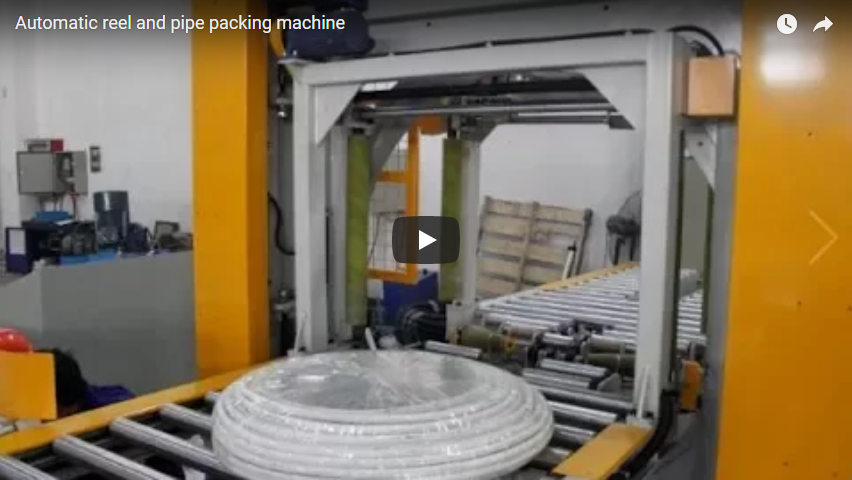
The wrapper is built for easy manual loading and unloading. The ring starts and stops softly and resets to its start position, and a time relay stops it automatically at the end of the wrap.
Three models by roll size
| Parameter | FPCA-100 | FPH-300N | FPH-400W |
|---|---|---|---|
| Roll ID | 150–350 mm | 300–700 mm | 300–1,250 mm |
| Roll OD | 300–500 mm | 500–1,000 mm | 700–1,500 mm |
| Roll width | 50–200 mm | 100–300 mm | 150–400 mm |
| Roll weight | 5–50 kg | 10–100 kg | 10–100 kg |
| Wrapping time | 25–35 s | 23–35 s | 30–55 s |
| Max. ring speed | 100 r/min | 120 r/min | 100 r/min |
| Film width | 50–70 mm | 90–100 mm | 90–120 mm |
| Power | 1.5 kW | 1.9 kW | 1.5 kW |
All three take light rolls, up to 50 kg on the FPCA-100 and 100 kg on the others, so weight rarely decides. Illustrative example: a corrugated conduit roll of 250 mm ID, 450 mm OD and 120 mm width fits the FPCA-100. A drainage pipe roll of 600 mm ID, 1,200 mm OD and 350 mm width fits only the FPH-400W.
Why corrugated rolls need roller support
A corrugated roll is springy and can shift as it turns through 360 degrees. Our wrappers deal with this in three ways:
- Adjustable support rollers keep the roll from shaking during the wrap.
- Adjustment for roll OD sets the rollers for the best package.
- A consistent tension device lets one machine wrap small to large rolls.
On the FPH-400W, the friction is adjustable to suit the roll.
Overlap on a ribbed surface
The film bridges the ribs rather than following them, so a higher overlap gives a tighter, sealed package. The FPH-300N sets overlap from 10% to 90%, and the FPH-400W from 20% to 90%.
The wraps fan out from the roll ID to the OD, so we size the wrap at the OD, where the gaps would open first. For a roll of 250 mm ID and 450 mm OD with 60 mm film:
- Outer circumference. π × 450 = about 1,414 mm.
- Wraps for 30% overlap at the OD. Each wrap advances 42 mm, so 1,414 ÷ 42 = about 34 wraps.
- At the ID. π × 250 = about 785 mm, so the same 34 wraps sit about 23 mm apart and overlap heavily. A special brake keeps the film from folding, and the packing tension is adjustable.
Cycle time
| Model | Wrapping time | Max. throughput, no handling time |
|---|---|---|
| FPCA-100 | 25–35 s | 3,600 ÷ 35 = about 102 to 3,600 ÷ 25 = 144 rolls per hour |
| FPH-300N | 23–35 s | about 102 to 156 rolls per hour |
| FPH-400W | 30–55 s | 3,600 ÷ 55 = about 65 to 3,600 ÷ 30 = 120 rolls per hour |
Manual loading and unloading add to each cycle, so we time the full cycle on your rolls.
Utilities and safety
| Utility | Requirement |
|---|---|
| Power | 1.5 kW (FPCA-100, FPH-400W), 1.9 kW (FPH-300N) |
| Power supply | 380 V, 60 Hz, 3 phase |
| Film core | ID 50 mm |
Guardrails, soft start and stop, and overcurrent protection for the drive motor protect the operator and the machine. A foot switch allows jog operation. The standards that apply depend on the destination market. For CE markets, ISO 12100 sets the risk-assessment method and EN 415-10 sets general requirements for packaging machines.
Selection checklist for a corrugated pipe wrapper
- Roll ID, OD, width and weight, smallest and largest.
- Rolls per hour.
- Film, paper, woven or HDPE.
- Logo tape, yes or no.
- Manual loading, or a line connection.
- Power supply at your site.
Engineering FAQ
Q: Which model fits small conduit rolls? A: The FPCA-100, for rolls of 150–350 mm ID, 300–500 mm OD and 5–50 kg.
Q: What about large drainage pipe rolls? A: The FPH-400W takes 300–1,250 mm ID and 700–1,500 mm OD.
Q: How do you stop a springy roll from shaking? A: Adjustable support rollers hold the roll, and a consistent tension device suits small to large rolls.
Q: How many rolls per hour? A: About 102–144 per hour on the FPCA-100 at 25–35 s per roll, before loading time.
Q: How many wraps does a small roll need? A: About 34 wraps for a 250 mm ID, 450 mm OD roll with 60 mm film, for 30% overlap at the OD.
Next step
We size your corrugated pipe wrapper in three steps:
- Submit your layout drawing with roll sizes and rolls per hour to info@fhopepack.com.
- Receive a proposal within 48 hours, with the model, film and overlap plan.
- Book a site survey to fit the wrapper to your line.
Related reading
- Corrugated hose packing machine FPCA-100
- Hose wrapping machine FPH-300N
- Hose coil wrapping machinery FPH-400W
- Hose packaging machine range
- Video: hose stretch wrapping machine for pipe coils
Sources
- FPCA-100, roller support, controls: corrugated hose packing machine page
- FPH-300N: hose wrapping machine FPH-300N page
- FPH-400W: hose coil wrapping machinery FPH-400W page
- Machine in action: our corrugated pipe rolls wrapping machine video on YouTube
- Standards scope: ISO 12100:2010, EN 415-10:2014
Last reviewed: 2026-10-04