Executive summary Our FPC-300 horizontal coil wrapper wraps copper and alloy steel strip coils lying flat on rollers, so narrow strip is supported from below while the ring passes paper or film through the eye. It takes coils of 10–1,000 kg and 10–300 mm wide, with OD minus ID under 600 mm. Conveyors in and out let it fill the wrapping gap in an existing line.
Table of Contents
- How horizontal wrapping works
- Why horizontal for strip
- Does your coil fit
- Wrap time and output
- Materials and overlap
- Retrofitting a line
- Utilities and safety
- Selection checklist
- Engineering FAQ
- Next step
- Related reading
- Sources
How horizontal wrapping works
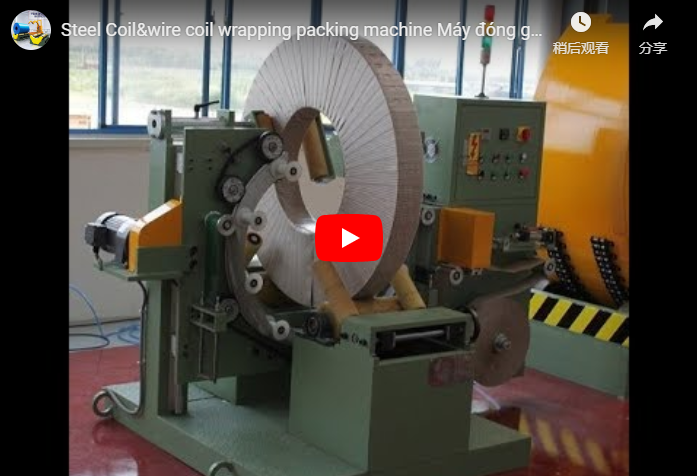
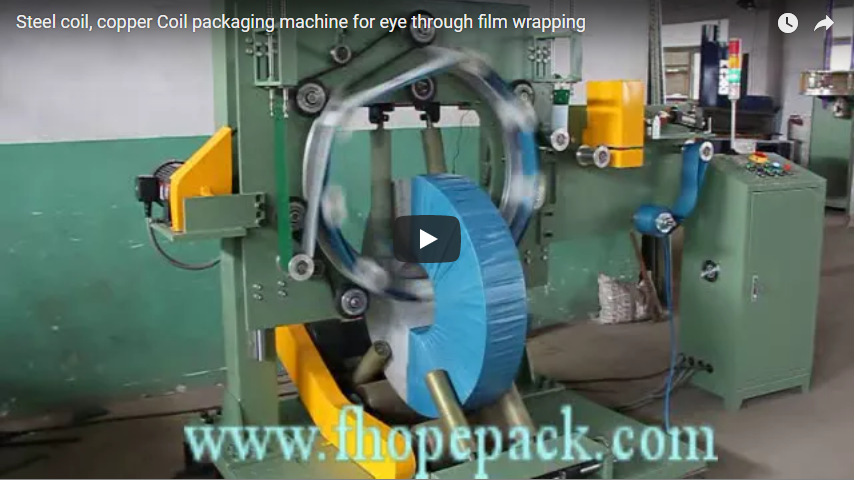
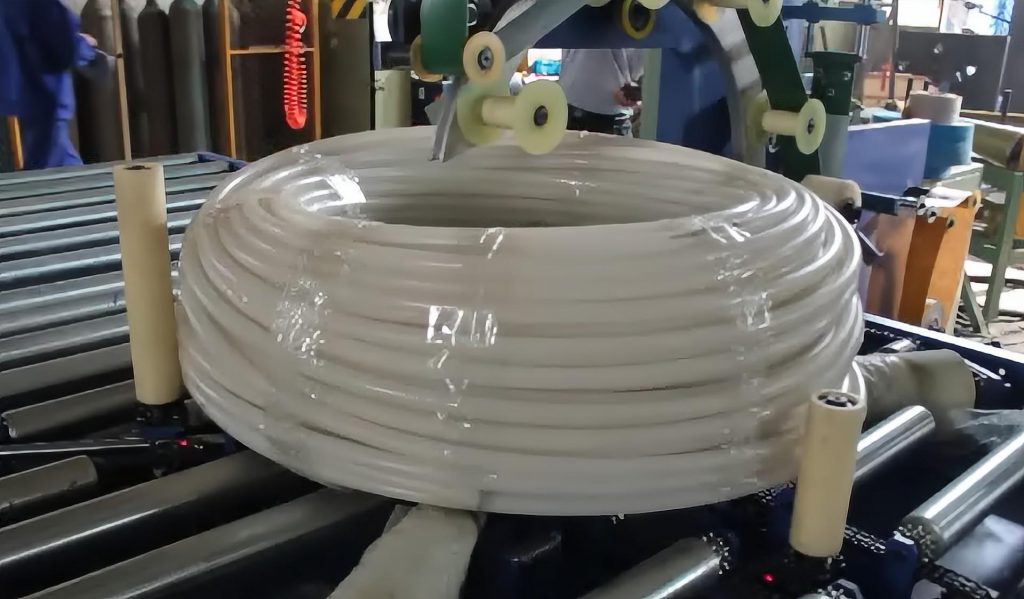
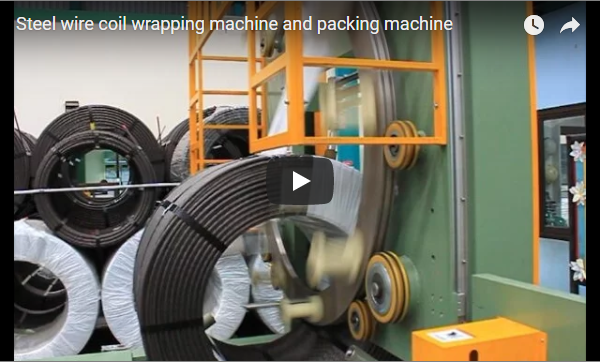
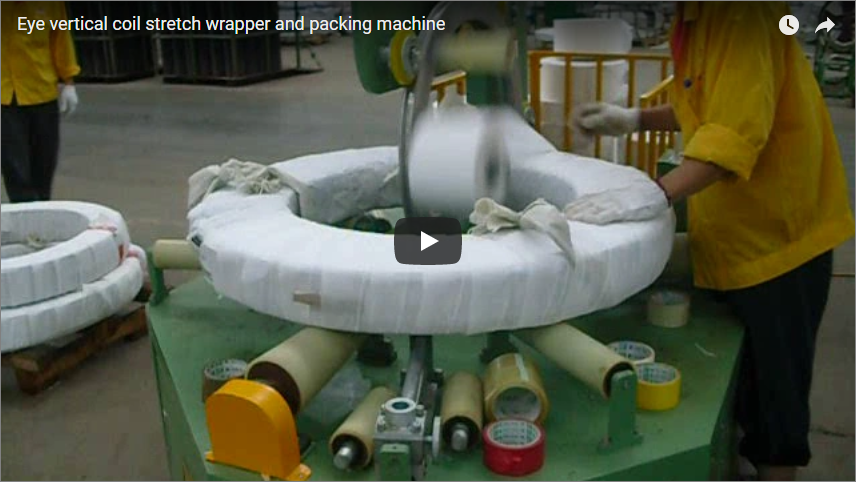
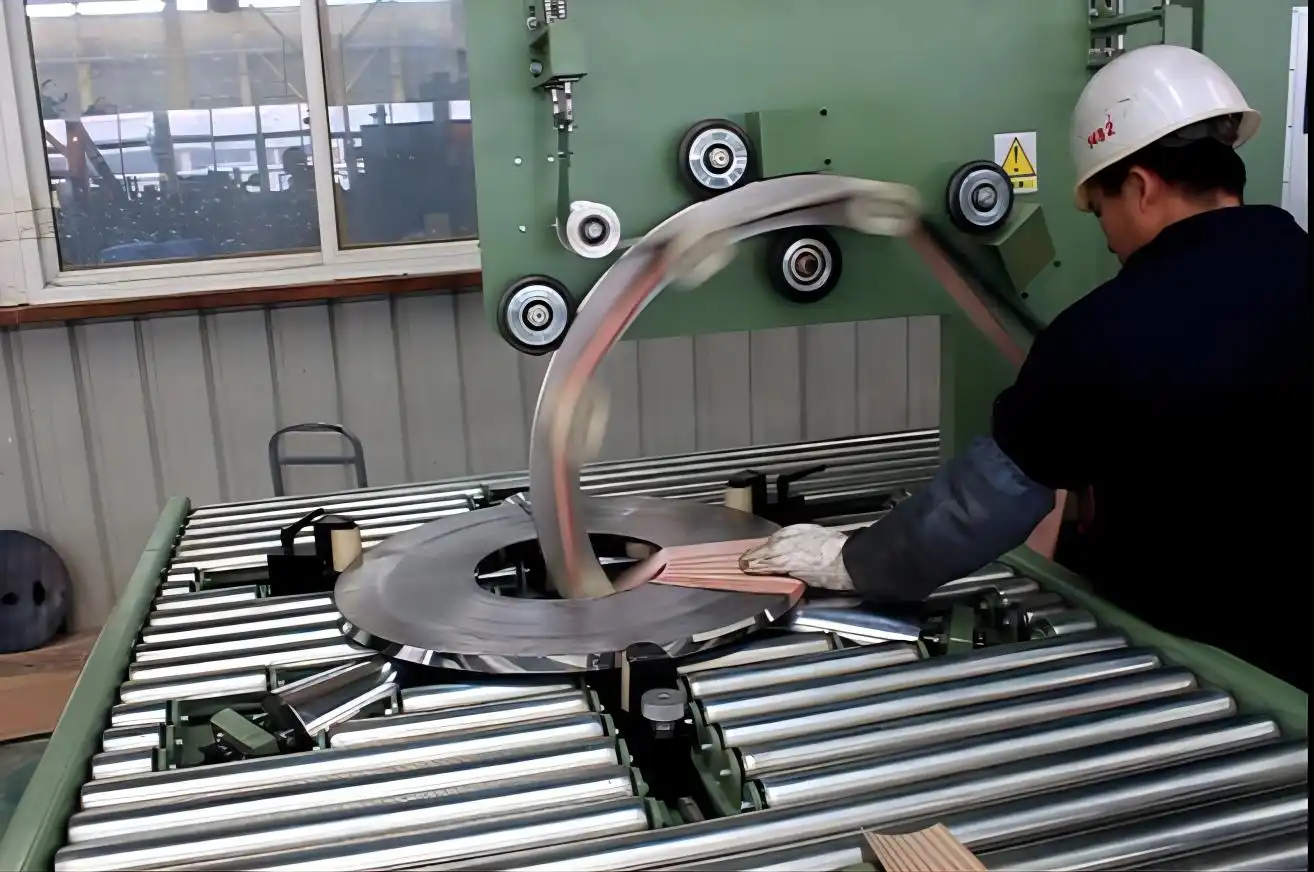
The strip coil lies flat, eye up, on a roller conveyor. A ring turns through the coil eye, so paper or film spirals over the outside, the faces and the bore. Rollers turn the coil slowly at the same time, so each turn of the ring overlaps the last. Tension control keeps the layers tight.
In our video, the ring carries light-coloured paper through the eye of a flat strip coil while yellow rollers turn the coil, so the wraps step around the whole coil.
Why horizontal for strip
A narrow strip coil standing on its edge rests on a small contact patch, and thin strip can bend under its own weight. Lying flat, the whole coil face sits on the rollers, so the coil keeps its shape during wrapping. This is why we recommend horizontal wrapping for thin-gauge copper and alloy strip.
Does your coil fit
| Parameter | FPC-300 |
|---|---|
| Coil weight | 10–1,000 kg |
| Coil width | 10–300 mm |
| Coil OD | 700–1,200 mm |
| Coil ID | 400–900 mm |
| OD minus ID | under 600 mm |
The last row matters. OD minus ID under 600 mm means the coil wall is under 300 mm thick, because the wall is half the difference.
| Example coil | OD | ID | OD minus ID | Fits |
|---|---|---|---|---|
| A | 1,000 mm | 508 mm | 492 mm | yes |
| B | 1,200 mm | 500 mm | 700 mm | no, wall too thick |
Coil B is inside the OD and ID ranges but still does not fit, so we check all three numbers on your coil list.
Wrap time and output
Illustrative example with 10 s for conveyor transfer in and out:
| Step | Fast coil | Slow coil |
|---|---|---|
| Wrap | 35 s | 50 s |
| Transfer (illustrative) | 10 s | 10 s |
| Total cycle | 45 s | 60 s |
| Coils per hour | 80 | 60 |
| Speed | FPC-300 |
|---|---|
| Ring rotation | 5–100 r/min |
| Roller speed | 2–4 m/min |
These are run-time figures before material roll changes and breaks.
Materials and overlap
| Item | FPC-300 |
|---|---|
| Materials | woven belt, paper, stretch film |
| Material roll | 50 or 76 mm core, 90–120 mm wide |
| Overlap | 10–90% |
The material roll rides on the ring and passes through the coil eye, so we check the roll size against your smallest coil ID. Ring height is adjustable, automatically or by hand, to suit different coil ODs. Polyurethane friction wheels drive the ring, and rubber-covered rollers protect the coil surface.
Retrofitting a line
Many older strip lines already have upenders upstream and strapping or stacking downstream, but no automatic wrapping station. The FPC-300 loads and unloads on conveyors, so we place it between your existing conveyors and the coils flow through without manual handling.
Options include automatic taping around the coil OD and automatic tail sealing, which cuts and secures the material tail by taping or heat sealing after wrapping.
Utilities and safety
| Utility | FPC-300 |
|---|---|
| Power supply | 380 V, 50/60 Hz, 3-phase |
| Compressed air | required; pressure not stated clearly on the page |
| Control | PLC, optional touch screen |
The electric cabinet has red and green status lights, and faults trigger an alarm light and show on the panel. The standards that apply depend on the destination market. For CE markets, ISO 12100 sets the risk-assessment method and EN 415-10 sets general requirements for packaging machines.
Selection checklist for a strip coil wrapper
- Coil OD, ID, width and weight, smallest to largest.
- OD minus ID for your thickest coil.
- Paper, film or woven belt.
- Taping or tail sealing, yes or no.
- Conveyor heights upstream and downstream.
- Coils per shift needed.
Engineering FAQ
Q: Why wrap strip coils lying flat? A: The whole face sits on the rollers, so narrow, thin strip does not bend during wrapping.
Q: What coil sizes does the FPC-300 take? A: 10–1,000 kg, 10–300 mm wide, 700–1,200 mm OD and 400–900 mm ID, with OD minus ID under 600 mm.
Q: How long does one coil take? A: 35–50 s of wrapping, depending on coil size and the overlap you set.
Q: Can it go into our existing line? A: Yes. It loads and unloads on conveyors, so we fit it between your upstream and downstream equipment.
Q: Which materials can it use? A: Woven belt, paper or stretch film.
Next step
We plan your strip coil wrapper in three steps:
- Submit your layout drawing with your coil list and coils per shift to info@fhopepack.com.
- Receive a proposal within 48 hours, with the model and conveyor layout.
- Book a site survey to fit the wrapper into your line.
Related reading
- FPC-300 copper coil wrapper
- Video: automatic copper strip coil packing line
- Video: slit steel coil packaging system
- Video: copper tube coil packing and shrinking machine
- Video: hose wrapping machine and copper tube packing machines
Sources
- FPC-300 data: FPC-300 copper coil wrapper page
- Machine in action: our strip coil wrapping video on YouTube
- Standards scope: ISO 12100:2010, EN 415-10:2014
Last reviewed: 2026-10-04