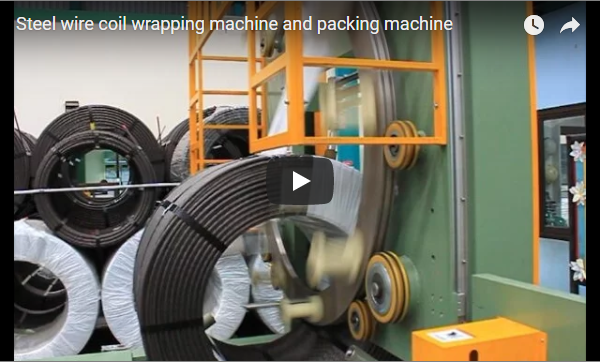
Executive summary Our eye-vertical coil wrapper wraps a copper tube coil lying eye-up on its table by passing a tape ring through the coil eye while rollers turn the coil. One operator loads the coil, ties the tape on, starts the wrap and cuts the tape at the end. Because the eye is smaller than the outside, the wrap always overlaps more at the eye, so overlap is set at the outside.
Table of Contents
- What the video shows
- Packing steps
- Why the eye overlaps more
- Tape per coil
- Why copper tube coils are wrapped
- Controls and safety
- Selection checklist
- Engineering FAQ
- Next step
- Related reading
- Sources
What the video shows
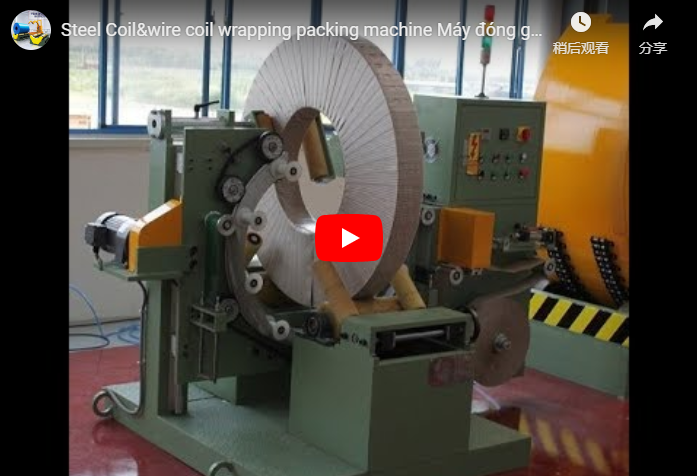
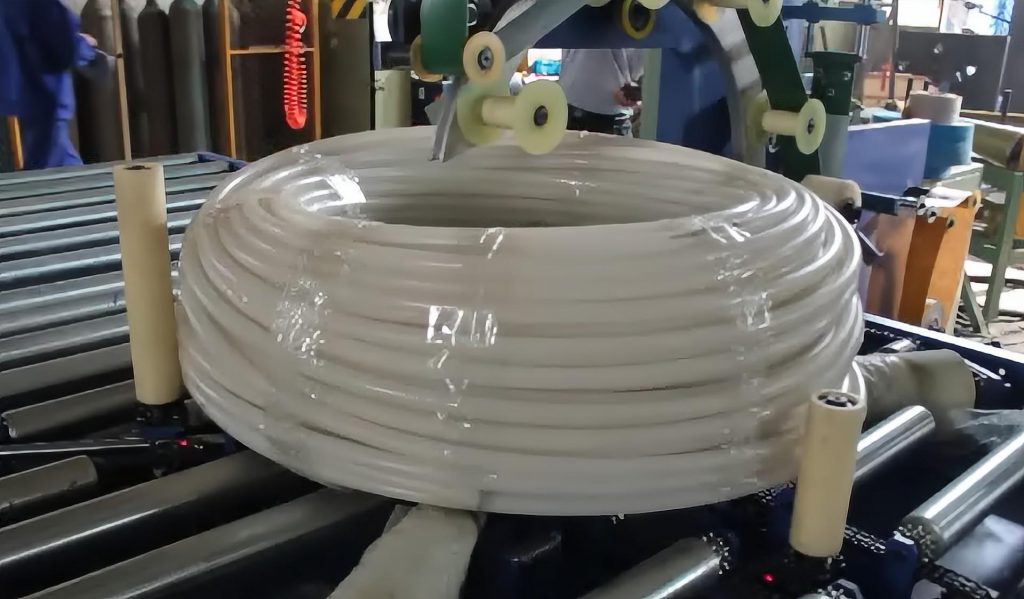
A copper tube coil lies flat on the rollers of our green wrapper, with the tape ring passing through its eye. As the ring turns, the coil rotates, and white tape builds up around its section. The operator steadies the coil by hand and smooths the tape at the start. Finished coils, fully covered in white, stand on a pallet beside the machine, and spare tape rolls sit on the machine top.
Packing steps
- Load. Put the copper tube coil onto the wrapping station. In the video it lies flat on the table rollers, eye up.
- Tie on. Fix the tape end to the coil.
- Start. Press start, and the coil is wrapped automatically.
- Cut. Cut the tape by hand when the wrap is complete.
- Unload. Take the wrapped coil off the station.
Loading and cutting are manual in the video, so the station needs no conveyor. A conveyor feed can be planned per project.
Why the eye overlaps more
When the overlap is set at the outside, the coil turns a set distance there for each ring turn. At the eye, the same angle covers a shorter arc, so each turn of tape sits closer to the last one there. Illustrative example with 100 mm tape set to 50% overlap at the outside of a coil with OD 700 mm and ID 400 mm:
| Item | Outside | Eye |
|---|---|---|
| Diameter | 700 mm | 400 mm |
| Circumference | 2,199 mm | 1,257 mm |
| Advance per ring turn | 50 mm | 29 mm |
| Overlap | 50% | 71% |
Set the overlap for the outside, where the cover is thinnest. The eye will always carry more layers. On coils where the ID is close to the OD, the difference is small.
Tape per coil
In the same example, with a coil 200 mm wide, each turn of tape goes round the coil section once.
| Item | Value |
|---|---|
| Section perimeter, 2 × (150 + 200) | 700 mm |
| Ring turns, 2,199 ÷ 50 | about 44 |
| Tape per coil, 44 × 700 mm | about 31 m |
At 75% overlap, the advance halves and the tape per coil doubles to about 62 m. Check the tape roll length against the tape per coil before you choose a roll size.
Why copper tube coils are wrapped
| Risk | How the wrap helps |
|---|---|
| Scratches and dents on the outer turns | Tape takes the contact in stacking and handling |
| Tarnish | The wrap keeps air and moisture off the tube surface |
| Loose turns | The wrap holds the tube turns in place through the eye |
| Dirt in the bore | Covering the coil keeps dust away from the tube ends |
Copper tube is soft, so set the tape tension low enough that the wrap does not mark the outer turns. Run a trial on your own coil before production.
Controls and safety
The ring turns at speed through the coil eye. Keep hands clear of the ring and rollers while the wrap runs, and cut the tape only after the machine has stopped.
The standards that apply depend on the destination market. For CE markets, ISO 12100 sets the risk-assessment method and EN 415-10 sets general requirements for packaging machines.
Selection checklist for an eye-through coil wrapper
- Coil ID, OD and width, smallest to largest.
- Heaviest coil and tube diameter.
- Tape material: PE, PVC, paper or HDPE.
- Overlap at the outside.
- Coils per shift.
- Manual roll-in or a conveyor feed.
Engineering FAQ
Q: What does the machine in the video wrap? A: Copper tube coils, lying flat on the table with the eye up.
Q: Why is the wrap thicker at the coil eye? A: The eye has a smaller circumference, so at 50% outside overlap our example coil gets 71% at the eye.
Q: How much tape does one coil use? A: About 31 m in our example, at 50% overlap with 100 mm tape.
Q: Why set the overlap at the outside? A: The outside is where each turn is spread widest, so the cover is thinnest there. The eye then gets more.
Q: How tight should the tape be on copper tube? A: Low enough not to mark the soft outer turns. Set it by trial on your own coil.
Next step
We plan your coil wrapper in three steps:
- Submit your layout drawing with coil sizes, weights and output to info@fhopepack.com.
- Receive a proposal within 48 hours, with the machine and tape plan.
- Book a site survey to check coil handling and floor space.
Related reading
- Video: hose wrapping machine, copper tube and pipe packing machines
- Wire coil wrapping machines
- Video: steel coil and copper coil packaging machine for eye-through film wrapping
Sources
- Product identification (copper tube coil): FHOPE engineering team, 2026-10-04
- Machine in action: our eye-through coil wrapper video on YouTube
- Overlap and tape examples: our worked examples, illustrative values
- Standards scope: ISO 12100:2010, EN 415-10:2014
Last reviewed: 2026-10-04