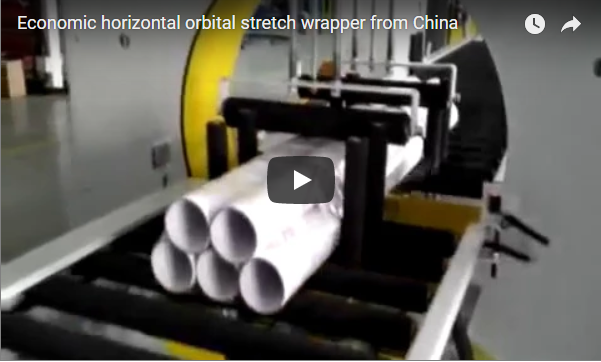
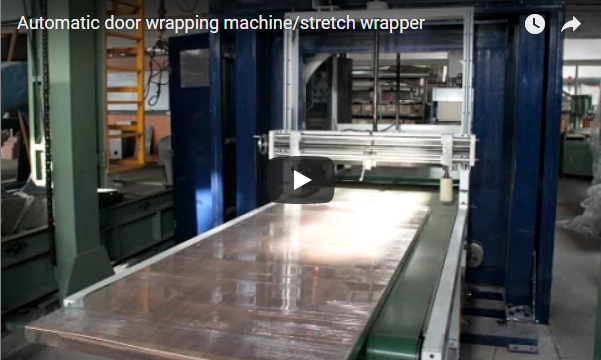
Executive summary Our horizontal furniture wrapper moves each piece through a rotating ring that spirals stretch film around it. It takes pieces over 1,500 mm long and 800–1,800 mm wide and high, at a conveyor speed of 4–12 m/min. Ring clearance and the match between conveyor speed and ring speed decide whether a piece is fully and evenly covered.
Table of Contents
- How the furniture wrapper works
- Size window and ring clearance
- Matching conveyor and ring speed
- Film and protection options
- Utilities and safety
- Selection checklist
- Engineering FAQ
- Next step
- Related reading
- Sources
How the furniture wrapper works
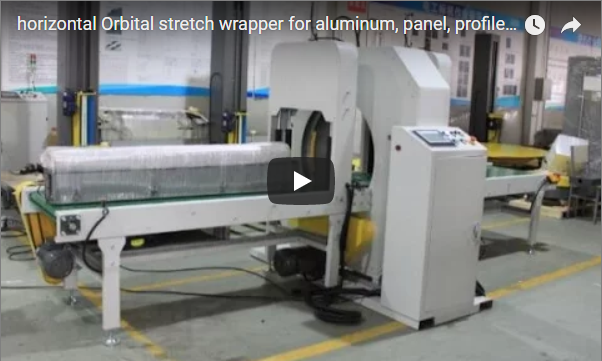
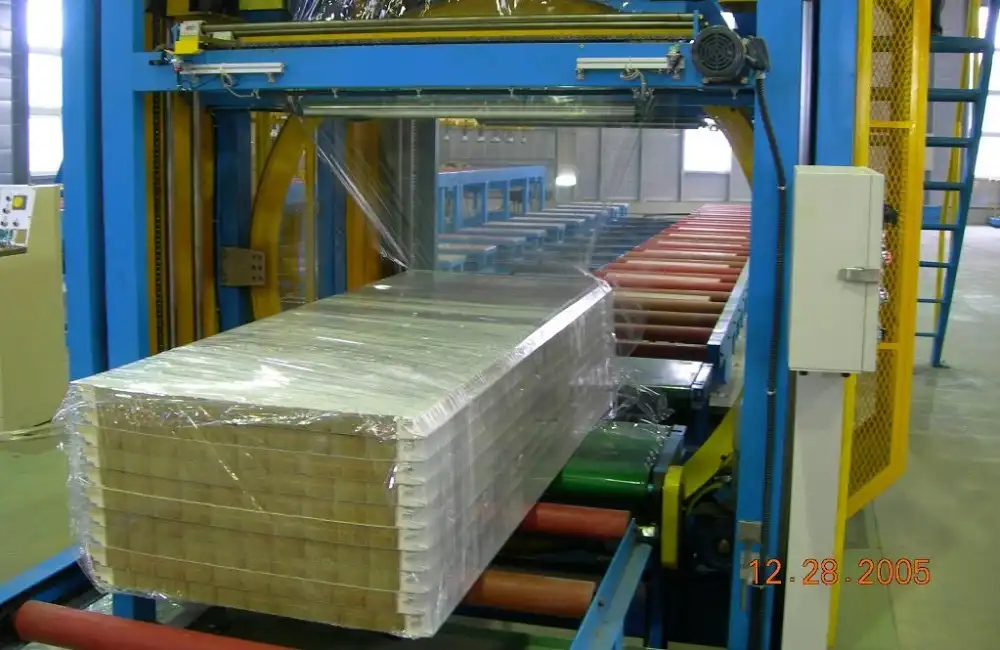
Our horizontal stretch wrapper wraps furniture lying flat, such as sofas, cabinets, doors, floor boards and windows. The operator only places and unloads the piece; the wrapper handles positioning, holding and wrapping. In our video, a wooden cabinet panel is wrapped in clear stretch film after the operator starts the cycle at the control panel.
The automatic cycle runs in eight steps:
- The operator places the product on the infeed conveyor.
- Sensors detect the product, and the conveyor moves it to the wrapping position.
- A press-down device with a pressure-relief (decompression) system holds the package without crushing it.
- The product stops automatically at the wrapping position.
- The film on the ring is fed to the package automatically.
- The product travels through the ring and is wrapped.
- Reinforcing wraps are placed at the tail end.
- The packed piece is unloaded.
The wrapper can also connect to a packing line for automatic inline wrapping.
Size window and ring clearance
| Parameter | Furniture horizontal wrapper |
|---|---|
| Product length | over 1,500 mm |
| Product width | 800–1,800 mm |
| Product height | 800–1,800 mm |
| Product weight | 20–200 kg |
| Wrapping ring ID | over 1,400 mm |
| Ring speed | about 10–60 r/min |
| Conveyor speed | 4–12 m/min |
The ring has to clear the diagonal of the piece’s cross-section, not just its width. Illustrative examples:
- 800 × 800 mm cabinet. √(800² + 800²) = about 1,131 mm, inside a 1,400 mm ring.
- 1,000 × 1,000 mm sofa section. √(1,000² + 1,000²) = about 1,414 mm, which is more than 1,400 mm.
So a larger cross-section needs a larger ring. The size window runs to 1,800 × 1,800 mm, which needs about 2,546 mm of clearance, so the ring and the conveyors listed below grow with the piece. We size both to your largest piece and confirm them in the proposal.
Matching conveyor and ring speed
Coverage depends on how far the piece moves for each ring turn. Advance per turn = conveyor speed ÷ ring speed. With a 250 mm film roll (illustrative) and 50% overlap (illustrative), the advance must stay at or below 125 mm:
| Conveyor speed | Ring speed | Advance per turn | Result with 250 mm film |
|---|---|---|---|
| 4 m/min | 60 r/min | about 67 mm | heavy overlap |
| 7.5 m/min | 60 r/min | 125 mm | 50% overlap |
| 12 m/min | 60 r/min | 200 mm | 20% overlap |
| 12 m/min | 10 r/min | 1,200 mm | open gaps |
Travel time for a 2,000 mm wardrobe (illustrative) at 7.5 m/min is 2 ÷ 7.5 = 0.27 min, or about 16 s. The tail-end reinforcing wraps, loading and unloading add to that, so we time the full cycle on your product.
Film and protection options
| Item | Specification |
|---|---|
| Wrapping material | LLDPE stretch film, PE film or PVC |
| Film roll width | 200–300 mm |
| Film roll OD | 100–250 mm |
| Film roll core ID | 50 mm |
For a fully sealed package, we add a film covering step before the ring wrap. Besides PE film covering, bubble film and EPE film are available, and our sofa packing line uses an automatic film covering machine.
Utilities and safety
| Utility | Requirement |
|---|---|
| Power | about 3.5 kW |
| Power supply | AC 380 V, 60 Hz, 3 phase |
| Control voltage | DC 24 V |
| Infeed conveyor (standard ring) | about 2,500 × 1,400 × 850 mm |
| Outfeed conveyor (standard ring) | about 2,500 × 1,400 × 850 mm |
| Machine size | about 6,300 × 2,500 × 2,500 mm |
The standards that apply depend on the destination market. For CE markets, ISO 12100 sets the risk-assessment method and EN 415-10 sets general requirements for packaging machines.
Selection checklist for a furniture wrapper
- Largest and smallest piece: length, width and height.
- Heaviest piece.
- Pieces per hour.
- Stretch film only, or film covering first.
- Bubble film or EPE protection for finished surfaces.
- Standalone, or inline with your packing line.
Engineering FAQ
Q: What furniture sizes does the wrapper take? A: Pieces over 1,500 mm long, 800–1,800 mm wide and high, weighing 20–200 kg.
Q: Why does ring size matter more than width? A: The ring must clear the diagonal. A 1,000 × 1,000 mm section needs about 1,414 mm, more than a 1,400 mm ring.
Q: How fast can we run the conveyor? A: Up to 12 m/min, but with 250 mm film and 50% overlap at 60 r/min, the limit is 7.5 m/min.
Q: Can we get a fully sealed package? A: Yes. We add film covering before the ring wrap, with PE film, bubble film or EPE film.
Q: Does the wrapper need an operator? A: The operator places the piece and unloads it. Positioning, pressing, film feeding and wrapping run automatically.
Next step
We size your furniture wrapper in three steps:
- Submit your layout drawing with piece sizes and pieces per hour to info@fhopepack.com.
- Receive a proposal within 48 hours, with ring size, speeds and film options.
- Book a site survey to fit the wrapper to your packing area.
Related reading
- Furniture wrapping machine
- Panel wrapping machine
- Bubble film wrapper
- Video: automatic door wrapping machine
- Video: 6-side sealed furniture packaging
Sources
- Furniture wrapper data, cycle and film options: furniture wrapping machine page
- Machine in action: our horizontal furniture wrapper video on YouTube
- Standards scope: ISO 12100:2010, EN 415-10:2014
Last reviewed: 2026-10-04