Executive summary
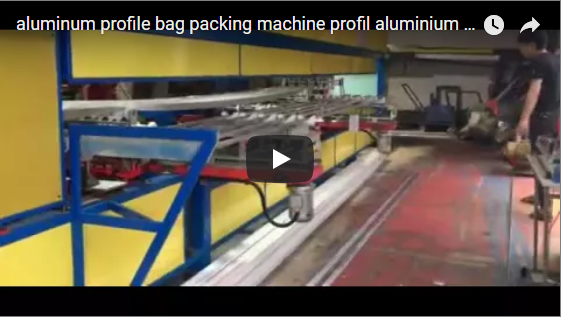
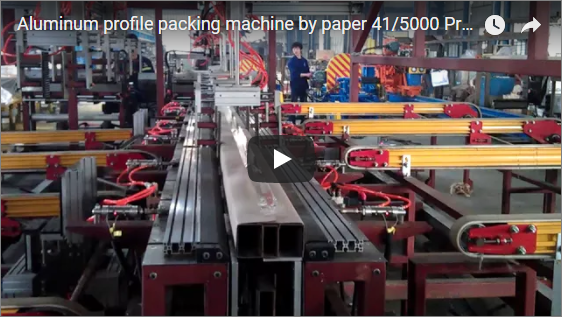
This clip shows an automatic aluminum profile stacker working at the end of an extrusion line: a blue gantry machine with a yellow gripper arm takes long aluminum profiles off a roller conveyor and places them on a pallet below, one layer at a time. The first seconds also show two workers moving profiles by hand, so the video gives a direct manual-vs-automatic comparison. The footage proves the machine concept and the stacking motion, but it gives no stacking rate, pallet height, profile length limits, or safety certification — those figures must come from the manufacturer.
The clip runs about 4 minutes and 12 seconds (252 s) with background music and no narration. All descriptions below come from a frame-by-frame look at the footage (60 frames sampled every 4 seconds).
What the video shows
The video is one continuous look at an aluminum-profile stacking station. The main story is easy to follow: profiles arrive on a conveyor, a gantry arm picks them up, and the arm stacks them on a pallet.
| Phase | Time (approx.) | What happens |
|---|---|---|
| Manual handling | 0:00–0:12 | Two workers (red hard hats, blue coveralls) take long profiles off the conveyor and place them onto a pallet by hand. |
| Stacker starts | 0:12–0:24 | The yellow gripper arm reaches down, grabs profiles on the conveyor, and places them on the pallet. Workers step back. |
| Automatic cycling | 0:24–0:56 | The stacker feeds continuously; the camera pans to reveal a longer line with several pallets and conveyors. |
| Grip-lift-place loop | 1:00–1:40 | The arm opens above the conveyor, grips a bundle, lifts, travels to the pallet, lowers the bundle, and returns for the next one. |
| Layers build up | 1:40–2:56 | The loop repeats and the stack on the pallet grows from one layer to about four visible layers. |
| Line overview | 3:00–3:32 | The camera returns to a full-length view; the conveyor keeps feeding silver profiles, with no stacking action on screen. |
The machine uses a gantry design: a main frame travels along a top rail while the arm moves vertically and horizontally over the conveyor. The workpiece stays level through the cycle — the arm lifts the profiles flat and lowers them flat, so each layer sits cleanly on the one below.
Machine structure: how the station is built
The station is not a single box; it is a small handling line made of a few connected parts.
| Part | Observed detail | Function |
|---|---|---|
| Gantry frame | Blue-painted metal main frame with a top beam and silver support columns | Carries the arm across the full width of the conveyor |
| Gripper arm | Yellow arm hung under the top beam, with a clamp/vacuum-style head visible under it | Picks profiles from the conveyor and releases them on the pallet |
| Roller conveyor | Multi-section yellow track with metal rollers | Brings profiles from the cooling table to the stacking area |
| Pallet | Metal-framed platform under the conveyor line | Receives the stacked layers until the load is complete |
| Control unit | Dark box mounted high on the machine; no screen or push buttons visible in the frames | Presumed to hold the control electronics (unconfirmed) |
The line runs along the workshop floor (grey concrete), with steel overhead structure and lighting. The stacker travels above the conveyor and covers its full length, so one arm can serve profiles arriving anywhere along the transfer.
The operator’s role changes from handling to supervising
The strongest evidence in the clip is the before-and-after role change of the two workers.
- 0:00–0:12 — handling: the workers physically pick profiles off the conveyor and lay them on the pallet.
- 0:12 onward — supervising: after the stacker starts, both workers stand beside the line and watch. No one touches the profile during the automatic loop.
This is exactly the shift automation promises: the repetitive, physical part moves to the machine, and the person becomes an observer who intervenes only when needed. What the video does not show is whether a worker must still adjust the bundle position before each pick, or how often a human must re-stack misaligned layers.
Direct observation notes
These notes describe exactly what is visible in the frames, without interpretation.
Machine appearance
- Machine colors: blue and yellow. The main frame is blue-painted metal with silver beams; the conveyor track, support parts, and gripper arm are yellow.
- Main parts: a gantry main frame that travels on a top rail, a yellow gripper arm with a clamp-or-vacuum head, a multi-section roller conveyor, and a metal pallet under the line.
- Layout: conveyor runs left to right along the workshop; the stacker sits above the conveyor at the stacking area; the pallet is below, at conveyor level.
- Control: a dark box is visible high on the machine; no screen, buttons, or indicator lights appear in any frame.
Workpiece and operation
- Profile type: long extruded aluminum profiles, rectangular or grooved cross-section, length far greater than width.
- Color and surface: profiles on the machine-fed conveyor are silver-grey and reflective; the set handled by hand in the first 12 seconds has a pink-orange tone (surface treatment or protective film). Surfaces look smooth, with no visible scratches.
- Orientation: profiles stay horizontal through the whole automatic cycle — picked flat, carried flat, placed flat.
- Operation cycle: the arm opens above the conveyor → grips a bundle → lifts → travels to the pallet → lowers the bundle → releases → returns. This loop repeats continuously and the stack on the pallet builds layer by layer.
- Workers: two operators in red hard hats and blue coveralls appear throughout; they supervise during automatic operation and stay at a distance from the arm’s travel range.
Safety observations
- No emergency stop button is visible.
- No safety fencing, light curtain, warning signs, or interlock devices are visible.
- The arm’s motion range is large and overhead; in the footage the workers keep clear of it, but the clip shows no active safeguarding around the pick-and-place area.
What the video does not show
A demonstration clip gives you confidence in the concept, not in the quotation. These points are not observable in the footage:
- Stacking rate — no number of picks per hour or per minute.
- Pallet capacity — no maximum stack height, layers, or load weight.
- Profile dimensions — no minimum or maximum profile length or cross-section.
- Cycle speed — whether the footage is real-time or slowed cannot be confirmed.
- Drive and power — no motor rating, voltage, or energy use.
- Control system — no PLC brand, communication protocol, or line-integration detail.
- Safety package — no emergency stop, guards, light curtains, or CE/ISO marks.
- Maintenance — no service intervals or changeover procedure.
- Model and manufacturer identity — no nameplate is readable (the on-screen watermark belongs to the video source, not to the machine).
The original article also mentions figures such as maximum profile length and faster stacking cycles; none of these numbers are verifiable from the clip, so treat them as manufacturer claims to confirm, not as video facts.
Does a gantry stacker fit your line?
A gantry profile stacker is not the only way to stack extrusions. It suits specific conditions.
| Consider this option if… | Consider another option if… |
|---|---|
| Profiles arrive continuously from a cooling table or saw | Volumes are low and manual stacking already keeps up |
| Long, straight profiles need careful layer-by-layer stacking | Profiles are short enough for a robot cell or manual rack |
| You want to remove heavy lifting from workers | Profiles are bagged or bundled before stacking elsewhere |
| One overhead arm can serve the full conveyor length | Multiple different profile sizes run at once and need quick changeover (requires a fast gripper change) |
For an extrusion shop that presses long, fragile profiles at high volume, this layout removes the most physical part of the job — reaching, lifting, and placing each profile by hand.
What to verify with the manufacturer
Before you budget for this machine, put these questions to the supplier. The video answers none of them.
- Maximum profile length and weight the gripper can lift reliably per pick.
- Picks per minute and whether that is measured at real running speed.
- Maximum stack height and layers before the pallet must be changed.
- Gripper changeover time between different profile cross-sections.
- Safety options — emergency stop, fencing, light curtain, and any CE/ISO certification.
- Line integration — conveyor height, transfer speed, and PLC protocol available.
When buying, check these points yourself
- Ask for rated specs in writing (rate, weight, dimensions) — the clip shows none.
- Ask which profile cross-sections and lengths the gripper can handle.
- Ask how the machine safeguards the pick-and-place area — the video shows no guards.
- Ask for electrical and compressed-air requirements before planning utilities.
- Confirm changeover time if you run multiple profile sizes.
- Ask for a running-speed/footage timestamp note, since the clip may be accelerated.
Why automating the stacking step matters
Palletizing long aluminum profiles by hand is slow, tiring, and uneven. Workers must reach across gaps, lift overhanging lengths, and keep every layer aligned to prevent bending. That combination is exactly where surface damage and ergonomic injuries start.
The video shows the mechanical answer: a machine that lifts the profile flat and places it flat, repeating the same motion layer after layer. The result on screen is orderly layers and a consistent stack. The trade-offs — speed, capacity, and cost — are exactly the items listed under “verify with the manufacturer,” because none of them appear in a four-minute clip.
Frequently asked questions
Q: Does this stacker work with hot profiles straight from the press? A: The video shows the stacker fed from a conveyor, but the profile temperature is not visible. Temperature handling depends on the gripper material and cooling-line layout, so confirm it with the manufacturer for your process.
Q: Can it stack different profile shapes and lengths? A: The clip shows long, straight profiles stacked flat. Different cross-sections require a compatible gripper head, and set-up time between shapes should be confirmed before purchase.
Q: How many layers can it build on one pallet? A: The footage shows the stack building to about four visible layers, but that is the limit of the recording, not the machine. Maximum pallet height must come from the supplier.
Q: Is it safe to run with people nearby? A: The workers in the video supervise from a distance, and no guards are visible in the clip. Whether the production version includes safety fencing, light curtains, and an emergency stop is a question for the manufacturer.
Q: What happens when the pallet is full? A: The video ends on a line overview with the conveyor still feeding; the full-pallet exchange step is not shown. Ask how the machine signals and handles a finished load.
Related reading
- aluminum profile handling and stacking machineries
- Automatic aluminum profile packing line for paper packing and stacking
- Automatic aluminum profile basket stacking line
- Transfer table for aluminum profile handling in printing
- Automatic aluminum profile packing line
- Aluminum profile packaging line (video overview)
Source and method
This article is based on the YouTube video embedded above. The footage was analyzed with a vision-language model (Qwen3-VL-30B) on 60 frames sampled every 4 seconds (0–236 s of a 252 s clip). The video contains background music and no narration, so every observation is visual. Direct observation notes stick to what the frames show; application guidance and the confirmation list rely on general industry knowledge and must be verified with the manufacturer.
Next step
To find out whether a gantry aluminum profile stacker fits your line — and to get real figures for rate, capacity, and safety — contact the FHOPE sales team with your profile length, cross-section, and target output. Reach them through the contact page.
Last updated: 2026-09-02.