Executive summary Aluminum profiles scratch easily, so packing lines first wrap each profile in film and only then group and strap them into bundles. Our high-speed line does both on one roller conveyor, inside a barred safety cage: film wrapping heads, a strapping head with green strap, and a side stacker. Film use follows from the profile perimeter and the overlap. Both are set per project.
Table of Contents
- What the video shows
- How the profile packing line works
- Calculating film per profile
- Bundle strap spacing
- Controls and safety
- Selection checklist for an aluminum profile packing line
- Engineering FAQ
- Next step
- Related reading
- Sources
What the video shows
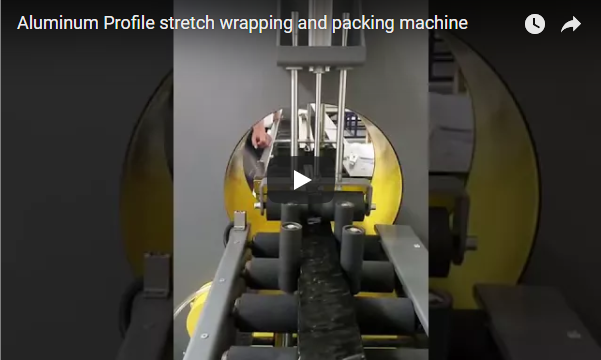
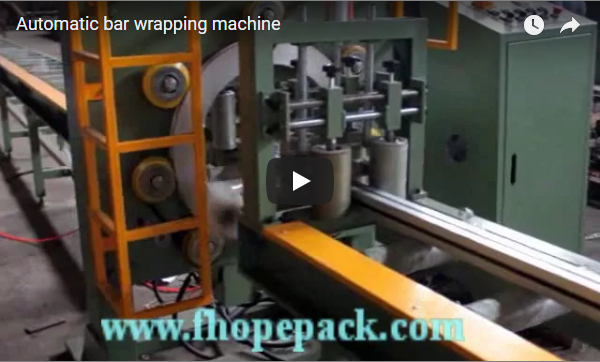
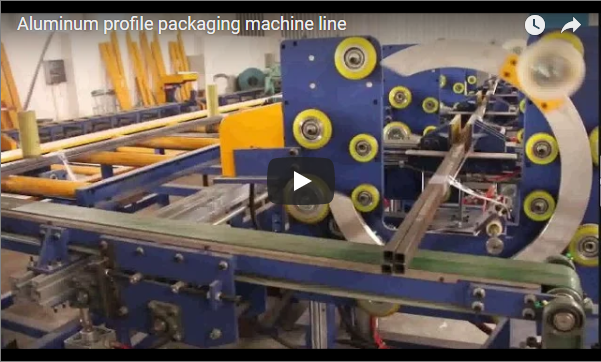
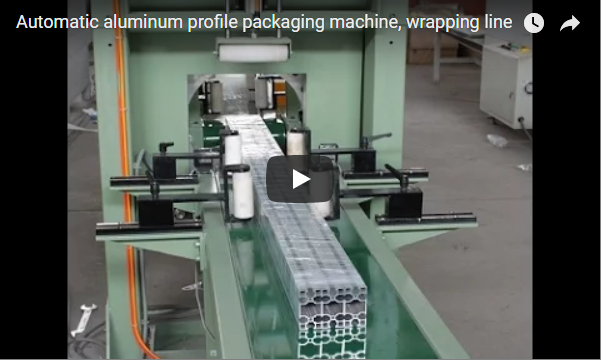
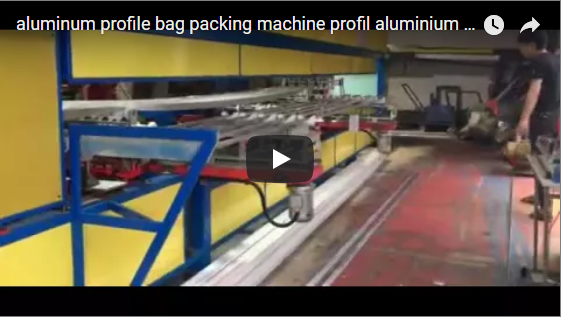
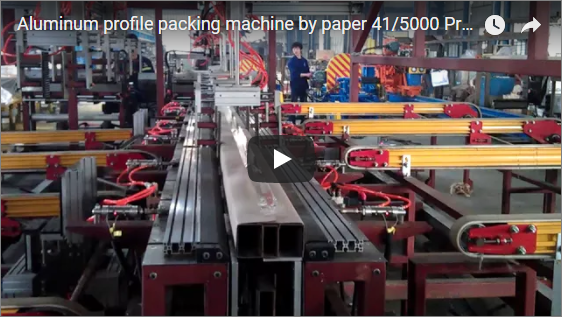
Bare aluminum profiles run along the blue roller conveyor into yellow film wrapping heads, where a white roller guides clear film onto each profile. The profiles leave shiny and covered.
Further on, the profiles are grouped and a strapping head puts green strap round the bundle. The line then moves the bundles sideways to a stack. A black barred cage encloses the line, and the panel carries a red emergency stop.
How the profile packing line works
| Station | What it does |
|---|---|
| Infeed conveyor | Carries single profiles in |
| Film wrapping heads | Wrap each profile in clear film |
| Grouping | Gathers wrapped profiles into a bundle |
| Strapping head | Bands the bundle with green strap |
| Side stacker | Moves finished bundles to a stack |
Wrapping each profile first stops extrusions rubbing against each other inside the bundle, which is where most scratches start. For single profiles only, see our aluminum profile stretch wrapping machine.
Calculating film per profile
Illustrative example for a 60 × 40 mm profile, 6 m long, with 100 mm film at half overlap:
| Item | Value |
|---|---|
| Profile perimeter, 2 × (60 + 40) | 200 mm |
| Advance per turn, half of 100 mm | 50 mm |
| Turns per metre, 1,000 ÷ 50 | 20 |
| Film per metre, 20 × 0.2 m | about 4 m |
| Film per 6 m profile, 6 × 4 m | about 24 m |
Less overlap saves film but leaves thinner cover at the edges. These are lengths laid on the profile; pre-stretch means the roll pays out less.
Bundle strap spacing
Illustrative example for a 6,000 mm bundle with 4 straps and 500 mm from each end to the first strap:
| Item | Value |
|---|---|
| Length between end straps, 6,000 − 2 × 500 | 5,000 mm |
| Gaps between 4 straps | 3 |
| Spacing, 5,000 ÷ 3 | about 1,667 mm |
Longer or thinner profiles need closer straps so the bundle does not sag when lifted. Our aluminum profile bundle tying machines show other ways to secure the bundle.
Controls and safety
The wrapping heads, strapping head and stacker move at speed inside the barred cage. Keep people outside the cage while the line runs, and use the emergency stop on the panel before reaching in.
The standards that apply depend on the destination market. For CE markets, ISO 12100 sets the risk-assessment method and EN 415-10 sets general requirements for packaging machines.
Selection checklist for an aluminum profile packing line
- Profile sizes and lengths, smallest to largest.
- Profiles per bundle and bundle shape.
- Film cover per profile, or per bundle only.
- Straps per bundle.
- Bundles per shift.
- Stacking and floor space.
Engineering FAQ
Q: Why wrap each profile before bundling? A: So profiles do not rub on each other inside the bundle, which is where most scratches start.
Q: How much film does a profile take? A: Profile perimeter times turns. About 24 m laid for a 60 × 40 mm, 6 m profile at half overlap in our example.
Q: How far apart should the straps be? A: About 1,667 mm for 4 straps on a 6,000 mm bundle with 500 mm end distances in our example.
Q: What if I reduce the film overlap? A: It saves film but leaves a thinner cover at the profile edges.
Q: Is the line guarded? A: Yes. A barred cage encloses it, with an emergency stop on the panel.
Q: What happens after strapping? A: The line moves the bundles sideways to a stack.
Next step
We plan your profile packing line in three steps:
- Submit your layout drawing with profile sizes, bundle sizes and output to info@fhopepack.com.
- Receive a proposal within 48 hours, with the film and strap plan.
- Book a site survey to check the line layout and stacking area.
Related reading
- Aluminum packing machines
- Video: automatic copper busbar packing machine
- Video: rod orbital wrapper and bar wrapping machine
- Video: full-automatic bagging machine for aluminum profile and stainless steel pipe
Sources
- Machine content: FHOPE engineering team, 2026-10-04
- Film and strap examples: our worked examples, illustrative values
- Machine in action: our video on YouTube
- Standards scope: ISO 12100:2010, EN 415-10:2014
Last reviewed: 2026-10-04