Executive summary
A door and board shrinking packaging machine wraps a flat panel in PE film, seals it, and shrinks the film tight in a hot-air tunnel. It packs wooden doors, boards and flat plates one by one on a roller line. Our door shrinking machine with motion sealer takes doors up to 1,250 × 2,500 mm and 10–90 kg, with the tunnel adjustable from 100 to 220°C. A worked example separates hot-air dwell time from total passage time.
Table of Contents
- What the machine does
- From board to shrunk pack
- Door shrinking machine data
- Worked example: time in the tunnel
- Shrink film or stretch film?
- Selection checklist
- Safety: EN 415-10 and ISO 12100
- Engineering FAQ
- Next step
- Related reading
- Sources
What the machine does
Doors, wooden boards and flat plates scratch easily and collect dust between the factory and the building site. A shrunk PE pack keeps the faces clean, holds loose parts in place and shows the product through the film.
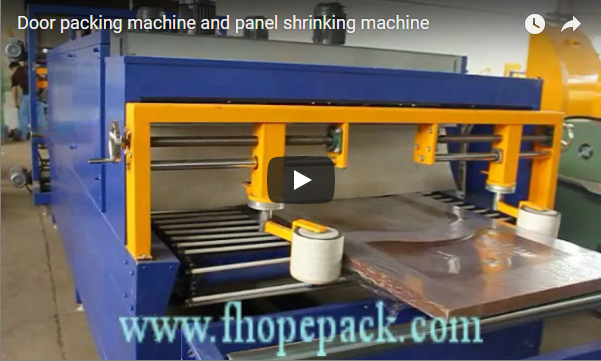
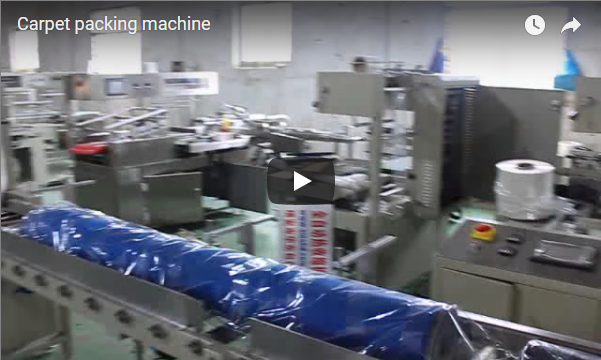
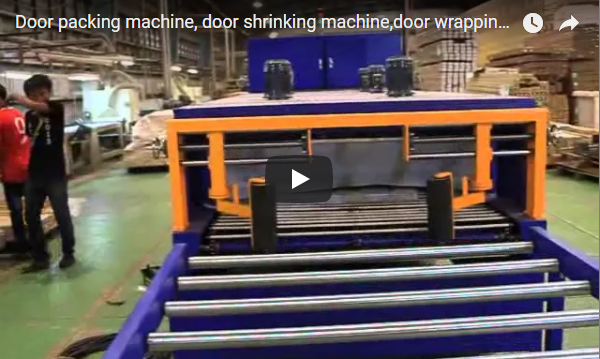
The machine has two parts: a sealing section and a shrinking tunnel. Both sit on one roller line, with an insulated tunnel housing and a control panel at the sealing section.
From board to shrunk pack
- Feed. The operator sets the board on the infeed rollers, between two adjustable side guides that centre it.
- Film. A roll above the line feeds clear PE film, which is drawn over and around the board as it moves forward.
- Seal. The board moves under the sealing frame. The frame comes down, seals the film around the board and cuts it from the roll.
- Shrink. The board runs into the roller tunnel. Hot air circulates and the film pulls tight onto the faces and edges.
- Cool and out. The pack leaves on the outfeed rollers and cools so the film stays tight.
The same line also takes thin metal plates. Feeding and sealing are the same as for a board, but the tunnel recipe differs: steel takes heat away from the film quickly, so a plate needs its own temperature and speed setting.
Door shrinking machine data
From our door shrinking machine with motion sealer, which adds two motion sealers to the long sealer so all sides close:
| Item | Value |
|---|---|
| Max. door size | width 1,250 mm, length 2,500 mm |
| Door weight | 10–90 kg |
| Sealing power | approx. 6.5 kW |
| Shrink tunnel size | L 2,600 × W 1,600 × H 1,300 mm |
| Tunnel temperature | 100–220°C, adjustable |
| Film | PE film, 30–45 µm |
| Conveyor speed | 0–12 m/min, adjustable |
| Tunnel heating power | confirmed at quote for the door range |
| Power supply | 380 V, 50 Hz, 3-phase |
The PLC sets the time of each stage, feed can run in automatic or manual mode, and a photoelectric sensor places each door for sealing. The tunnel uses insulated recirculating heating and a fast cooling section.
Worked example: time in the tunnel
Illustrative door: 2,100 × 900 × 45 mm, 35 kg, wrapped in 40 µm PE.
| Check | Calculation | Result |
|---|---|---|
| Size | 2,100 ≤ 2,500 mm; 900 ≤ 1,250 mm | fits |
| Weight | 35 kg, range 10–90 kg | fits |
| Film | 40 µm, range 30–45 µm | fits |
| Dwell of any point of the door in the tunnel, 6 m/min | 2.6 m ÷ 6 m/min × 60 | 26 s |
| Same dwell at 12 m/min | 2.6 m ÷ 12 m/min × 60 | 13 s |
| Total passage, front edge in to back edge out, 6 m/min | (2.6 + 2.1) m ÷ 6 m/min × 60 | 47 s |
Result. Each point of the film sees 26 s of hot air at 6 m/min, while the whole door takes 47 s to pass. Halving the speed doubles the dwell. Thicker film or a cold workshop needs more dwell or more heat, and thinner film or a heat-sensitive surface needs less. We set the speed and temperature together on trial packs, and fix them in the recipe once the film lies flat without burning.
For output, the rate is set by the slower of two times: the sealer cycle, t_seal, and the pitch through the tunnel, (door length + gap) ÷ conveyor speed. We measure t_seal on your doors at the factory acceptance test.
Shrink film or stretch film?
Before we quote, we ask for the largest door’s length, height, thickness and weight, and which pack the market wants. Shrink film gives a tight, clear, closed pack. Stretch film wrapping, on a horizontal ring wrapper, needs no heat and suits doors that travel in rough conditions.
Selection checklist
- Largest and smallest door or board: L × W × thickness, weight.
- Material and surface: painted, veneered, glass inserts, metal.
- Film thickness and whether a printed film is used.
- Output in doors per hour.
- Manual or automatic feed; link to the production line.
- Voltage and space for the line and tunnel.
Safety: EN 415-10 and ISO 12100
We design the machine to EN 415-10 and assess its risks to ISO 12100. The hazards are the sealing frame closing, the hot sealing wire and the hot tunnel. Guardrails keep hands away from the frame, and the tunnel housing is insulated with warning labels at the hot surfaces. The system detects faults and reports them on the panel. Who supplies the guards and the CE paperwork is settled in the contract.
Engineering FAQ
Q: Will the heat mark a painted door? A: We set temperature and speed on trial packs of your doors before the recipe is fixed.
Q: Can it pack boards and plates as well as doors? A: Yes, flat products within the size and weight range run the same way.
Q: Which film thickness? A: PE film of 30–45 µm.
Q: Which standard applies? A: EN 415-10 for the machine, with ISO 12100 for the risk assessment.
Next step
- Send door sizes, weights and output to info@fhopepack.com.
- We choose the sealer and tunnel for your range.
- We reply within 24 hours with a layout and quotation.
Related reading
- Door shrinking machine with motion sealer (product)
- Wood door protection film shrinking machine
- Automatic panel sealing and shrinking machine
- Good price door shrinking machine
- Horizontal wrapping machine for door panel
Sources
- FHOPE product page: door shrinking machine with motion sealer
- FHOPE project notes on pre-quote questions for door packing
- Our door and board shrinking machine shown above
- Worked example: illustrative figures
- Standards: EN 415-10; ISO 12100:2010
Last reviewed: 2026-10-18