Executive summary A steel coil packaging line takes coils from the slitter through strapping, labeling, eye-through wrapping and stacking to a pallet ready for dispatch. Whether the line pays back is judged on five metrics: coils per hour against the slitter, labour hours per coil, package defects and transit claims, material per coil and availability. Payback follows directly from a clear cost-benefit formula populated with your plant’s operational data.
Table of Contents
- What the machine does
- Metric 1: coils per hour against your slitter
- Metric 2: labour hours per coil
- Metric 3: package defects and transit claims
- Metric 4: material per coil
- Metric 5: availability
- Putting it together: payback
- RFQ checklist for a steel coil packaging line
- Controls and safety
- Engineering FAQ
- Next step
- Related reading
- Sources
What the machine does
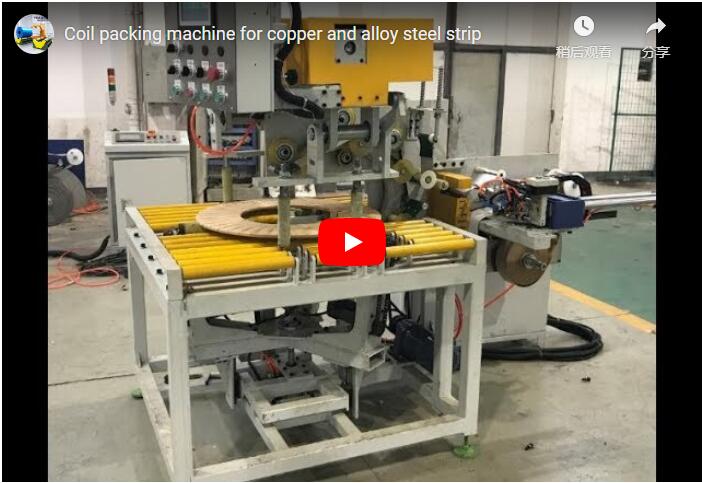
The packaging line operates as an automated, continuous sequence across dedicated engineering stations:
| Station | Function |
|---|---|
| Head stations over the infeed conveyor | Strapping heads lower onto the top face of each coil |
| Overhead arm strapping station | A second strapping position, run from its own HMI column |
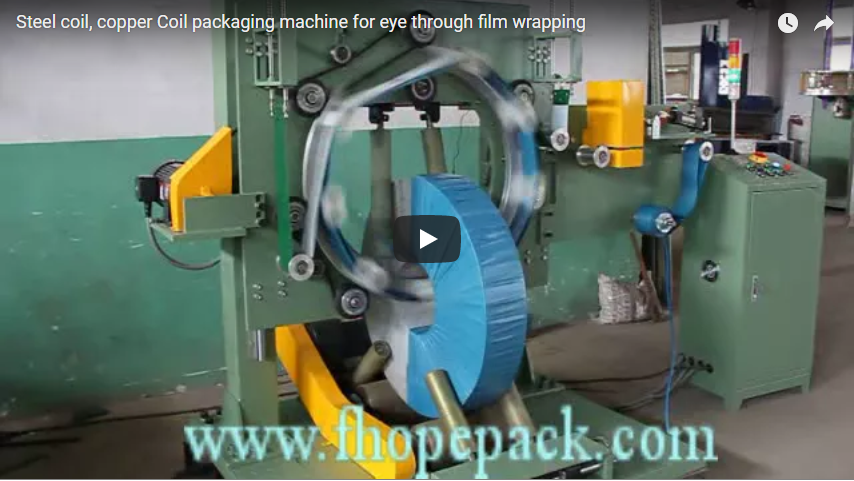
| Orbital eye-through wrapper | Rotating ring shuttles film through the coil core, applying continuous overlap along the circumference |
| Inline label applicator | Applies barcode and inventory tracking labels onto the coil OD under a rigid overhead frame |
| Gantry stacker | Lifts wrapped coils and places them on a pallet |
| Heavy-duty pallet conveyor | Powered roller conveyor transfers completed, nested coil stacks toward the warehouse pickup zone |
Each hand-over is on rollers or by gripper, so coils move between stations without manual lifting.
Metric 1: coils per hour against your slitter
The net throughput of an automated line is governed by its slowest processing station (the critical bottleneck).
Line output is calculated as:
Coils per hour = 3600 ÷ seconds per coil at bottleneck station
Compare this calculated rate directly with your slitting line output. If the packaging line is slower, coils pile up and the slitter waits; if it is much faster, you are paying for capacity you do not use.
Our technical overview of steel coil strapping and wrapping line modules illustrates how station cycle times balance across production stages. Every engineering proposal provides itemized cycle calculations for each station, identifying capacity limits prior to layout sign-off.
Metric 2: labour hours per coil
Direct labor reduction represents the most predictable operational saving on an automated coil handling line.
Total annual labor commitment is modeled as:
Labour hours per year = operators per shift × hours per shift × shifts per day × working days per year
The comparative baseline below outlines a typical service center conversion from manual pack-stations to an integrated automated line:
| Operational Parameter | Manual Packaging Line | Automated Coil Packaging Line |
|---|---|---|
| Operators per shift | 4 | 1 |
| Hours per shift | 8 | 8 |
| Shifts per day | 2 | 2 |
| Working days per year | 250 | 250 |
| Total annual labor hours | 16,000 | 4,000 |
Net labor hours per coil equal total annual labor hours divided by annual coil production volume. Plant engineering teams should apply their own shift counts and base wage metrics to calculate hard savings.
Metric 3: package defects and transit claims
Count two things for a few months before and after automation:
- Package defects at dispatch: loose film, missing straps, wrong or unreadable labels, per 1,000 coils.
- Transit claims: coils rejected for edge damage, rust or loose packs, per 1,000 coils shipped.
Repeatable strapping, programmed wrap tension and overlap, and machine stacking remove most of the variation between operators. The value of each avoided claim is your own figure; we do not put a percentage on it without your data.
Metric 4: material per coil
Strap bands and stretch film constitute ongoing variable operating costs. Determine baseline consumption by weighing stretch film rolls before and after a verified batch run, and logging strapping length consumed per coil.
On an automated line equipped with programmable tension controllers, material consumption remains consistent across all operating shifts. If it drifts, tension or overlap settings have changed. Our performance KPI report for coil strapping, labelling and stacking provides complete film-mass calculation formulas based on coil width, outer diameter, and overlap percentage.
Metric 5: availability
Line availability evaluates true operational uptime:
Availability = actual operating runtime ÷ planned production time
Operational stops must be systematically logged by category:
- Consumable replenishment (PET/steel strap coil splicing, stretch film roll changeover, label ribbon reloading)
- Interlocking faults and mechanical strap jams
- Infeed starve (waiting for slitter batch discharge)
- Waiting for forklifts or pallet clearance
The long list usually shows two or three causes. Most are layout issues, such as no buffer before the slowest station or a forklift route that crosses the stacker outfeed. We fix those at layout stage, which is why we ask for your drawing first.
Putting it together: payback
Capital investment payback is calculated as:
Payback period (months) = total line investment ÷ net monthly operational saving
Where:
Net monthly saving = (monthly labor hours saved × fully loaded hourly rate) + avoided monthly transit claims + monthly packaging material savings – monthly maintenance and utility costs
A packaging system designed to match slitter throughput on paper will fall short of its financial payback targets if unaddressed layout pinch points suppress uptime. High equipment availability remains as vital to financial return as raw nameplate cycle speed.
RFQ checklist for a steel coil packaging line
Prepare the following core operational specifications when requesting an engineered line proposal:
- Coil OD, ID, width and weight range, and slitter output per hour.
- Strapping specification: High-tensile steel or PET strap; radial through-the-eye (radial strapping machine) versus circumferential strapping; required strap count per coil.
- Wrap: stretch film, paper or woven, and the overlap you specify.
- Label content and data source (ERP, MES or manual).
- Stack height, pallet type and forklift access.
- Current staffing per shift and the stops you log today.
Controls and safety
System safety architectures must comply with destination market legislation. For CE markets, ISO 12100 sets the risk-assessment method and EN 415-10 covers general requirements for packaging machines, which fixes guarding and the emergency-stop arrangement.
The portal heads, the wrapping ring and the stacker gripper are the moving hazards. The stacker zone is fenced, and consumables are changed with the station stopped.
Engineering FAQ
Q: Which single metric exerts the largest influence on line payback? A: Direct labor hours per coil, followed by system availability. Calculate labor reduction using operators × shift hours × shifts per day × operating days, and verify runtime ratios against planned production schedules.
Q: Can operational payback be reliably modeled before capital commitment? A: Yes. Payback period in months equals total equipment investment divided by net monthly operational savings. Using your plant’s labor cost, packaging consumable budget, and transit claim history, we map individual station cycle times against slitter output to model net returns.
Q: What staffing level is required on an automated packaging line? A: Fully automated systems shift labor responsibilities from manual lifting to supervisory oversight and material restocking. Typical configurations operate with one operator per shift, provided infeed loading from the slitter turnstile and outfeed pallet removal are mechanized.
Q: How is industrial line availability precisely measured? A: Availability = running time ÷ planned production time. Log every stop with a reason (consumables, jams, waiting for coils or forklifts) to see which two or three causes dominate.
Q: Does purchasing an over-specified, high-speed line accelerate ROI? A: No. Speed above the slitter’s output is unused. Match the slowest station to the slitter and invest in availability.
Next step
Line engineering and sizing follows a structured three-stage validation:
- Submit your layout drawing along with coil dimensions, weight, slitter output rates, and current operating shift configurations to info@fhopepack.com.
- Receive a formal technical proposal within 48 hours, including station-by-station cycle simulations, layout footprint options, and utility requirements to populate your payback model.
- Book a site survey so we confirm the slitter exit, buffer positions and forklift routes.
Related reading
- Steel Coil Strapping, Labelling and Stacking Line: Four Performance KPIs
- Stainless Steel Coil Packaging Line: Tilting, Eye-Through Wrapping, Labelling and Stacking
- Slit Coil Packing Line for Service Centers
- Automatic Coil Packing Line
Sources
- Automated coil strapping, orbital eye-through wrapping, labeling, ERP integration, and gantry stacking configurations: Automatic Coil Packing Line
- Machine safety standards and compliance: EN ISO 12100:2010 (Safety of machinery — General principles for design — Risk assessment and risk reduction); EN 415-10:2014 (Safety of packaging machines — Part 10: General requirements)
- Commercial turnaround benchmark: Approved manufacturer technical proposal delivery within 48 hours
Last reviewed: 2026-10-29