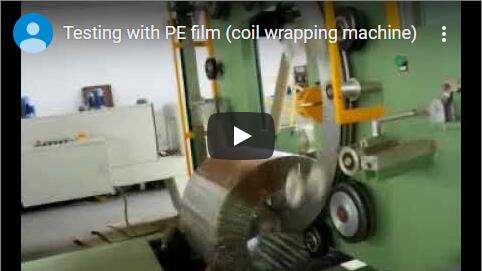
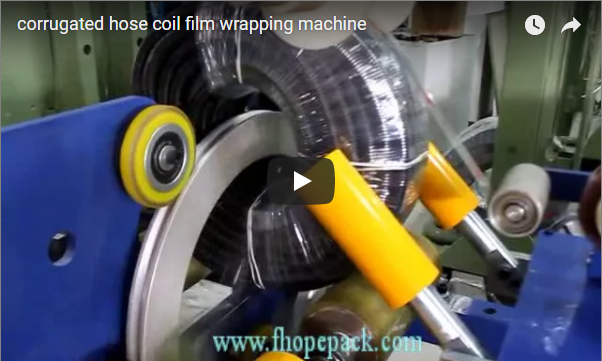
Executive summary This 117 s clip follows copper strip coils from an upender at the slitter exit through a portal station, eye-through wrapping, a weighing and stacking station and a second wrapping ring. Copper is soft, so every contact point is a damage risk. On this line family we use PU-coated contact parts and a stacking accuracy of ±2 mm, and we keep the coil flat on rollers from the upender onwards.
Table of Contents
- What the clip shows
- Where copper strip coils get damaged
- Contact parts and handling choices
- Weighing and stacking to ±2 mm
- Coil weight range and line configuration
- Selection checklist for a copper strip coil packing line
- Controls and safety
- Engineering FAQ
- Next step
- Related reading
- Sources
What the clip shows
The clip is titled “Copper Strip Coil Upending, Handling, Strapping & Packing Line” and runs 117 s. Times are read from the recording.
| Clip time | Station | What happens |
|---|---|---|
| 0–5 s | Upender | A yellow tilting arm at the slitter exit turns the coil; an operator stands outside the guard rail. |
| 15–30 s | Portal station | The coil lies flat on the green roller conveyor and stops under a white portal. |
| 35–50 s | Eye-through wrapping | A ring passes through the coil eye and covers the coil section by section. |
| 60–95 s | Weighing and stacking | A gantry places coils into stacks on the outfeed; a digital weighing display sits beside the station. |
| 105–117 s | Second wrapping ring | Another eye-through ring works on a coil further down the line (compare our two-stage copper coil wrapping line). |
From the upender onwards the coil travels flat, face up, on rollers. Nobody touches a coil during the sequence.
Where copper strip coils get damaged
Copper strip is soft and its surface shows marks easily. On a packing line, damage comes from a few predictable places:
- Edges during upending. If the coil drops onto its edge or slides in the cradle, the outer laps dent. Telescoped laps follow if the coil is not supported across its width.
- Faces on conveyors. Hard rollers or a coil dragged across a stop leave lines on the bottom face.
- Bore and outer laps during wrapping. The wrapping ring must clear the bore without rubbing it.
- Stacking. A coil set down off-centre loads one edge of the coil below.
- Transit. Moisture and dust reach the strip through gaps in the wrap.
The line is designed to remove the hand steps where most of these happen: no lifting by crane hook, no pushing coils by hand, no manual stacking.
Contact parts and handling choices
Our copper strip line family uses PU (polyurethane) coated contact parts. PU is softer than the copper surface it touches, so a coil can roll and stop without picking up marks from steel.
Three handling choices matter as much as the coating:
- Tilt in a cradle, not on a corner. The upender and down-ender carry the coil across its full width while it turns.
- Keep the coil flat after upending. In the clip the coil stays face up from the upender to the stacker. Fewer orientation changes mean fewer contact events.
- Wrap eye-through, not over a fixed mandrel. Eye-through wrapping covers the bore, faces and OD while the coil turns on rollers, so nothing slides through the bore.
Wrap material is chosen per order: PE, stretch film or paper. For export by sea, film or paper plus film gives a sealed pack against moisture.
Weighing and stacking to ±2 mm
The stacking section in the clip is the longest scene, from 60 s to 95 s. A gantry lifts each wrapped coil and lowers it onto the stack, with a weighing display beside the station.
Our product page for this line family gives a stacking accuracy of ±2 mm. That figure matters for copper: a coil set within ±2 mm of the stack axis bears evenly on the coil below, instead of on one edge.
Weighing at this point gives each coil a net weight before it disappears into a stack. The weight can go onto the coil label or into your ERP record. An automatic timber runner dispenser is an option on this line family, so skids or runners are placed without manual work.
Coil weight range and line configuration
Our copper coil packaging line page lists two capacity bands:
| Configuration | Coil weight |
|---|---|
| Basic line | 20–1,500 kg |
| Standard fully automatic line | 100–4,000 kg |
The control is a Siemens PLC with an HMI and Auto/Manual modes. Stations are configured per project: tilter and down-ender, strapping, eye-through wrapping, weighing, stacking and pallet wrapping can be combined in different orders. Like all our lines it is built to your coil range, so motor sizes and frame weights vary from one project to the next.
Selection checklist for a copper strip coil packing line
- Coil OD, ID, width and weight range, lightest and heaviest.
- Strip thickness and surface grade, and which faces must stay mark-free.
- How coils leave the slitter: eye horizontal or eye vertical.
- Wrap material: PE, stretch film or paper, and the overlap you specify.
- Strapping: PET or steel strap, through-the-eye or circumferential.
- Weighing and labelling: data you need on each coil and the ERP link.
- Stack height, skid or runner type, and forklift access.
Controls and safety
The standards that apply depend on the destination market. For CE markets, ISO 12100 sets the risk-assessment method and EN 415-10 covers general requirements for packaging machines, which fixes guarding and the emergency-stop arrangement.
The upender arm, the wrapping rings and the stacking gantry are the moving hazards. In the clip the operator stays behind the guard rail; consumable changes are done with the station stopped.
Engineering FAQ
Q: How do you stop roller marks on copper strip coils? A: PU-coated contact parts and a coil that rolls instead of sliding. We also cut the number of orientation changes: in the clip the coil stays flat from the upender to the stacker.
Q: What stacking accuracy do you design for? A: ±2 mm on this line family, so each coil bears evenly on the coil below.
Q: What coil weights can the line handle? A: 20–1,500 kg on the basic configuration and 100–4,000 kg on the standard fully automatic line. We confirm it against your heaviest coil.
Q: Paper or film for copper coils? A: Choose film for a moisture-tight seal, paper for a cushion layer, or both together for long sea transport and storage. The route and storage time decide.
Q: What controls the line? A: A Siemens PLC with an HMI, in Auto or Manual mode. Coil programs, weighing data and stacking positions run from the same control.
Next step
We size a copper strip coil packing line in three steps:
- Submit your layout drawing with the coil OD, ID, width, weight range, wrap material and output target, to info@fhopepack.com.
- Receive a proposal within 48 hours, including the upender, wrapping, weighing and stacking stations and the contact materials.
- Book a site survey so we confirm the slitter exit, the line direction and forklift access to the stacks.
Related reading
- Automatic Copper Strip Coil Packing Line with Labeling, Wrapping and Stacking
- Copper Strip Coil Packing Line: Handling, Wrapping and Stacking
- Eliminating Edge Damage on Steel Coils: Handling, Wrapping and Strapping Line
- Copper coil packaging line
Sources
- Station sequence and clip times: the video on YouTube (117 s; @Fhopepack)
- Capacity bands, PU-coated contact parts, ±2 mm stacking, Siemens PLC and HMI, timber runner dispenser, wrap materials: Copper coil packaging line
- Standards scope: ISO 12100:2010; EN 415-10:2014
- Proposal timing: approved house CTA (proposal within 48 hours)
Last reviewed: 2026-10-06