Executive summary
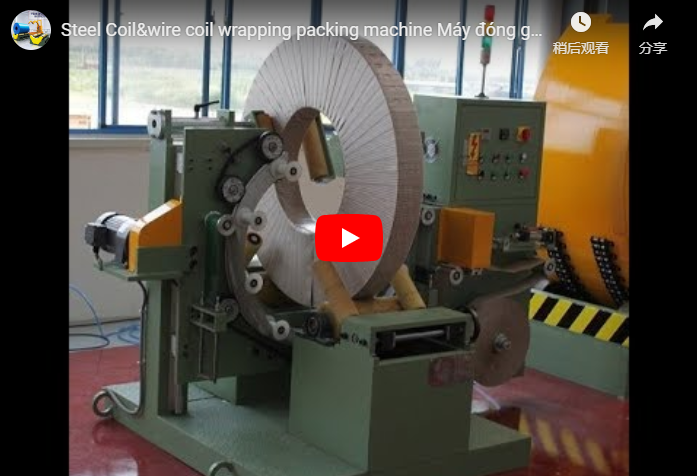
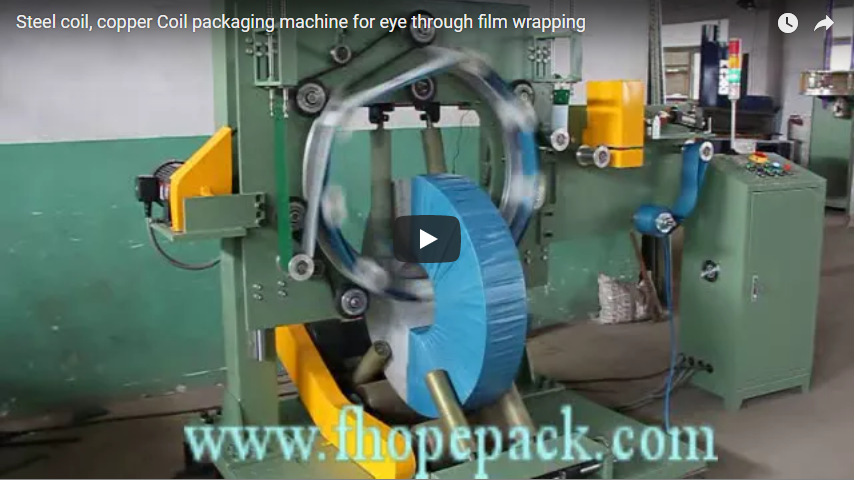
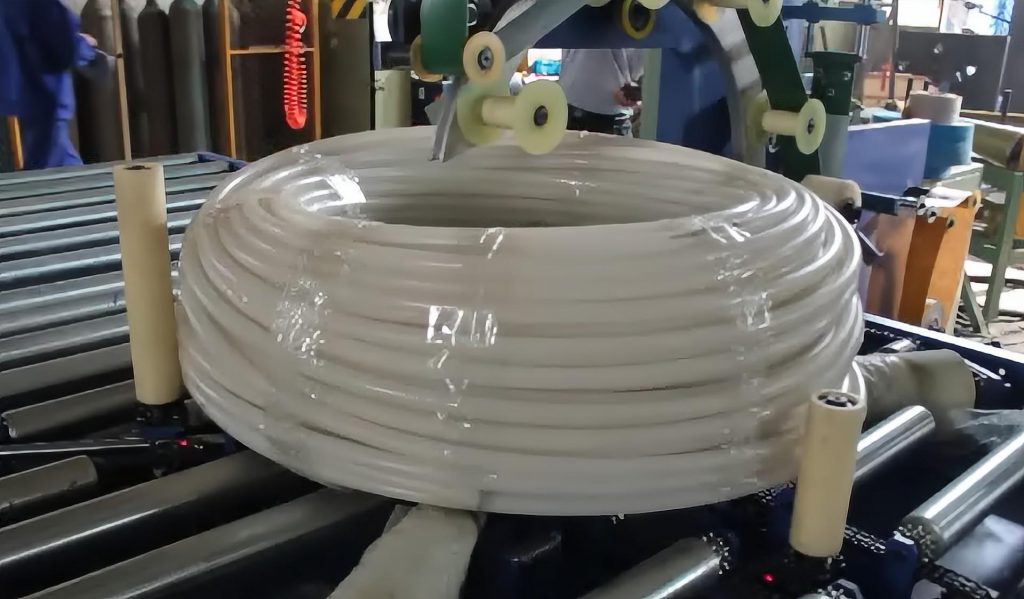
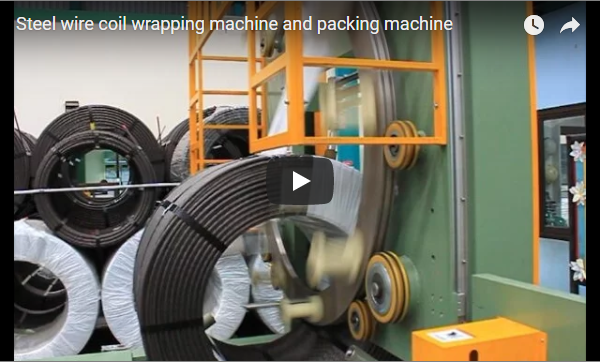
A wire coil has to be wrapped through its eye, so the film must pass inside the coil ID and around the outside. Our wire coil wrapping machine does this with a ring that orbits through the eye while rollers turn the coil. The wrapping station sits on a moving base, so it opens to take the coil and closes around it.
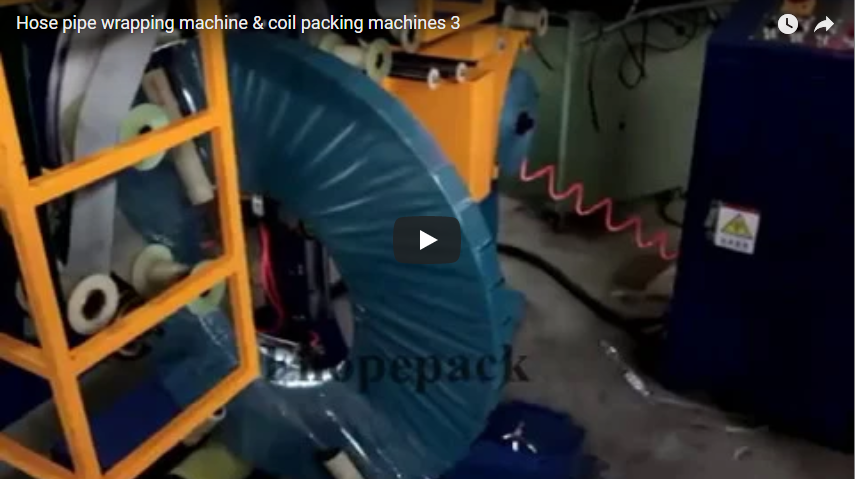
The coil stands upright in a roller cradle on a green base, and the ring head works inside a yellow mesh guard. Blue film builds up around the coil section turn by turn until the whole coil is covered. The operator runs the cycle from a separate control desk with a touch screen and a warning light.
Table of Contents
- Why wire coils are wrapped through the eye
- What the moving station does
- Machine sequence
- Machine data
- Overlap and cycle time
- Selection checklist
- Safety
- Engineering FAQ
- Next step
- Related reading
- Sources
Why wire coils are wrapped through the eye
A film wrapped only around the outside of a coil leaves the inner turns and both faces open to moisture and dust. Wrapping through the eye covers the whole cross-section, so the coil is sealed on all sides. It also ties the turns together, which keeps loose wire ends from catching in handling.
What the moving station does
The ring must pass through the coil eye, so it has to open or move aside while the coil is loaded. On this machine the ring head is built on a moving base. It retracts away from the cradle, so a crane or forklift can set the coil without hitting the ring. After loading, the station moves forward, the ring passes through the eye and wrapping starts.
Machine sequence
- The coil is set upright in the roller cradle.
- The wrapping station moves forward and the ring passes through the coil eye.
- The film end is held and the ring starts to orbit.
- The cradle rollers turn the coil slowly so each wrap overlaps the last.
- After one full coil turn the film is cut and the tail is pressed down.
- The station retracts and the wrapped coil is lifted away.
Machine data
| Item | FPW-300 wire coil wrapping machine |
|---|---|
| Coil ID | 508–610 mm |
| Coil OD | 600–1,200 mm |
| Coil width | 100–300 mm |
| Coil weight | 20–1,000 kg |
| Power | 1.5 kW |
| Air supply | 4–6 bar |
The FPW-300 and our FPS-300 strip coil wrapper are the same machine with the same data, set up for wire or strip and fine-tuned to your coil size. Ring speed, film width and the moving base stroke are confirmed at quote.
Overlap and cycle time
Film advance per ring turn = film width × (1 − overlap)
Ring turns per coil ≈ π × coil OD ÷ film advance
Example only: 100 mm film at 50% overlap advances 50 mm per ring turn. A 1,000 mm OD coil has an outer circumference of about π × 1,000 ≈ 3,142 mm, so the ring makes about 3,142 ÷ 50 ≈ 63 turns. The inner side of the coil gets a much higher overlap, because the eye circumference is smaller than the outside.
Wrapping time (min) = ring turns ÷ ring speed (r/min)
Total cycle time adds the station travel in and out, film clamping and cutting, and the start and stop of the coil rollers. Ring speed and roller speed are both set by frequency inverter, so the overlap can be changed without changing parts. The ring speed range and the base stroke for your coil are confirmed at quote.
Selection checklist
- Coil ID, OD, width and weight.
- Wire material: steel, copper or aluminium.
- Film, woven tape or paper, and how many layers.
- Loading method: crane, forklift or conveyor.
- Coils per hour you need.
- Whether a coil compactor or strapping machine comes before the wrapping station.
Safety
We design to EN ISO 12100:2010 for risk assessment, EN 415-10 for packaging machine safety and EN 60204-1 for the electrical equipment. The ring head sits inside a mesh guard, and the warning light shows when the ring is running.
Engineering FAQ
Q: Can it wrap copper and aluminium wire coils as well as steel? A: Yes. Inside the coil size and weight range, the material does not change the machine. Film tension is set by a brake device on the dispenser, so soft wire can be wrapped at lower tension. The supporting and protective rollers are covered with polyurethane to protect the coil surface.
Q: Can I wrap two materials in one cycle? A: A second dispenser can lay paper or VCI film first and stretch film over it. This is confirmed at quote.
Q: Why does the coil turn and not the ring travel around it? A: Turning the coil on rollers keeps the ring in one place, so the guard stays small and the coil stays in the cradle during wrapping.
Next step
- Send your coil ID, OD, width, weight and coils per hour to info@fhopepack.com.
- We set the ring size, film and loading layout.
- We reply within 24 hours with a proposal and quotation.
Related reading
- Wire coil wrapping machine FPW-300 (product)
- Steel coil wrapping machine FPS-300 (product)
- Wire wrapping machine for steel wire or copper wire
Sources
- FHOPE product pages: FPW-300, FPS-300
- EN ISO 12100:2010; EN 415-10; EN 60204-1
Last reviewed: 2026-10-20