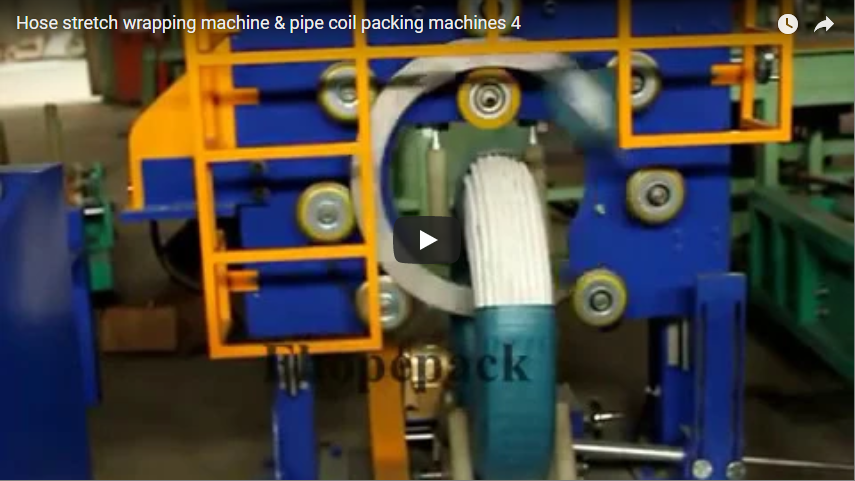
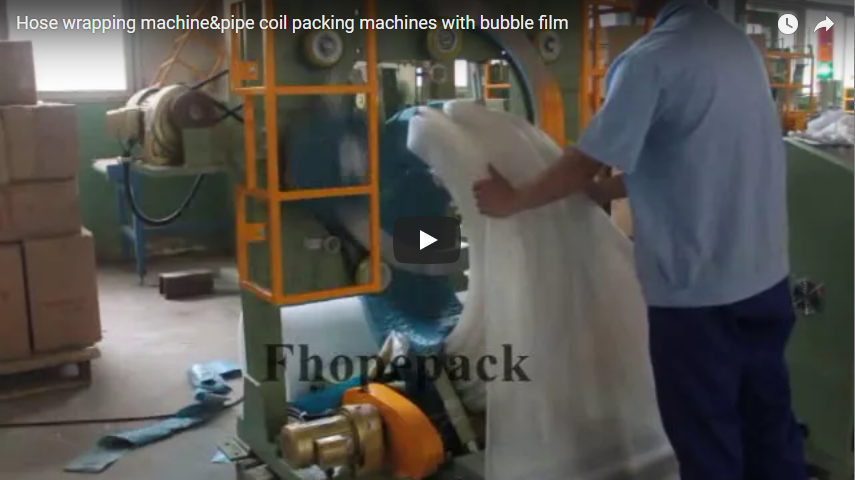
Executive summary This video shows a PET wrapping machine in operation at a factory: an operator loads a workpiece onto a rotating platform, the machine wraps it with strap/film, and the finished, fully wrapped piece is removed. The footage covers the full load–wrap–unload sequence, the machine’s structure (yellow safety fencing, blue base, top-mounted material roll, control buttons), and two different workpiece examples. No capacity, cycle-time, model, or power data is shown — those points must be confirmed with the manufacturer.
Why this video matters for buyers
If you are evaluating a PET wrapping machine, a product video is one of the most honest sources of information available. Brochures list specifications; a video shows you how the machine actually behaves in a real workshop — how an operator interacts with it, how the wrapping motion looks, and what the finished package actually feels like in terms of coverage and consistency.
This footage is especially useful because it shows two different workpieces being processed on the same type of machine: a stack of folded cardboard strips, and a large ring-shaped part that appears to be a coil or similar circular product. Seeing the machine handle both gives you a better sense of its flexibility than a single-product demo would.
The article below walks through what the video shows, what it deliberately does not show, and the questions you should ask before making a purchase decision.
The machine in action: what the video shows
The video runs for roughly one minute and follows a complete wrapping cycle. Here is the sequence, based on frame-by-frame analysis:
Loading (0–4 seconds)
The video opens on a factory floor. A roll of green PET strapping and a stack of folded cardboard strips sit beside the machine. An operator wearing white gloves approaches and begins feeding material into the machine’s inlet. The machine’s yellow safety fencing, blue base, and a top-mounted roll of clear tape/film are clearly visible from the start.
The operator then places the workpiece — first the stack of cardboard strips, in one sequence a large ring-shaped part — onto the machine’s rotating platform. The safety fence is closed before the machine runs.
Wrapping (4–36 seconds)
The rotary table begins turning, and the wrapping head at the top of the machine draws material from the roll above. The material is applied in a spiral pattern around the workpiece as the table rotates. During this phase:
- The operator steadies the workpiece with their hands to keep it centered and stable.
- The wrapping motion and table rotation stay synchronized, so the coverage is even.
- The cardboard strips are gradually formed into a tidy cylindrical bundle; the ring-shaped part is covered with a uniform protective layer.
- The yellow guarding frame and blue base remain stable throughout, with no visible vibration issues.
Unloading (36–56 seconds)
Once the final wrap is complete, the wrapping mechanism stops. The operator’s hands move away, the machine comes to rest, and the fully wrapped workpiece is removed from the platform and set down. The machine then sits idle, ready for the next cycle.
Machine structure at a glance
The video gives a clear view of the machine’s physical layout. Here is what can be observed:
| Component | Observed detail | Apparent function |
|---|---|---|
| Frame | Blue painted metal base and support structure | Carries the rotating platform and wrapping head |
| Safety fencing | Yellow metal mesh guard around the rotating section | Prevents contact with moving parts during operation |
| Rotating platform | Positioned at the center of the machine | Holds and turns the workpiece for even wrapping |
| Wrapping head | Top-mounted, with a white/clear material roll above | Applies strap/film in a spiral over the workpiece |
| Control panel | On the right side; one red button and one green button, no visible text | Presumably start and stop functions (confirm with manufacturer) |
| Warning sign | Yellow triangular sign with a black exclamation mark on the fence | General caution marking; text unreadable in footage |
| Branding | “FHOPEGROUP — PACKING SOLUTION FOR YOU” watermark/lettering visible | Manufacturer marking |
The machine is a vertical, floor-standing unit: rotary table at the bottom, wrapping mechanism at the top, guarding surrounding the rotating area. The operator works from one side.
Direct observation notes
The following is a plain, factual description kept close to the source analysis, with only grammar-level editing. It is included so you can verify exactly what the footage supports.
- The video starts on a factory floor showing a roll of green PET strapping and a row of folded cardboard strips, with an operator standing beside a large machine.
- The operator feeds the strapping end into the machine’s inlet, then places the folded cardboard strips onto the rotating table.
- The table starts turning while clear tape is drawn from the roll at the top of the machine.
- A wrapping mechanism applies the clear tape in a spiral around the strips; the operator’s hands assist in holding the workpiece steady so it is wrapped evenly.
- Wrap rotation and tape feed remain synchronized; the yellow frame and blue base stay stable.
- Near the end, wrapping completes, the mechanism stops, and the operator prepares to remove the finished piece.
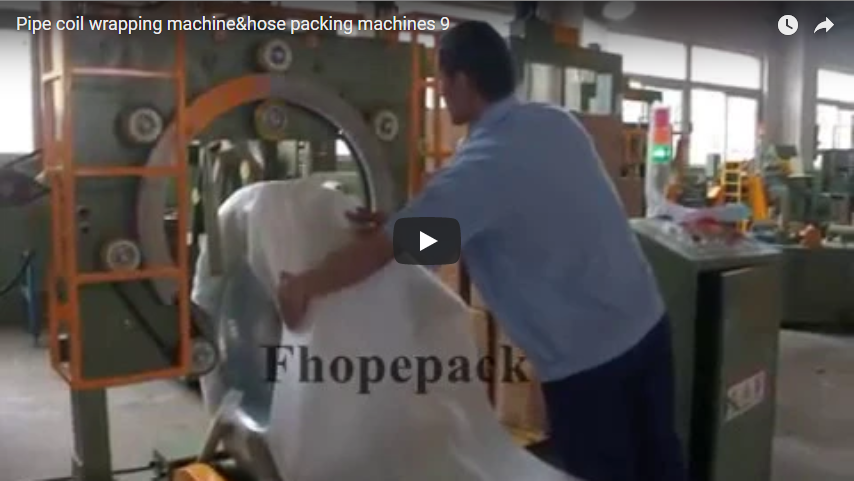
- In a second sequence, the operator places a large ring-shaped workpiece (possibly a coil, such as for a transformer or motor) onto the rotating platform; the film wraps it uniformly, and the wrapped part is removed and placed on the floor.
- Control panel: one red and one green round button on the right side of the machine; no text on the buttons.
- No emergency-stop button, light curtain, or interlock was observable in the footage. A yellow triangular warning sign with a black exclamation mark is present on the fence.
- Not observable anywhere in the video: rated capacity, machine dimensions, cycle time, model number, power rating, or any certification marks.
What the video does not show
Knowing the gaps is just as important as knowing what is visible. The footage does not provide:
- Rated capacity or throughput — no packs-per-hour or similar figure is shown.
- Cycle time — the video is edited, so real elapsed time per wrap cannot be measured from it.
- Machine dimensions and weight — important for floor planning and installation.
- Power requirements — voltage, phase, and consumption are not stated.
- Model designation — the specific model name is not shown.
- Certifications — no safety or quality certification marks are visible.
- Strapping/film specifications — the width, thickness, and material grade of the PET strap and wrapping film are not stated.
- Emergency stop or interlock details — although these are common on such machines, nothing is visible in this footage; confirm the actual safety configuration with the manufacturer.
Treat this list as your first checklist when you contact a supplier.
Where a PET wrapping machine fits
Based on the workpieces shown, this type of rotary-table wrapping machine suits elongated or ring-shaped products that need to be bundled or protected for storage and shipping. Typical candidates (inferred, not stated in the video) include:
- Cardboard strips and profiles — bundled into stable cylindrical packages as shown in the first sequence.
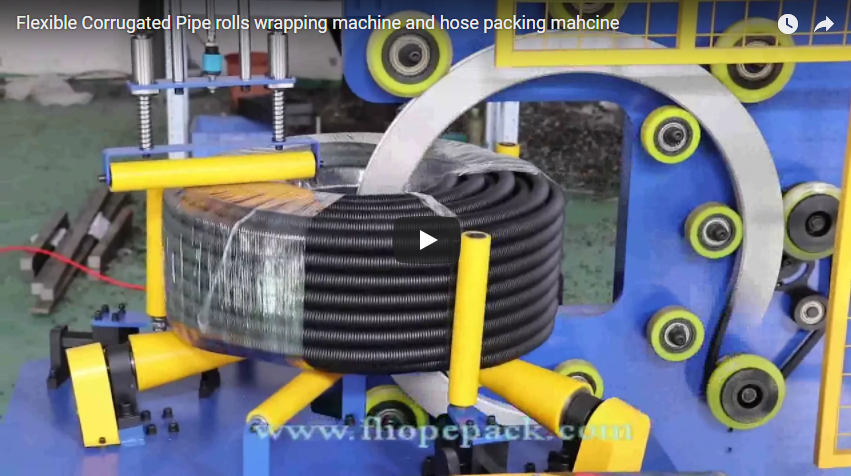
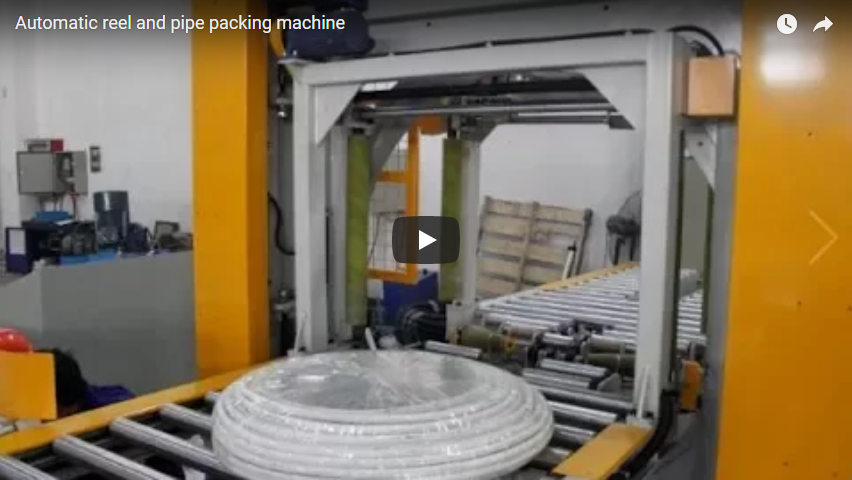
- Coils and ring-shaped parts — such as wire, cable, hose, or electrical coils, as suggested by the second sequence.
- Long extrusions, tubes, and bars — items that are awkward to handle loose and benefit from being consolidated.
The key benefit visible in the footage is consistency: the spiral wrap covers the product evenly every cycle, and the operator’s role is limited to loading, steadying, and unloading. Compared with manual wrapping with stretch film or tape by hand, a rotary machine typically delivers more uniform tension and coverage with less operator effort — though the exact gain depends on your current process and should be evaluated case by case.
The main limitation is also visible: the rotary-table format works best with products that can sit on the table and rotate. Highly irregular or very heavy items may need a different machine configuration.
Safety observations for operators
The footage supports a few practical safety points:
- Keep hands clear of rotating parts while the table turns. The operator in the video steadies the workpiece early in the cycle, then reduces hand contact as the wrap proceeds — a sensible pattern.
- Keep the yellow mesh fence closed during operation. It exists to prevent contact with the rotating section.
- Heed the warning sign on the fence; its text is unreadable in the video, so ask the manufacturer what it specifies.
- Note that the footage shows no visible emergency-stop button, light curtain, or interlock. This does not mean the machine lacks them — the camera angles simply do not confirm. Make the full safety configuration an explicit item when you request a quotation.
Questions to verify with the manufacturer
Before committing to a purchase, confirm the following:
- Workpiece size range — minimum and maximum diameter, height, and weight the table can accept.
- Compatible wrapping materials — which PET strap widths, and whether stretch film or other materials are supported.
- Real cycle time for a product like yours, not a generic figure.
- Power supply requirements and installation footprint.
- Safety configuration — emergency stop, interlocks, and compliance with your local standards.
- After-sales support — spare parts availability, commissioning, and operator training.
FAQ
Q1: What products was the machine shown wrapping? Two: a stack of folded cardboard strips, which was wrapped into a cylindrical bundle, and a large ring-shaped part resembling a coil. Both were wrapped on the same rotating-platform machine.
Q2: Does the operator need to hold the product during wrapping? In the video, the operator steadies the workpiece with their hands at the start of the cycle and reduces hand contact as wrapping proceeds. Whether a holding fixture or automatic centering is available for your product is worth confirming with the manufacturer.
Q3: What safety features does the machine have? The video clearly shows a yellow metal mesh safety fence and a triangular warning sign. No emergency stop, light curtain, or interlock was observable in the footage — check the full safety specification with the manufacturer.
Q4: How fast does it wrap? The video does not show rated capacity or an accurate cycle time (the footage is edited). Request a measured cycle time for a workpiece similar to yours.
Q5: What materials does it use? Green PET strapping and clear tape/film are visible. The exact widths, thicknesses, and material grades are not stated — verify compatibility with the consumables you plan to use.
Q6: What are the machine’s dimensions and power requirements? Not shown in the video. Ask the manufacturer for the dimensioned drawing and electrical specification before planning your installation.
Related reading
Explore other packaging machines and systems from the same manufacturer:
- Hose packaging machine — for coiled hose and tube products.
- Coil packing machine — wrapping solutions for metal coils.
- Automatic coil packing line — full-line automation for coil handling and packing.
- Steel coil wrapping machine — heavy-duty wrapping for steel coils.
- Wire coil wrapping machine — for wire and cable coil packaging.
Next step
The best way to judge whether this machine suits your products is to see it running on workpieces like yours — or to send the manufacturer your product dimensions and photos for a recommendation. Contact the FHOPE team to discuss your application, request specifications not shown in the video, and arrange a demonstration.
Source and method: This article is based solely on the product video above (background music only; no narration or speech track). Analysis was performed by a vision-language model on sampled frames, and all factual statements are drawn from what is visible in the footage. Statements marked as inferred are clearly labeled, and anything not observable in the video should be verified with the manufacturer.