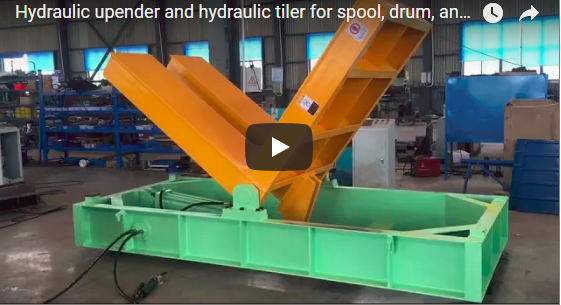
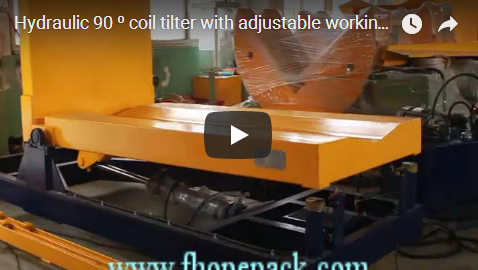
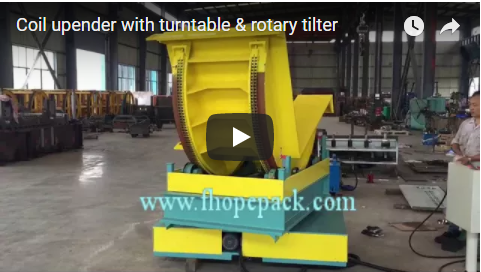
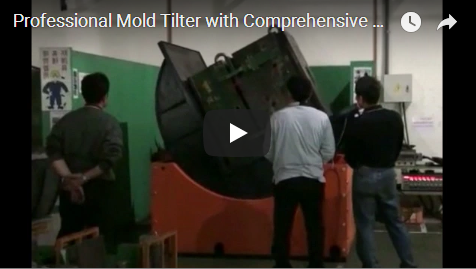
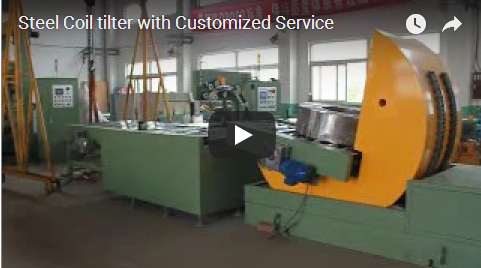
Executive summary This clip shows a two-leaf sheet flipper in a fabrication shop. The operator places a steel plate on one leaf, both leaves rise to vertical so the plate passes from one leaf to the other, and the second leaf lowers it with the other face up. No crane, chains or hooks touch the plate. The footage was shared with us; our equivalent solution turns sheets and plates the same way, with the leaves sized to your largest sheet.
Table of Contents
- What the clip shows
- What crane flipping costs
- Time per flip
- What we set per shop
- Selection checklist
- Safety
- Engineering FAQ
- Next step
- Related reading
- Sources
What the clip shows
| Step | What you see |
|---|---|
| Loading | An operator places a steel plate on the left leaf of the flipper |
| Lifting | Both leaves rise towards vertical on their hydraulic arms |
| Transfer | At vertical the plate leans from the first leaf onto the second |
| Lowering | The second leaf lowers the plate, now with its other face up |
| Reset | The plate is unloaded, then the leaves return to the loading position |
What crane flipping costs
- Crane time. Each crane flip ties up the crane and a slinger for several minutes.
- Risk. A plate turned on chains can swing or drop as it passes its balance point.
- Marks. Hooks and chains can scratch or bend sheet edges.
- Waiting. Other jobs wait while the crane flips plates.
A flipper keeps the plate supported on a leaf the whole time, so the turn is controlled.
Time per flip
Worked example (illustrative).
| Item | Value |
|---|---|
| Crane flip with slinger (illustrative) | 6 min |
| Flipper cycle (illustrative) | 1 min |
| Time saved per flip, 6 − 1 | 5 min |
| Flips per shift (illustrative) | 24 |
| Crane time freed per shift, 24 × 5 | 120 min, 2 hours |
What we set per shop
| Setting | Depends on |
|---|---|
| Leaf size | Largest sheet length and width |
| Capacity | Heaviest sheet or plate |
| Leaf surface | Plain steel, or pads for finished sheet |
| Control | Hold-to-run or two-hand control at the operator station |
Selection checklist
- Largest and smallest sheet size.
- Sheet or plate weight.
- Surfaces that must not be marked.
- Flips per shift.
- Floor space and loading side.
- Crane or forklift loading.
Safety
- Keep clear of the leaves while they move; use the two-hand or hold-to-run control.
- Never stand between the leaves.
- Lock out the hydraulic unit before maintenance.
- For CE markets, the machine is designed to ISO 12100 and EN 415-10.
Engineering FAQ
Q: What does a sheet flipper do? A: It turns a sheet or plate face-down between two hydraulic leaves, without a crane.
Q: Why not flip with the crane? A: Crane flipping ties up the crane and a slinger, and the plate can swing as it passes its balance point.
Q: How much time does it save? A: About 5 minutes per flip in the worked example, or 2 hours of crane time per shift at 24 flips.
Q: Will it mark finished sheet? A: We fit pads to the leaves where the surface must stay clean.
Q: Can you build this configuration? A: Yes. We build equivalent sheet flippers sized to your sheets and shop layout.
Q: Which standards apply? A: For CE markets, ISO 12100 and EN 415-10.
Next step
We match a sheet flipper in three steps:
- Submit your layout drawing with sheet sizes, weights and flips per shift, to info@fhopepack.com.
- Receive a proposal within 48 hours with the machine data and layout.
- Book a site survey so we confirm the loading side and floor space.
Related reading
- Steel Sheet Upender for 180 Degree Safety Turning
- Big Frame Flipper for 180 Degree Turning
- 180 Degree Turning Machine for Glass, Sheet, Board and Panels
- Steel sheet flipper and upender machine
Sources
- Machine content: FHOPE engineering team, 2026-10-10
- Clip: the video on YouTube
- Time per flip: our worked example, illustrative values
- Standards scope: ISO 12100:2010; EN 415-10:2014
- Proposal timing: approved house CTA (proposal within 48 hours)
Last reviewed: 2026-10-10