Executive summary
Steel coil wrapping and packing on an automatic line holds each coil in a rotating clamp arm, applies film or band around the full circumference, and presses the layer tight before it moves on. A rail cart or track brings the coil into the station, and a robotic arm transfers each packed coil to the next step. Coil size and line layout are confirmed per project.
Table of Contents
- Why wrap and pack steel coils
- What the line does
- Clamp arm and material supply
- Wrapping and pressing cycle
- What the footage shows
- Typical configuration
- Selection checklist
- Operation and safety
- Engineering FAQ
- Next step
- Related reading
- Sources and standards
Why wrap and pack steel coils
Steel coils are heavy and their edges are easy to damage, so a clean, tight wrap keeps the surface protected from dust, moisture and scuffs during storage and transport.
Automatic wrapping gives the same overlap on every coil, which makes the packed coils consistent and easier to load. Coil size and film choice are confirmed per project.
What the line does
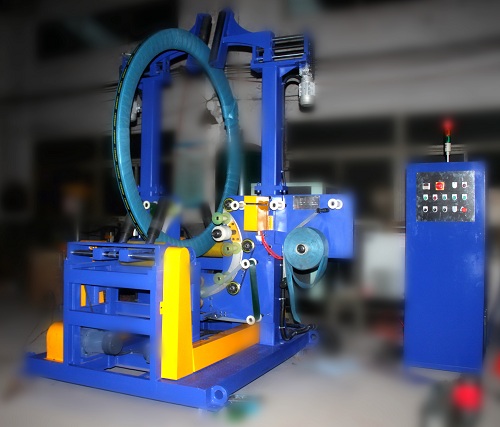
The line is a set of automatic stations built around the coil. A rail cart or roller track brings the coil to the wrapping station, a rotating clamp arm holds it in place, and film or band is applied around the full circumference.
An axial press tightens the finished layer, and a robotic arm lifts the packed coil to the next station. Line length and station order are confirmed per project.
Clamp arm and material supply
The clamp arm and its support are the heart of the wrapping station. They grip the coil on its axis while the coil rotates for even coverage.
On the supply side, a roll feeds film or band through guide rollers into the wrapping path, with tension kept steady during the wrap. Material width and tension are confirmed per project.
Wrapping and pressing cycle
The cycle starts when the coil is fixed in the clamp arm. The coil turns slowly while film or band winds around the circumference, layer by layer, until the coil is covered.
After the last layer, the press tightens the wrap and the clamp releases the coil. Wrap layers and press travel are confirmed per project.
What the footage shows
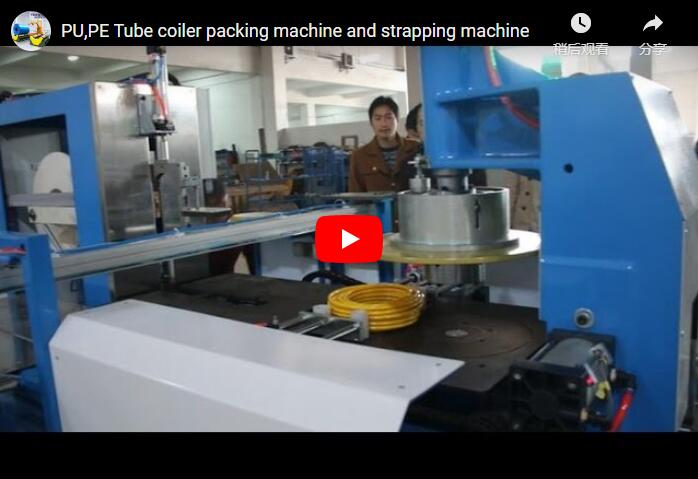
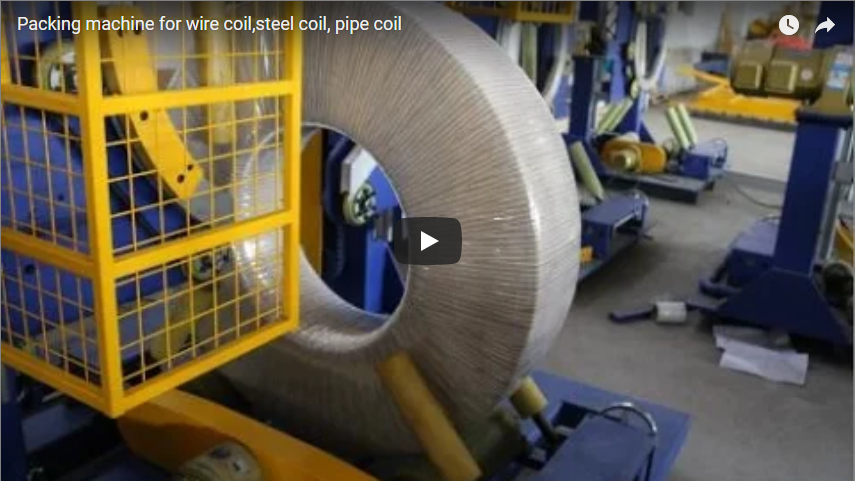
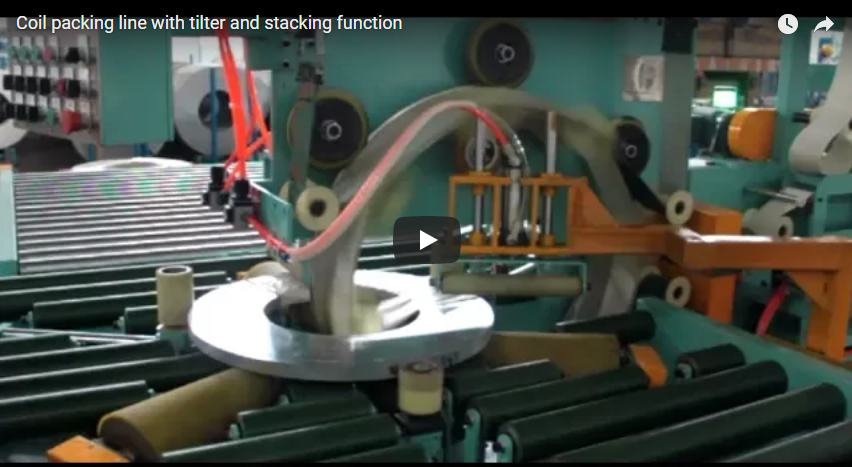
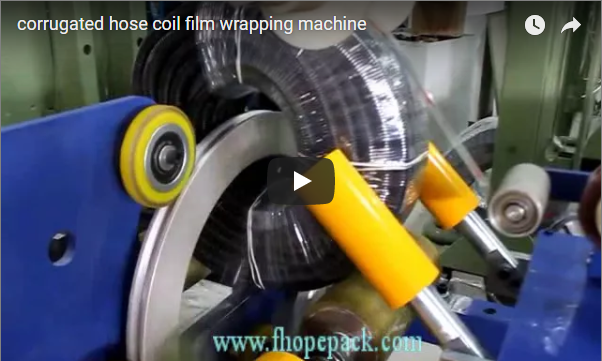
Our footage shows an automatic coil packing line with a rotating clamp arm holding a steel coil while film or band winds around it, framed by perimeter guarding. A robotic arm then lifts a coil clear of the track and moves it toward the next station. It is a general demonstration, so your coil size, film and line layout are confirmed with us per project.
Typical configuration
Figures below list functional design boundaries rather than numeric values, and are confirmed per project.
| Parameter | Typical range, confirmed per project |
|---|---|
| Feed | steel coil delivered on a rail cart or roller track |
| Coil | coil outer diameter and width in mm, confirmed per project |
| Wrap | rotating clamp arm applies film or band around the coil |
| Film | stretch film or VCI rust-protection paper, selected per project |
| Press | axial press tightens the finished layer |
| Transfer | robotic arm moves the packed coil to the next station |
| Guard | perimeter fencing around the wrapping area |
| Electrical supply | 380 V three phase 50 Hz, or 220 V single phase for light machines, selected per project |
Selection checklist
| Question | Confirm per project |
|---|---|
| Line layout | stations needed for wrapping, pressing and transfer |
| Coil range | outer and inner diameter and width per coil family |
| Film | stretch film for short, clean trips or VCI rust paper for long transport |
| Straps | 1 to 3 straps per coil, chosen from coil width, diameter and stability |
| Transfer | robotic arm or rail cart, matched to the existing line |
| Electrical supply | voltage, phase and frequency on site |
Operation and safety
Bring the coil to the station on the cart or track, let the clamp arm hold it, and start the wrapping and pressing cycle. Keep clear of the clamp arm, the rotating coil and the robotic arm path while the line runs.
Routine checks cover the clamp pads, the material guides and the guarding, per the machine manual. Confirm the coil is centered before each cycle.
Engineering FAQ
Q: What does this line do? A: It holds each steel coil in a clamp arm, wraps film or band around it, and presses the layer tight.
Q: How is a coil loaded? A: A rail cart or roller track brings the coil into the station, where the clamp arm fixes it.
Q: How does the coil get wrapped? A: The coil rotates in the clamp arm while film or band winds around the full circumference.
Q: Can it use paper and film together? A: Yes, the layer materials are arranged per project, including VCI rust paper and stretch film combinations.
Q: What electrical supply does it need? A: The line runs on 380 V three phase 50 Hz as standard, and light arrangements can be selected at 220 V single phase per project.
Next step
- Email us at info@fhopepack.com with your coil size and line requirement.
- We send a wrapping and packing line proposal within 48 hours.
- We confirm the film and station layout for your coils.
Related reading
- Steel Coil Wrapping and Packing: Technology and Best Practices
- Automatic Steel Coil Packing Line
- Steel Coil Strapping and Wrapping Line: The Four Modules
- FHOPE packing machinery product lines
Sources and standards
- ISO 12100:2010 Safety of machinery, general principles for design and risk assessment
- EN 415-10:2014 Safety of packaging machines, general requirements
- EN ISO 13849-1:2023 Safety of machinery, safety-related parts of control systems
FHOPE steel coil wrapping and packing line demonstration video. Reviewed as a general demonstration; coil size, film and line layout confirmed per project.
Last reviewed: 2026-10-12