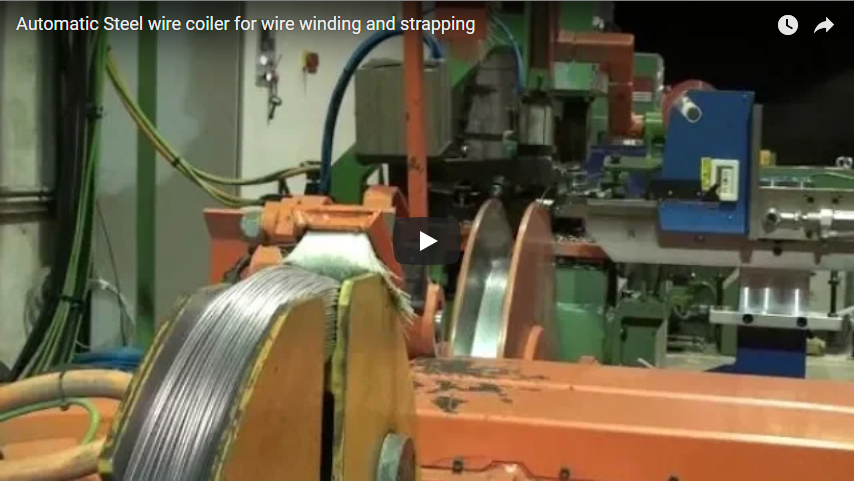
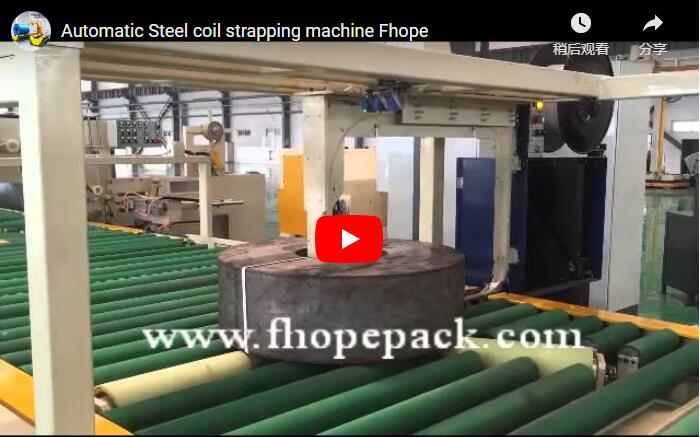
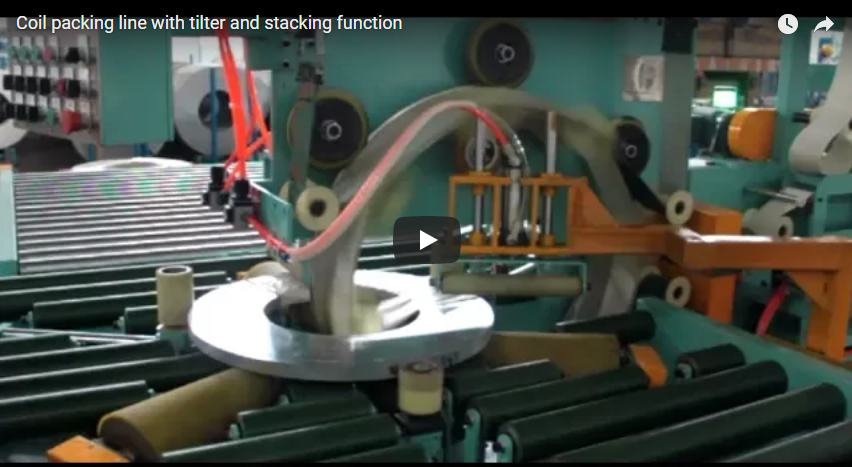
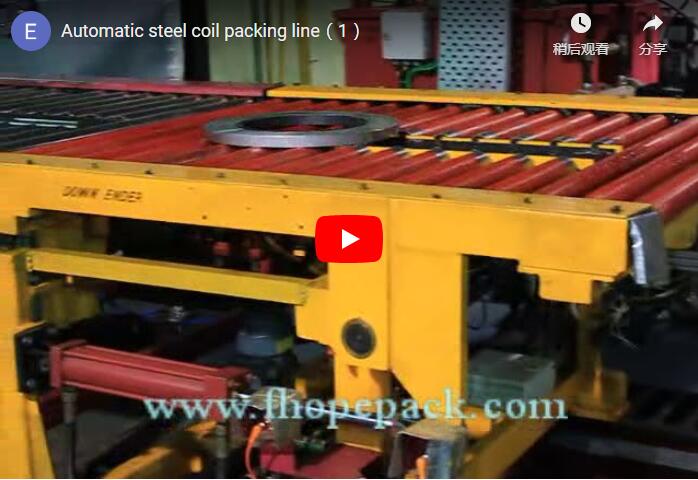
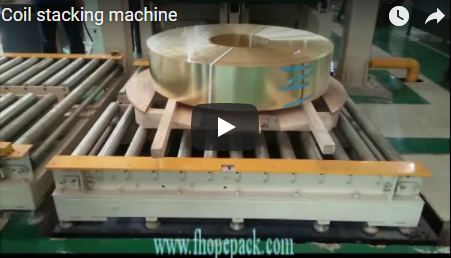
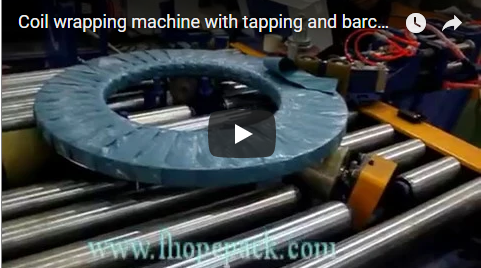
Executive summary From eye-to-wall to eye-to-sky, the coil orientation shapes the whole packaging line. This clip follows a steel coil through one of our automatic lines. The coil travels flat, eye to sky, through an overhead station, an eye-through wrapper and a strapping arch, and the last frames show a wrapped coil standing eye to wall at the end of the line. Below we explain both orientations and how the choice fixes where the tilter goes, how the coil is strapped and how it is stacked.
Table of Contents
- What the clip shows
- Eye to sky and eye to wall compared
- Where the tilter goes in the line
- Wrapping and strapping a flat coil
- Stacking and the final package
- Selection checklist
- Controls and safety
- Engineering FAQ
- Next step
- Related reading
- Sources
What the clip shows
| Part of the clip | What is on screen |
|---|---|
| Opening | A flat coil on a wide roller table under an overhead manipulator head, next to a guarded yellow cabinet; an operator stands by |
| Early middle | The flat coil reaches a station with a touch-panel control desk and an overhead beam |
| Middle | A light-green eye-through wrapper lays film round the coil section; the coil leaves white-wrapped |
| Late middle | A yellow arch with a strapping head stands beside the wrapped coil on the rollers |
| Near the end | A light-green overhead gantry over a roller table, with staff watching the cycle |
| Closing | A wrapped coil stands on its edge, eye to wall, beside the end station |
Picture-in-picture windows show other stations of the same line.
Eye to sky and eye to wall compared
The two terms describe where the coil eye points in the finished package.
| Eye to sky | Eye to wall | |
|---|---|---|
| Coil position | Lies flat, eye vertical | Stands on its edge, eye horizontal |
| Typical use | Narrow slit coils that can be stacked | Wide or heavy coils carried in a saddle or cradle |
| Stacking | Several coils in one stack | One coil per position, on a cradle or saddle |
| Lifting | Forklift under runners or a pallet | Crane hook or C-hook through the eye |
| Damage to avoid | Edge damage from the coil above | Flattening of the bottom wraps |
On our automatic coil packing line, the final package direction is one of the first questions in a project. Both directions can be built.
Where the tilter goes in the line
A coil leaves the slitter or recoiler in one orientation and may need to ship in the other. A coil tilter turns it between horizontal and vertical. There are two places to put it:
- Before packing. The coil is turned first and wrapped and strapped in its shipping orientation.
- After packing, as in the clip. The coil is wrapped and strapped flat, which keeps it stable on the rollers, and is turned at the end.
Turning after packing means the tilter table touches film, not bare steel. Turning before packing suits lines where the wrapper and strapper are built for upright coils.
Our coil upenders cover loads from 2 t to 50 t, with a turning time of 50–100 s depending on the model. The table is made to the coil size.
Wrapping and strapping a flat coil
In the clip the eye-through wrapper works on a coil lying flat. The ring carries film through the eye and round the section while the rollers turn the coil. Our PLC and HMI hold a preset program for each coil type that sets centring, wrapping tension and overlap rate. The wrap can be film, paper or woven material.
In this line the strapping arch comes after the wrapper. For the through-the-eye pattern, see our radial strapping machine. From our steel coil strapping machine page:
| Item | Range |
|---|---|
| Coil diameter | 500–2200 mm (customised) |
| Coil weight | up to 20 t |
| Strap tension | 500 N to 30000 N, by strapping head |
| Radial straps per coil | 2, 3, 4 or 6 |
Strap can be PET or steel. For an eye-to-wall coil lifted by a C-hook through the eye, the radial straps are placed so the hook does not bear on them. Each machine is built to the coil range of the project, so these figures can change.
Stacking and the final package
For eye-to-sky packages, our automatic coil packing line stacks up to 6 coils per stack. Eye-to-wall coils are usually not stacked; each one leaves the line on its own cradle or saddle.
Labelling can sit at the end of either layout, linked to your ERP or MES, so the label carries the coil data whichever way the coil faces.
Selection checklist
- Coil ID, OD, width and weight range.
- Orientation coming in and orientation going out.
- Tilter position: before or after packing.
- Wrap material, strap material and straps per coil.
- Stack height for eye-to-sky coils; cradle or saddle type for eye-to-wall coils.
- How the package is lifted at your dispatch area: forklift or crane.
Controls and safety
The standards that apply depend on the destination market. For CE markets, ISO 12100 sets the risk-assessment method and EN 415-10 covers general requirements for packaging machines, which fixes guarding and the emergency-stop arrangement.
A coil tilter moves a heavy load past its balance point, and a strapping head stores energy in the strap. Guarding and access around both are fixed in the risk assessment for each layout.
Engineering FAQ
Q: What is the difference between eye to sky and eye to wall? A: Eye to sky means the coil lies flat with the eye pointing up. Eye to wall means the coil stands on its outer diameter with the eye horizontal.
Q: Can one line deliver both orientations? A: Yes, if a coil tilter is part of the layout. The final package direction is fixed at the design stage.
Q: How heavy a coil can the tilter turn? A: Our coil upender range covers 2 t to 50 t.
Q: How long does one turn take? A: 50–100 s, depending on the model.
Q: What can the eye-through wrapper apply? A: Stretch film, paper or woven material, set per coil type.
Q: How many radial straps does a coil get? A: 2, 3, 4 or 6, chosen by coil size and transport route.
Q: How high can eye-to-sky coils be stacked? A: Up to 6 coils per stack on our automatic coil packing line.
Next step
We plan a coil packaging line in three steps:
- Submit your layout drawing with coil range and the orientation in and out, to info@fhopepack.com.
- Receive a proposal within 48 hours, with tilter position, wrapping, strapping and stacking stations.
- Book a site survey so we confirm floor space, crane or forklift access and dispatch routes.
Related reading
- Steel Coil Upender and Eye-Through Wrapping Line: Where the Safety Gains Come From
- How Does a Two-Stage Automatic Steel Coil Packaging and Stacking Line Work?
- Automatic Steel Coil Strapping, Packaging and Stacking Line: Choosing the Strap Pattern Before the Stack
- Coil upender
Sources
- Machine in action: the video on YouTube
- Final package direction eye to sky / eye to wall, PLC/HMI preset programs for centring, tension and overlap, film/paper/woven wrap, PET or steel strap, up to 6 coils per stack, labelling with ERP/MES: Automatic coil packing line
- Upender loads 2–50 t, turning time 50–100 s, table made to coil size, tilting between horizontal and vertical: Coil upender
- Coil diameter, weight, tension range, radial strap counts: Steel coil strapping machine
- Standards scope: ISO 12100:2010; EN 415-10:2014
- Proposal timing: approved house CTA (proposal within 48 hours)
Last reviewed: 2026-10-06