Executive summary
To choose packing material for steel wire packing, first see how the coil is wound and how far it must travel. For short, clean trips stretch film alone protects the coil surface, while VCI rust-protection paper suits long storage and sea transport. Straps are planned at 1 to 3 per coil, and every choice is confirmed per project.
Table of Contents
- Why material choice starts at the coil
- What the machine does
- Wire feed and winding unit
- Winding cycle and ring transfer
- What the footage shows
- Typical configuration
- Selection checklist
- Operation and safety
- Engineering FAQ
- Next step
- Related reading
- Sources and standards
Why material choice starts at the coil
The packing material has to match how the steel wire leaves the machine. A tightly wound coil holds its shape and needs only a surface film, while a loose or heavy coil calls for extra strapping and stronger protection.
Film and strap over the coil keep the wires together and the surface clean from the machine to the delivery point. Packing material and strap count are confirmed per project.
What the machine does
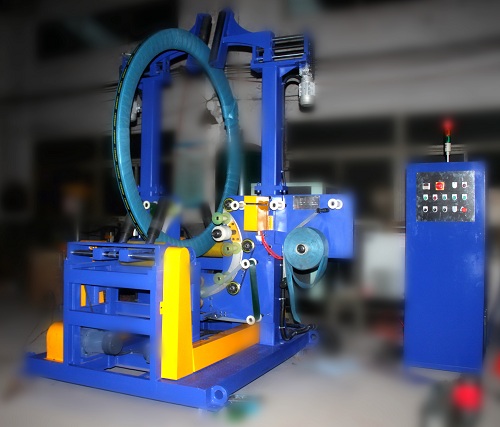
The machine is a steel wire coiling unit that turns long steel wire into wound coils. The wire is drawn from a pay-off reel through guide rollers and tension wheels, then wound onto a take-up spool to form a compact coil.
A robotic arm lifts the finished ring of wire and positions it for the next step. The finished coil is then packed with the material you choose per project.
Wire feed and winding unit
At the feed end, the wire passes through guide rollers and a pair of sizing and tension wheels that keep the wire path steady. Pneumatic elements support the movements along the line.
The winding unit takes the wire around a take-up spool, where the layers build up into a compact coil. Wire diameter and coil size range are confirmed per project.
Winding cycle and ring transfer
The cycle starts when the wire is guided into the take-up spool and winds at a steady speed until the coil is full. The wire path is held through the whole build so the layers stay even.
When the coil is finished, a robotic arm moves the formed ring into position for the next operation. Winding speed and ring timing are confirmed per project.
What the footage shows
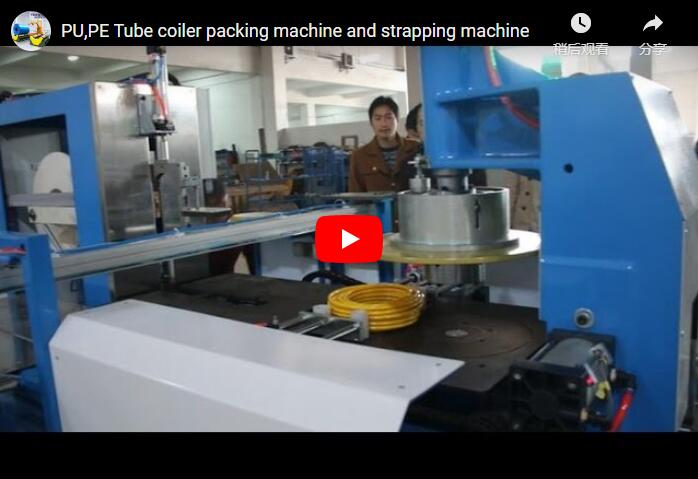
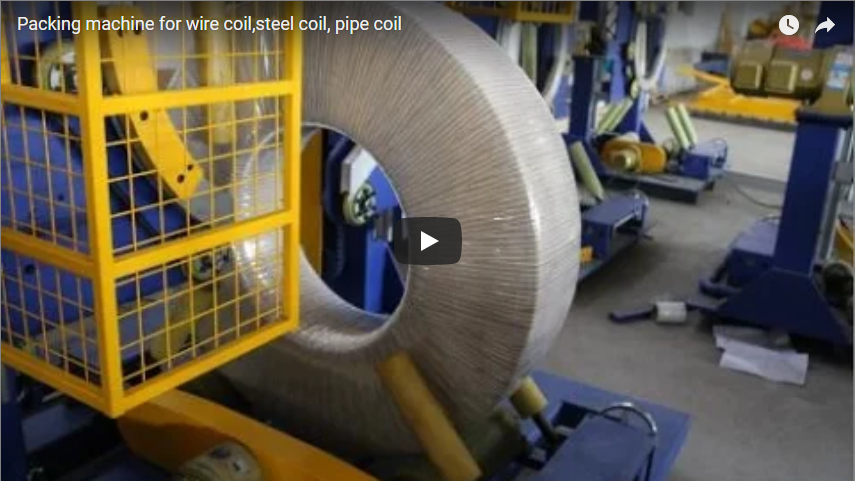
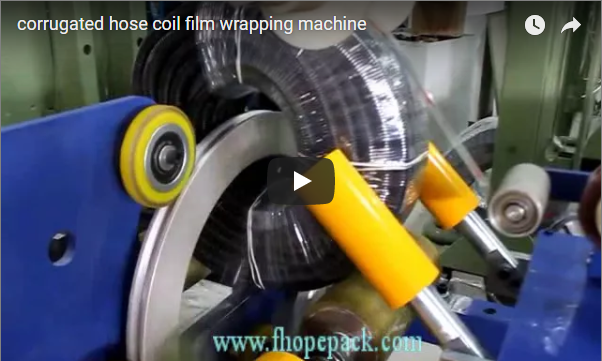
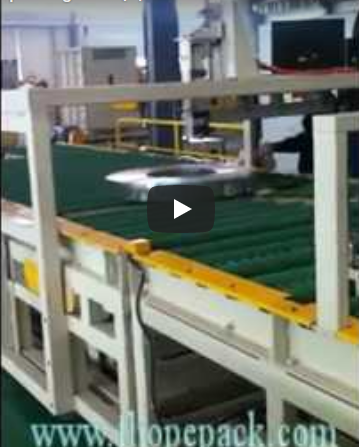
Our footage shows a steel wire coiling machine drawing wire through guide and tension wheels, winding it onto a take-up spool, and a robotic arm lifting the formed wire ring clear of the unit. It is a general demonstration, so your wire size, coil type and packing material are confirmed with us per project.
Typical configuration
Figures below list functional design boundaries rather than numeric values, and are confirmed per project.
| Parameter | Typical range, confirmed per project |
|---|---|
| Feed | steel wire from a pay-off reel through guide rollers |
| Straighten | sizing and tension wheels hold the wire path |
| Wind | take-up spool builds the wire into a compact coil |
| Ring | robotic arm transfers the finished ring |
| Control | panel with start-up and emergency stop per project |
| Film | stretch film or VCI rust-protection paper per project |
| Straps | 1 to 3 straps per coil, selected per project |
| Electrical supply | 380 V three phase 50 Hz, or 220 V single phase for light machines, selected per project |
Selection checklist
| Question | Confirm per project |
|---|---|
| Wire range | wire diameter and coil outer and inner size |
| Coil type | round coil or flat ribbon and ring form |
| Film | stretch film for short trips or VCI rust paper for long storage |
| Straps | 1 to 3 per coil, chosen from coil width, diameter and stability |
| Control | panel layout, speed setting and emergency stop |
| Electrical supply | voltage, phase and frequency on site |
Operation and safety
Guide the wire into the feed rollers, start the cycle, and let the machine wind and transfer the finished ring. Keep your hands clear of the take-up spool, the tension wheels and the robotic arm while the unit runs.
Routine checks cover the guide rollers, the tension wheels and the spool, per the machine manual. Confirm the wire path is clear before each start.
Engineering FAQ
Q: What does this machine do? A: It winds long steel wire into compact coils and transfers the finished ring for the next step.
Q: How is the wire fed in? A: The wire is drawn from a pay-off reel through guide and tension wheels into the take-up spool.
Q: What packing material suits steel wire? A: Stretch film for short, clean trips, and VCI rust-protection paper for long storage or sea transport.
Q: How many straps does a coil need? A: Straps are planned at 1 to 3 per coil, chosen from coil width, diameter and stability.
Q: What electrical supply does it need? A: The machine runs on 380 V three phase 50 Hz as standard, and light machines can be arranged for 220 V single phase, selected per project.
Next step
- Email us at info@fhopepack.com with your wire size and coil type.
- We send a packing proposal within 48 hours.
- We confirm the film and strap plan for your coils.
Related reading
- How to choose packing material bombination for the steel wire packing?
- Automatic Steel Wire Coiler for Wire Winding and Strapping
- Automatic Wire Coil Rewinding and Tying Machine
- FHOPE packing machinery product lines
Sources and standards
- ISO 12100:2010 Safety of machinery, general principles for design and risk assessment
- EN 415-10:2014 Safety of packaging machines, general requirements
- EN ISO 13849-1:2023 Safety of machinery, safety-related parts of control systems
FHOPE steel wire coiling machine demonstration video. Reviewed as a general demonstration; wire size, coil type and packing material confirmed per project.
Last reviewed: 2026-10-12