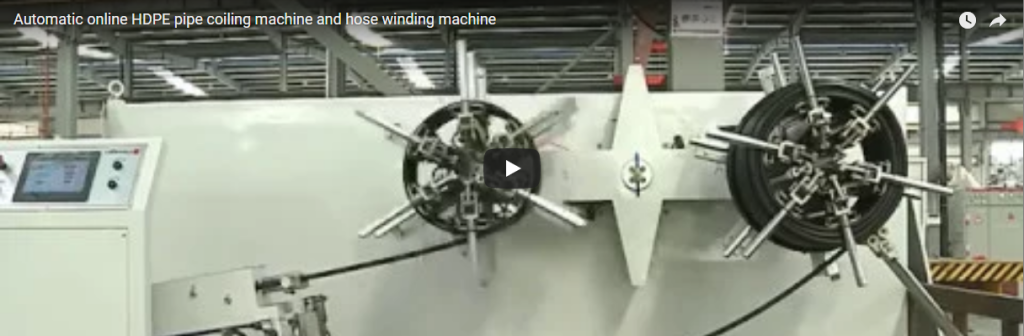
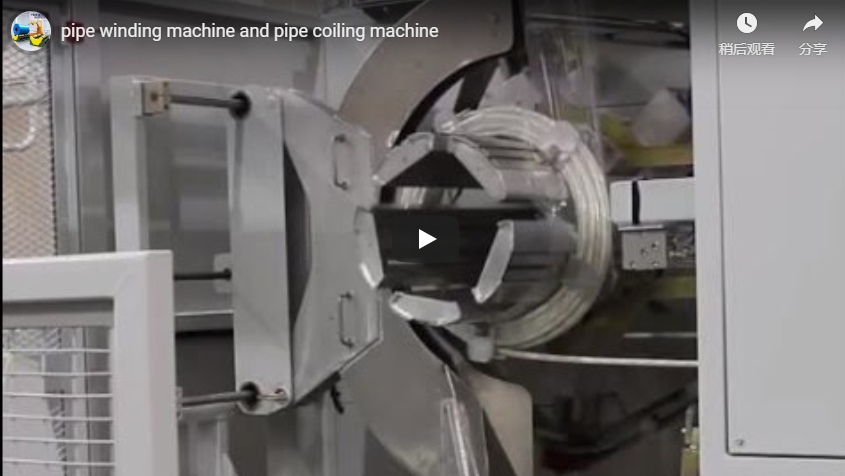
Executive summary The clip shows a rail-mounted coil transfer car with a red V-block cradle: the car travels on a floor rail, the cradle lifts and rotates the coil through 360°, then feeds it into a decoiler. The footage is not from our shop, so below we treat it as a reference sequence and map it to our equivalent coil transfer car (20 t class, rail travel, 360° turn). You get the motion the clip shows, the published car parameters, and the checks before a car is linked to a decoiler.
Table of Contents
- What the clip shows
- Why a rail coil car replaces crane loading
- Our equivalent coil transfer car
- Matching the car to the decoiler
- Selection checklist for a coil car
- Controls and safety
- Engineering FAQ
- Next step
- Related reading
- Sources
What the clip shows
| Step | What is on screen |
|---|---|
| Travel | Grey-and-black rail-mounted car moves along a floor rail toward the coil |
| Cradle | Red V-block cradle holds a large steel coil horizontally |
| Lift | Two vertical hydraulic cylinders raise the platform under the cradle |
| Rotate | Cradle turns to align the coil with the decoiler centerline (360° capability) |
| Feed | Coil is presented into the decoiler take-up after alignment |
Factory hall with concrete floor and metal walls; other machines in the background.
Why a rail coil car replaces crane loading
Crane-and-sling loading of a decoiler puts a swinging coil under a hook and asks the rigger to chase the mandrel centerline by eye. A rail car keeps the coil on a fixed path: travel to the station, lift to height, rotate to angle, then hand off.
Three points decide when a car is the right station:
- The route is fixed between storage, turnstile or packing and the decoiler.
- Coil weight is beyond safe manual push, so a powered rail drive is required.
- The decoiler needs repeatable alignment, which a rotating cradle can hold.
Our equivalent coil transfer car
Published parameters for our coil transfer car:
| Item | Specification |
|---|---|
| Maximum load | 20 t |
| Power supply | 380 V, 60 Hz |
| Drive power | 2.5–5.5 kW |
| Mode | Semi-automatic |
| Transfer | By floor rail |
| Turning | 360° |
| Control | Manual control box or remote; speed-regulating inverter |
| Safety | Emergency stop; position lock; two displacement limiters |
The car is used on coil slitting lines, packing lines and stacking layouts, and can link to a turnstile or down-ender so the crane is not needed for every move.
Matching the car to the decoiler
| Project input | What we fix |
|---|---|
| Max coil weight | Car load class (up to 20 t) |
| Coil OD / width | V-cradle or saddle size |
| Decoiler mandrel height | Lift stroke and hand-off height |
| Required rotation | 360° cradle or a fixed saddle |
| Rail length and stops | Track layout, limiters and lock positions |
Speed is adjustable on the inverter so the car can creep into the decoiler without shocking the mandrel.
Selection checklist for a coil car
- Max coil weight against the 20 t class.
- Coil OD and width for the V-cradle.
- Decoiler mandrel height and centerline tolerance.
- Whether 360° rotation is required or a fixed saddle is enough.
- Rail route, stops and exclusion zones.
- Manual pendant vs remote control preference.
- Destination market for the risk assessment package.
Controls and safety
The standards that apply depend on the destination market. For CE markets, ISO 12100 sets the risk-assessment method and EN 415-10 covers general requirements for packaging machines, which fixes guarding and the emergency-stop arrangement. Coil cars used with packaging or handling cells follow that pair.
On our car we publish: emergency stop, position lock and two displacement limiters. Guarding and light curtains around the rail path are fixed in the risk assessment for each layout.
Engineering FAQ
Q: Is the machine in the clip one of our coil cars? A: No. The clip is reference footage; we supply our equivalent rail-mounted coil transfer car, sized to your coil weight (up to 20 t) and decoiler height.
Q: What is the published load rating? A: Maximum load 20 t on our coil transfer car page.
Q: Does the cradle really turn a full 360°? A: Yes. The published turning degree is 360°, matching the alignment move shown in the clip.
Q: How is the car controlled? A: Manual control box or remote, with a speed-regulating inverter (2.5–5.5 kW drive).
Q: Which safety functions are published? A: Emergency stop, position lock and two displacement limiters.
Q: Can the car replace crane moves on a packing line as well as a decoiler? A: Yes — on slitting, packing and stacking layouts, and it can link to a turnstile or down-ender so the crane is not needed for every move.
Q: How does the car avoid shocking the decoiler mandrel? A: Drive speed is inverter-regulated, so the car can creep into the final hand-off.
Next step
We plan a coil car station in three steps:
- Submit your layout drawing with coil weight, OD/width, decoiler height and rail route, to info@fhopepack.com.
- Receive a proposal within 48 hours, with the car load class, cradle and rail layout.
- Book a site survey so we confirm floor rails, stops and the decoiler hand-off.
Related reading
- Hydraulic Coil Tilter for 90° Turning: Matching the Clip Cycle to Our FPCT Range
- Steel Coil Upender and Eye-Through Wrapping Line: Where the Safety Gains Come From
- Coil Tilter and Upender: 90° Turn of a Palletised Coil
- Coil transfer car
Sources
- Machine in action (reference clip, non-own footage): the video on YouTube
- Max load 20 t, 380 V 60 Hz, semi-automatic, floor-rail transfer, 360° turning, manual/remote + inverter, E-stop / position lock / two limiters, 2.5–5.5 kW: Coil transfer car
- Standards scope: ISO 12100:2010; EN 415-10:2014
- Proposal timing: approved house CTA (proposal within 48 hours)
Last reviewed: 2026-10-07