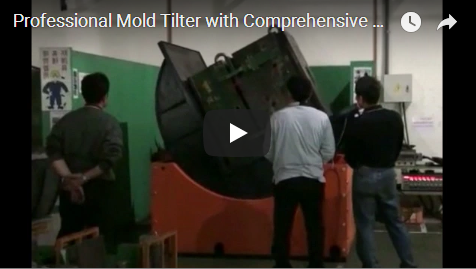
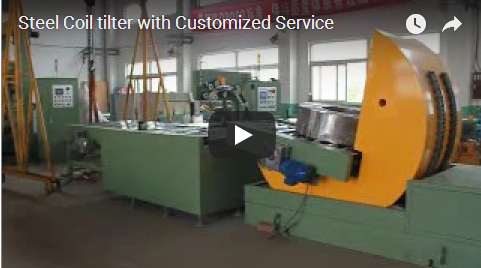
Executive summary The clip shows a yellow-and-blue coil upender turn a film-wrapped steel coil from eye-to-wall (horizontal) to eye-to-sky (vertical), hand it to a yellow V-cradle trolley on floor rails, travel along the track, then bring the coil back toward eye-to-wall for unloading. The footage is not from our shop, so below we treat it as a reference handling sequence and map it to our equivalent FPCT hydraulic coil upender plus coil transfer car. You get the motion on screen, the FPCT load table, and the checks before an unload cell is built.
Table of Contents
- What the clip shows
- Upender → trolley → unload sequence
- Our FPCT upender range
- Our equivalent transfer trolley / coil car
- Selection checklist for an unload cell
- Controls and safety
- Engineering FAQ
- Next step
- Related reading
- Sources
What the clip shows
| Step | What is on screen |
|---|---|
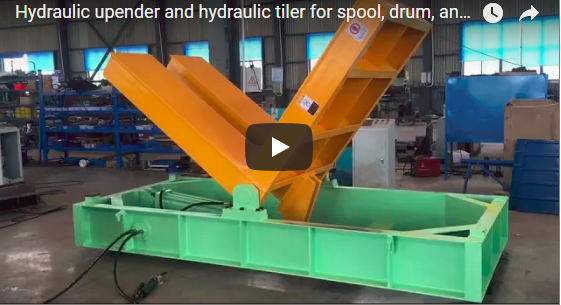
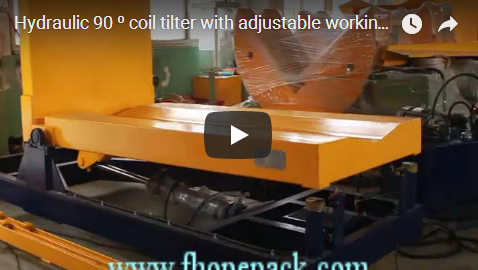
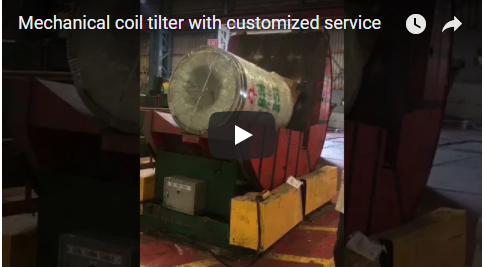
| Lift / turn | Blue base with four hydraulic cylinders; yellow arm turns a white-film-wrapped coil from horizontal toward vertical |
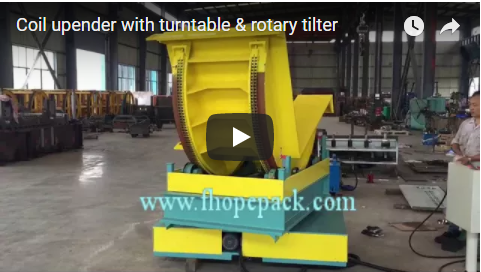
| Hand-off | Coil moves onto a yellow V-cradle transfer trolley |
| Travel | Trolley runs on floor rails along a concrete channel |
| Lower / unload | Coil is brought back toward horizontal for unloading |
| People / controls | Operators in hard hats and vests; white electrical cabinet; yellow railings and hazard markings |
Factory hall with high truss roof. Exact coil weight and cycle time are not readable on the machine.
Upender → trolley → unload sequence
- Coil arrives eye to wall (horizontal) on the upender table.
- Hydraulic cylinders drive a 90° turn toward eye to sky (vertical).
- The coil is transferred onto the rail trolley V-cradle.
- The trolley travels to the unload position.
- The coil is lowered for forklift, crane or downstream take-away.
The same cell can run the reverse path when a vertical coil must be laid down for packing or storage.
Our FPCT upender range
| Model | Max load | Power | Cycle time (approx.) | Machine weight |
|---|---|---|---|---|
| FPCT-02 | 2 t | 1.5 kW | 50–70 s | 2.0 t |
| FPCT-05 | 5 t | 1.5 kW | 50–80 s | 2.5 t |
| FPCT-10 | 10 t | 3.2 kW | 60–90 s | 3.0 t |
| FPCT-20 | 20 t | 4.5 kW | 60–90 s | 3.5 t |
| FPCT-30 | 30 t | 6.5 kW | 60–90 s | 4.0 t |
| FPCT-50 | 50 t | 11.5 kW | 60–100 s | 4.5 t |
Table size is designed per coil size. Warranty on the range is 2 years.
Our equivalent transfer trolley / coil car
Published parameters for our coil transfer car that pairs with an upender cell:
| Item | Specification |
|---|---|
| Maximum load | 20 t |
| Power supply | 380 V, 60 Hz |
| Drive power | 2.5–5.5 kW |
| Transfer | By floor rail |
| Turning | 360° cradle option |
| Safety | Emergency stop; position lock; two displacement limiters |
V-cradle size is matched to coil OD. Rail length and stops follow the unload route in the layout drawing. The published car class is 20 t; heavier coils stay on a custom car specified with the FPCT model.
Selection checklist for an unload cell
- Max coil weight against FPCT model (2–50 t) and trolley class (up to 20 t). Coils above 20 t need a heavier custom transfer car on the project.
- Coil OD / ID / width for table and V-cradle.
- Start and end orientation (eye to wall ↔ eye to sky).
- Rail length, pit/channel depth and stop positions.
- Hand-off to forklift, crane or packing conveyor.
- Guarding, railings and exclusion zones around the swing and the trolley path.
Controls and safety
The standards that apply depend on the destination market. For CE markets, ISO 12100 sets the risk-assessment method and EN 415-10 covers general requirements for packaging machines, which fixes guarding and the emergency-stop arrangement. Tilters, upenders and coil cars used with packaging cells follow that pair.
Production cells use railings, hazard striping, warning labels and a control cabinet, plus interlocks and marked exclusion zones fixed in the risk assessment.
Engineering FAQ
Q: Is the system in the clip one of our FPCT cells? A: No. The clip is a reference unload sequence; we supply our equivalent FPCT upender (2–50 t) plus rail trolley / coil car (up to 20 t), sized to your coil weight and route.
Q: What loads do FPCT upenders cover? A: 2 t to 50 t across FPCT-02…FPCT-50.
Q: What load does the transfer car take? A: Maximum load 20 t on our coil transfer car page.
Q: Can the cell run both ways (lay-down and stand-up)? A: Yes. The same 90° upender stroke is used in either direction when the layout allows.
Q: Which standards apply? A: For CE markets, ISO 12100 and EN 415-10.
Q: What safety functions are published for the transfer car? A: Emergency stop, position lock and two displacement limiters.
Q: What power supply does the car page list? A: 380 V, 60 Hz, with a 2.5–5.5 kW drive.
Q: What warranty applies to the FPCT range? A: 2 years.
Next step
We plan an unload cell in three steps:
- Submit your layout drawing with coil weight, OD and the rail route to the unload point, to info@fhopepack.com.
- Receive a proposal within 48 hours, with the FPCT model, trolley and rail layout.
- Book a site survey so we confirm pit/channel, floor loading and guarding.
Related reading
- Hydraulic Coil Tilter for 90° Turning: Matching the Clip Cycle to Our FPCT Range
- Rail-Mounted Coil Transfer Car with 360° Cradle for Decoiler Feeding
- Coil Tilter and Upender: 90° Turn of a Palletised Coil
- Coil upender
Sources
- Machine in action (reference clip, non-own footage): the video on YouTube
- FPCT-02…FPCT-50: Coil upender
- Coil transfer car 20 t / rail / E-stop / limiters / 2.5–5.5 kW: Coil transfer car
- Standards scope: ISO 12100:2010; EN 415-10:2014
- Proposal timing: approved house CTA (proposal within 48 hours)
Last reviewed: 2026-10-07