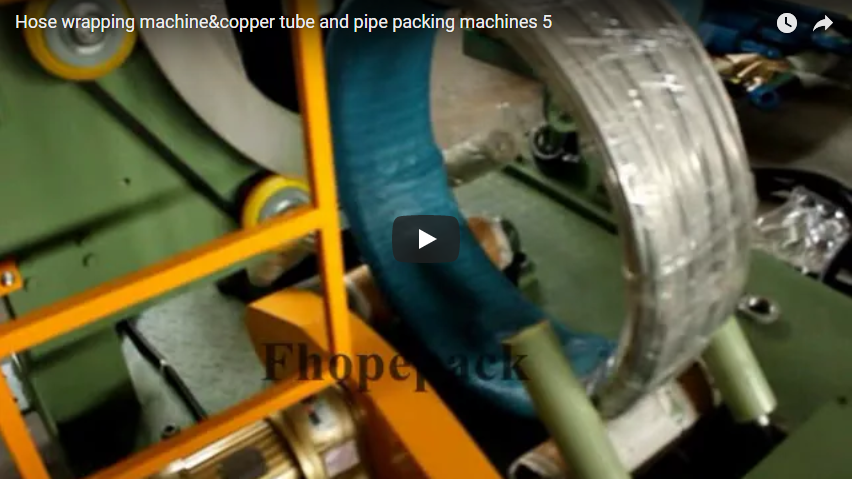
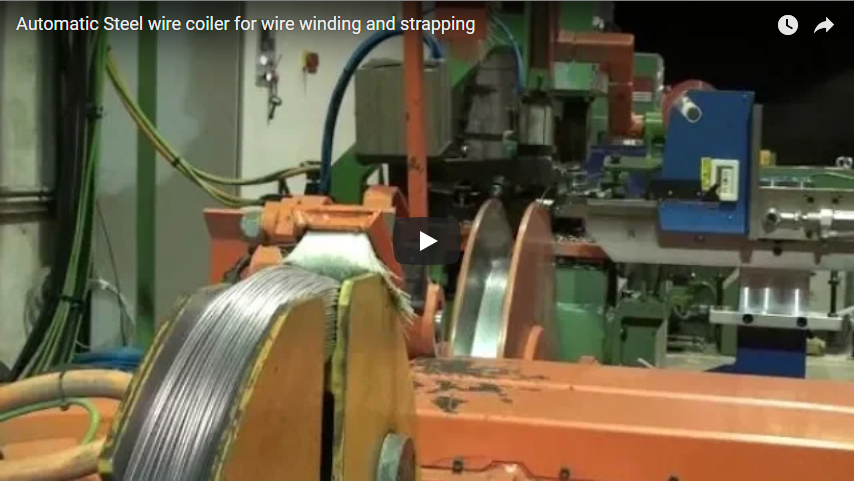
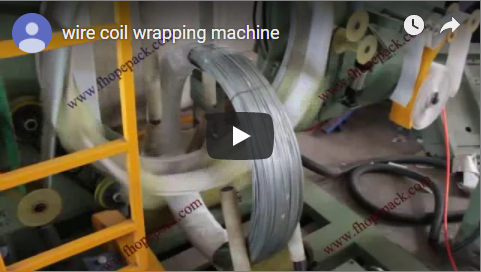
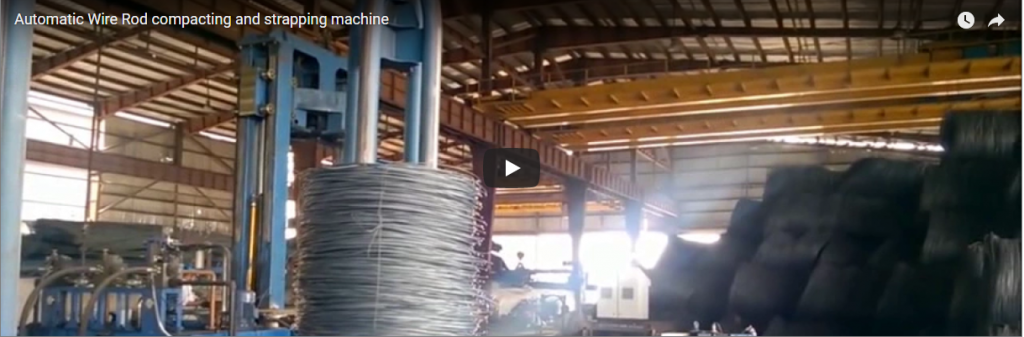
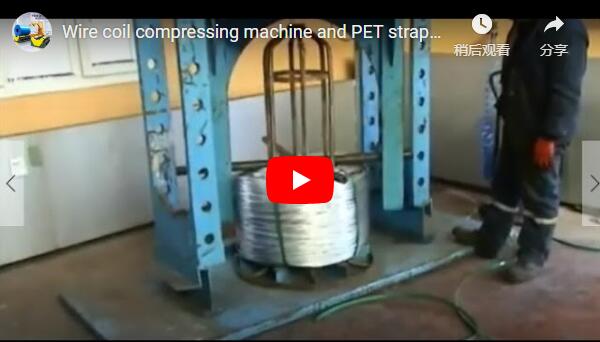
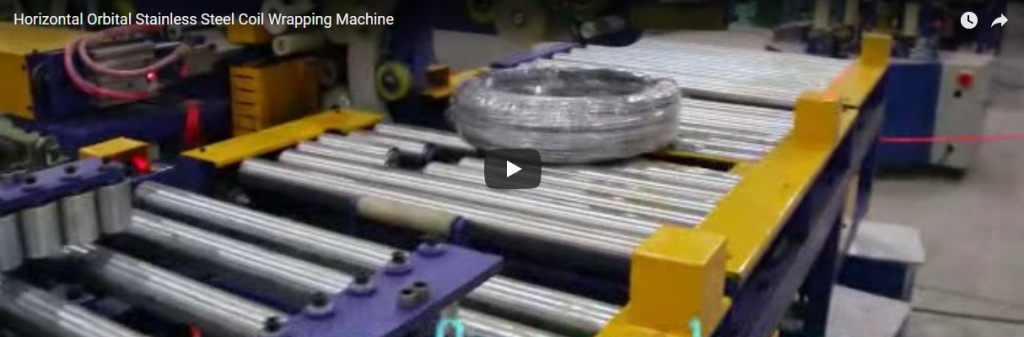
Executive summary The clip shows a yellow-and-grey turntable stretch wrapper covering a steel wire coil on a wooden carrier with a metal handle. The platform turns while a vertical film arm moves up and down, then the wrapped carrier leaves on a roller conveyor. Below we walk through that short wrap cycle, map it to our equivalent B100/B200 wrappers (2000 kg class, published pre-stretch ranges), and list what to fix before a carrier-wrap station is built.
Table of Contents
- What the clip shows
- Why a wire coil on a carrier needs a stretch wrap
- Our equivalent B100 / B200 turntable wrappers
- Selection checklist for a carrier-wrap station
- Controls and safety
- Engineering FAQ
- Next step
- Related reading
- Sources
What the clip shows
| Clip time | What is on screen |
|---|---|
| 0–4 s | Steel wire coil on a wooden pallet carrier is on the rotating platform; operator in a yellow hard hat at the panel |
| 4–8 s | Platform turns; vertical wrapping arm applies clear film up and down the load |
| 8–12 s | Wrapped carrier moves out on the roller conveyor |
The observed wrap window runs about 0–12 s. Times come from frames at 0 / 4 / 8 / 12 s. Machine colours are yellow and grey. Control panel sits on the left with start/stop, speed control and an emergency stop. A guard is fitted around the rotating area. Warehouse shelves of pipe and other stock appear in the background.
Why a wire coil on a carrier needs a stretch wrap
Wire coils often leave the plant on a wooden or steel carrier so the coil stays stable under a forklift or crane. The stretch wrap does two jobs:
| Job | What the film does |
|---|---|
| Surface cover | Keeps dust and splash off the wire and the carrier |
| Hold-down | Keeps the coil from shifting on the carrier during travel |
A turntable wrapper is the usual choice when the coil already sits on a pallet-style carrier: the whole load turns under a vertical film arm. When the coil is bare and must be wrapped through the eye, we use an FPW eye-through wire coil wrapper instead.
Our equivalent B100 / B200 turntable wrappers
Published values from our automatic pallet wrapper pages (the same turntable architecture as the clip):
| Item | B100 | B200 |
|---|---|---|
| Turntable diameter | 2200 mm | 1800 / 2000 mm |
| Max load | 2000 kg | 2000 kg (option 2500–3000 kg) |
| Turntable speed | up to 12 rpm | 3–12 rpm |
| Pre-stretch | 250% (adjustable 100–300%) | up to 200% |
| Film | LLDPE 0.025 mm; 500 mm width × 76 mm core (B100) | per program |
| Throughput guide | min 24 loads/hour (B100) | depends on wrap program |
| Controls | PLC, buttons, HMI; photocell; soft start/stop | PLC; inline conveyors option; pneumatic top plate option |
Air supply on the B100 page is 6–8 kgf/cm². Packing height on the B200 can reach 2800 mm as an option.
These figures are for our machines. We size the station from your carrier weight and height, together with the published B100/B200 load and film ranges.
Selection checklist for a carrier-wrap station
- Carrier type (wooden pallet, steel skid) and max coil + carrier weight against 2000 kg (or the B200 2500–3000 kg option).
- Coil OD and height on the carrier, against turntable diameter and wrap height.
- Film type and pre-stretch target (B100 100–300%, B200 up to 200%).
- Infeed/outfeed: forklift only, or roller conveyor as in the clip.
- Whether weighing or labelling is a separate upstream/downstream station.
- Guarding and access around the turntable.
Controls and safety
The standards that apply depend on the destination market. For CE markets, ISO 12100 sets the risk-assessment method and EN 415-6 covers pallet wrappers, which fixes guarding and the emergency-stop arrangement for this turntable architecture.
On the B100 the wrapper runs from a PLC with buttons and HMI, and the turntable has soft start and soft stop. Guarding around the turntable is set in the risk assessment for each layout.
Engineering FAQ
Q: Is the machine in the clip one of our B100 / B200 wrappers? A: No. The clip shows a turntable cycle; B100 and B200 are our equivalent production models for this carrier-wrap application, sized to your carrier weight and height.
Q: When do we use a turntable wrapper instead of an FPW eye-through wire wrapper? A: Turntable when the coil already sits on a pallet-style carrier; FPW eye-through when the bare coil must be wrapped through the eye.
Q: What load do B100 / B200 take? A: 2000 kg on both; B200 offers 2500–3000 kg as an option.
Q: What pre-stretch is published? A: B100: 250% (adjustable 100–300%); B200: up to 200%.
Q: Does this page cover weighing and tapping? A: No. Those stations are not in the clip; they would be specified as separate upstream or downstream units if the line needs them.
Q: Which standard applies to a turntable stretch wrapper? A: For CE markets, ISO 12100 and EN 415-6 for pallet wrappers.
Q: What air supply does the B100 page list? A: 6–8 kgf/cm².
Q: What turntable speeds are published? A: B100 up to 12 rpm; B200 from 3–12 rpm.
Next step
We plan a carrier-wrap station in three steps:
- Submit your layout drawing with carrier type, coil weight/height and film preference, to info@fhopepack.com.
- Receive a proposal within 48 hours, with the B100/B200 model, film program and conveyor layout.
- Book a site survey so we confirm floor space, forklift routes and guarding.
Related reading
- Automatic Inline Pallet Wrapper Factory Test Run: What to Check Before It Ships
- Turntable Stretch Wrapper B200: Inline Roller Turntable with Pneumatic Top Plate
- Steel Wire Coil Wrapping, Upending and Stacking Line: Conveyor Test Run
- Pallet wrapping machine B100
Sources
- Machine in action: the video on YouTube
- B100 values: pallet wrapping machine B100
- B200 values: pallet wrapping machine B200
- FPW eye-through alternative for bare wire coils: Wire coil wrapping machine FPW-500
- Standards scope: ISO 12100:2010; EN 415-6 (pallet wrappers)
- Proposal timing: approved house CTA (proposal within 48 hours)
Last reviewed: 2026-10-07