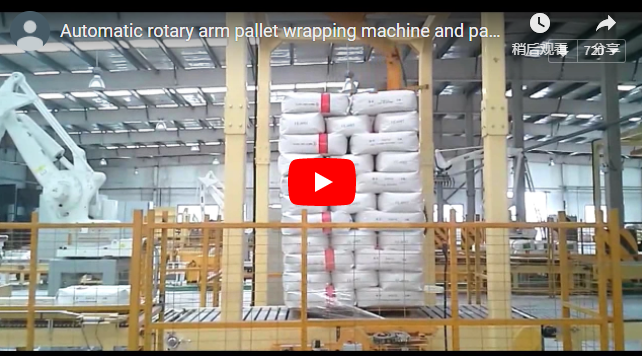
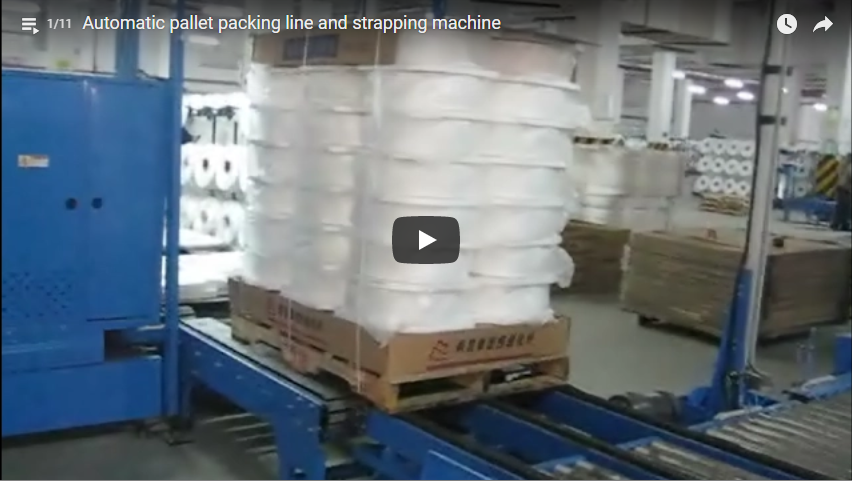
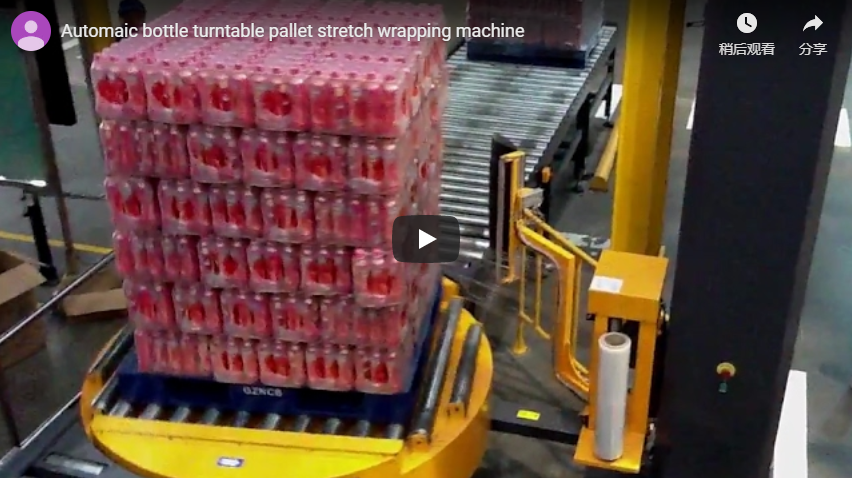
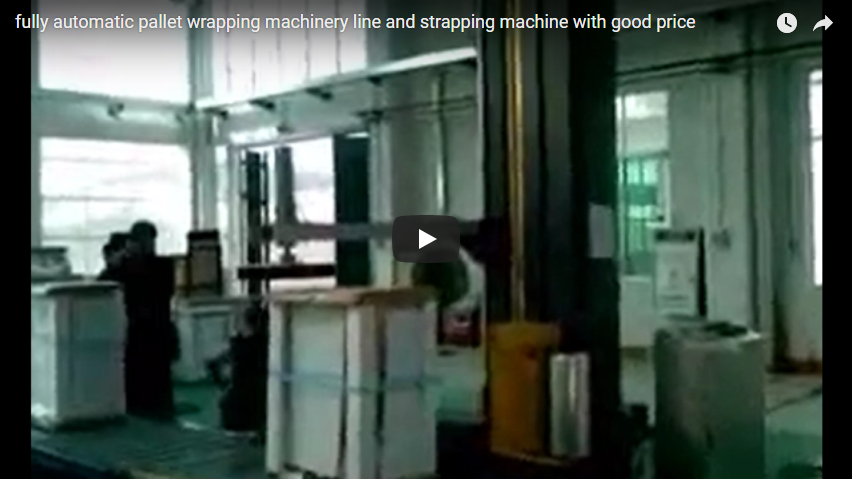
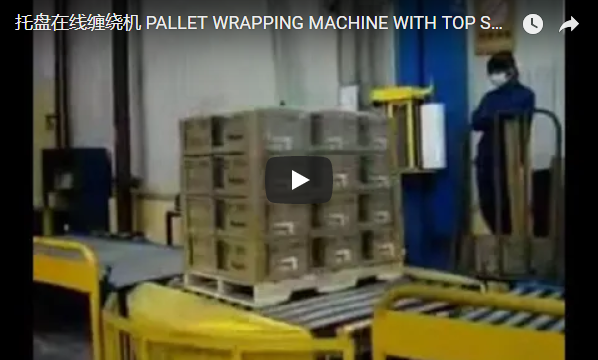
Executive summary Strapping, wrapping and top covering usually mean three machines and two pallet moves. Our system in this video does all three at one station; the captions describe strapping first, film round the sides, then a top cover, and the footage shows the film wrap on a carton load. Film per load follows from the load size and the number of turns. We set both per project.
Table of Contents
- What the video shows
- How the one-station cycle works
- Stretch film per load
- What to set per load
- Controls and safety
- Selection checklist for a one-station wrap, strap and cover system
- Engineering FAQ
- Next step
- Related reading
- Sources
What the video shows
A load of brown cartons on a blue pallet stands on the turntable of our gantry machine: two columns, a top beam with a red drive section and a carriage that moves up and down. A green light shows on the control panel on the left, and a red emergency stop sits on the right.
The turntable starts turning and the carriage moves down, laying clear stretch film tightly around the cartons. Captions across the top read “wrapping + strapping + top covering, three in one” and “strap, wrap the four sides, cover the top, all at the same station”. No one touches the load.
How the one-station cycle works
| Step | What happens |
|---|---|
| Load | The pallet is set on the turntable |
| Strap | Bands go round the load to hold it |
| Wrap | The turntable turns and the carriage lays film on the sides |
| Cover | Film goes over the top of the load |
| Remove | The finished load is taken off |
Doing all three on one turntable means the load is set down once and picked up once.
Stretch film per load
Illustrative example:
| Item | Value |
|---|---|
| Load footprint (illustrative) | 1,200 × 1,000 mm |
| Perimeter, 2 × (1,200 + 1,000) | 4,400 mm |
| Load height (illustrative) | 1,500 mm |
| Film width (illustrative) | 500 mm |
| Rise per turn at 50% overlap | 250 mm |
| Turns, 1,500 ÷ 250 travel turns + 2 bottom + 2 top | 10 |
| Film laid on the sides, 10 × 4.4 m | 44 m |
That is film laid on the load; pre-stretch means the roll pays out less.
What to set per load
| Choice | What it decides |
|---|---|
| Bands per load | How well the stack holds when lifted |
| Side turns | Film layers on the sides |
| Top cover | Rain and dust from above |
| Order of steps | Strap first or wrap first |
We set these on trial with your loads and keep them as recipes. For online lines with a top sheet, see our pallet wrapping machinery with top sheet covering.
Controls and safety
The turntable turns a full load and the carriage moves on the gantry. Keep clear of the turntable while it turns, and step in only when the cycle has stopped. For pallet wrapping machines, EN 415-6 adds the specific safety requirements.
The standards that apply depend on the destination market. For CE markets, ISO 12100 sets the risk-assessment method and EN 415-10 sets general requirements for packaging machines.
Selection checklist for a one-station wrap, strap and cover system
- Load footprint, height and weight.
- Bands per load and direction.
- Film layers on the sides.
- Top cover needed or not.
- Loads per hour.
- Forklift or conveyor loading.
Engineering FAQ
Q: Why combine strapping, wrapping and covering? A: The load is set down once and picked up once, instead of moving between three machines.
Q: How much film do the sides take? A: About 44 m laid for 10 turns at 50% overlap on a 1,200 × 1,000 × 1,500 mm load in our example; pre-stretch means the roll pays out less.
Q: Can it be fed by conveyor as well as forklift? A: Yes. We set the loading method to your line design.
Q: Does anyone touch the load during the cycle? A: No. The load stays on the turntable until the cycle ends.
Q: Can the order of steps change? A: Yes. Strap first or wrap first is set per load type.
Q: Which safety standard applies? A: For CE markets, EN 415-6 covers pallet wrapping machines.
Next step
We plan your one-station pallet system in three steps:
- Submit your layout drawing with load sizes, weights and output to info@fhopepack.com.
- Receive a proposal within 48 hours, with the band, film and cover plan.
- Book a site survey to check loading method and floor space.
Related reading
- Automatic pallet wrapping machine
- Video: horizontal orbital stretch wrapper for pallet loads
- Video: pallet wrapping machine with automatic film cutting
Sources
- System content: FHOPE engineering team, 2026-10-04
- Pallet wrapper safety: EN 415-6
- Film example: our worked example, illustrative values
- Machine in action: our video on YouTube
- Standards scope: ISO 12100:2010, EN 415-10:2014
Last reviewed: 2026-10-04