Executive summary: We build wire rod coil compacting and strapping lines that squeeze a loose coil along its axis, so it binds shorter and denser. Our compactor is specified for 4 straps per coil and a 30-40 s cycle. Send your layout drawing and you receive a proposal within 48 hours.
Table of Contents
- What the compacting and strapping line does
- Inside the compacting cycle
- Coil loading and line layout
- Strapping and binding
- Sizes and specifications
- Illustrative sizing examples
- RFQ checklist
- Controls and safety
- Engineering FAQ
- Related reading
- Sources
- Next step
What the compacting and strapping line does
A wire rod compactor squeezes a loose coil along its axis so the coil binds shorter and denser; the straps then hold the compacted height. Binding runs as several straps spaced round the coil, each passing through the eye and over the outside. Because the loose coil is mostly air, compacting first is what lets the strap hold a stable, dense bundle instead of a springy one. Our strapping station is specified for 4 strapping heads.
Inside the compacting cycle
The compacting cycle runs in sequential technical stages: crane loading, vertical hydraulic compression, radial strapping feed, and horizontal coil handling.
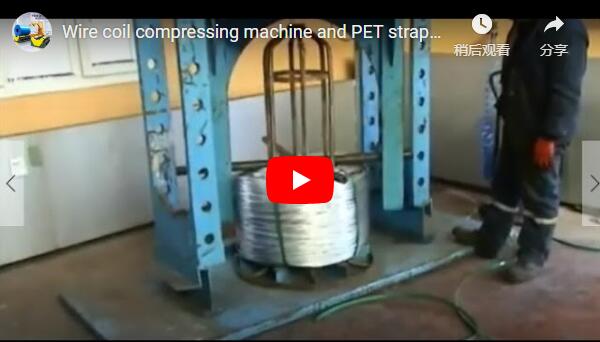
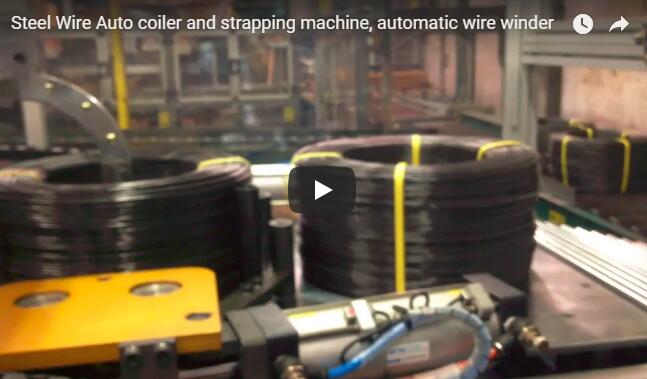
First, a crane with a C hook hoists the wire rod coil to the compacting station, where the coil stands bore-vertical inside the blue vertical compacting frame with curved guide bars. More coils stand stacked near the machine. Because the crane does the infeeding, the bay between the staging area and the press stays short.
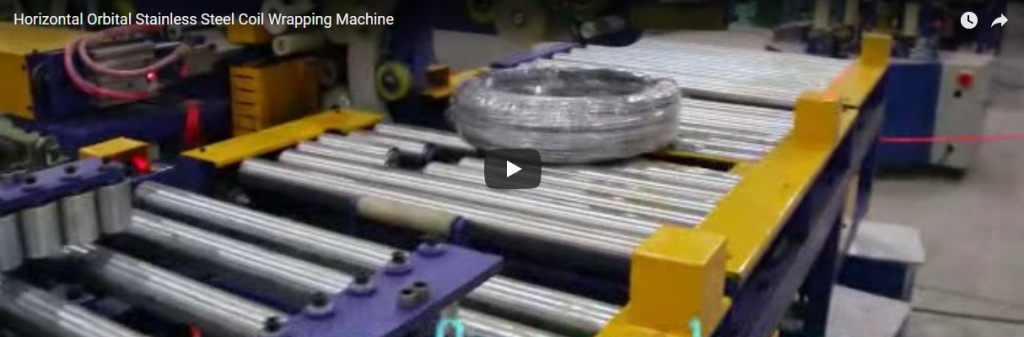
Second, the vertical hydraulic press closes over the coil on the roller conveyor and compresses it between the machine’s vertical columns, so the loose coil is bound shorter and denser. Vertical arms stand positioned over the coil before the stroke starts.
Third, the strapping heads feed the binding wires radially, through the eye and round the outside of the compacted coil. Finally, a tilting arm lays the finished coil bore-horizontal and moves it into a horizontal frame. From there the coil leaves the line as a stable, dense bundle.
Coil loading and line layout
On our line a crane with a C hook carries the wire rod coil to the compressing station, and the compression stroke is set per project. Coils wait in stacks beside the press until the crane lifts them, so the compacting station itself stays short and the bay does the buffering.
That layout keeps the crane cycle and the press cycle independent: one coil can travel while another is being squeezed. Because the crane does the infeeding, no long conveyor has to sit between the staging area and the press. Tell us your crane span and your coil staging plan, and we place the compacting station where your existing crane already reaches.
Strapping and binding
Our strapping station is configured to apply 4 binding wires at one time. Binding wire is specified for a 6.3-8 mm diameter, and each coil takes 4 binding wires. The straps run radially: through the eye, over the outside, and back, so the compacted height is held from several directions at once. Our power unit is specified for 210 bar, and the compacting force is adjustable over 60-400 kN.
Sizes and specifications
| Parameter | Our specification |
|---|---|
| Straps per coil | 4 |
| Coil outside diameter | 1000-1800 mm |
| Coil weight | 500-2000 kg maximum |
| Compactor cycle time | 30-40 s |
| Binding wire diameter | 6.3-8 mm |
| Compacting force | adjustable 60-400 kN |
All tooling, strokes and strapping heads are configured per project, and the press stroke is set per coil, so the table gives the specification ranges we build to rather than one fixed duty point.
Illustrative sizing examples
For a coil with a 1200 mm outside diameter, a 700 mm bore and an 800 mm width, a single radial strap loop needs about 2100 mm of strap (illustrative). Compacting a 900 mm loose coil down to a 600 mm compacted height gives a 1.5 x compaction ratio (illustrative). A 2000 kg coil carries a weight force of about 19620 N (illustrative).
The loop result is the strap length for one pass; multiply it by the strap count on your coil for the total per coil. Submit your coil dimensions to receive strap length calculations, compaction ratio estimates, and required pressing forces.
RFQ checklist
- Coil outside diameter, bore and width
- Coil weight and coils per shift
- Strap material and strap count
- Layout drawing with crane and C-hook data
- Destination market, so the right standards apply
Controls and safety
The standards that apply depend on the destination market: for CE markets, ISO 12100 sets the risk-assessment method and EN 415-10 covers the safety of packaging machines of this kind. Stop and isolate the machine and apply lock-out before reaching into the coil area. Never reach into the frame while the press is moving.
Engineering FAQ
Q: How many straps does the machine put on each coil? A: Our compactor is specified for 4 straps per coil, and the straps run radially through the eye.
Q: What coil sizes can the line accept? A: Our machine is specified for coils with a 1000-1800 mm outside diameter and a 500-2000 kg weight.
Q: How long does one compacting cycle take? A: Our compactor is specified for a 30-40 s cycle time, and the stroke is set per coil.
Q: Which standards cover the safety of this machine? A: CE markets require a risk assessment to ISO 12100, and EN 415-10 covers the safety of packaging machines of this kind.
Q: What material does the head bind with? A: Our strapping heads are specified for binding wire of 6.3-8 mm diameter and 4 straps per coil.
Related reading
- Wire Rod Coil Compacting Press: the Cycle Before Strapping
- Automatic Steel Wire Coil Compacting and Strapping Machine
- Automatic Steel Wire Coil Rewinding and Compacting Line
- Steel Wire Rod Coil Upender: 90 Degree Hydraulic Tilter
Sources
Last reviewed: 2026-10-06
Next step
- Send your layout drawing to info@fhopepack.com.
- Receive a proposal within 48 hours.
- Book a site survey with our engineers.