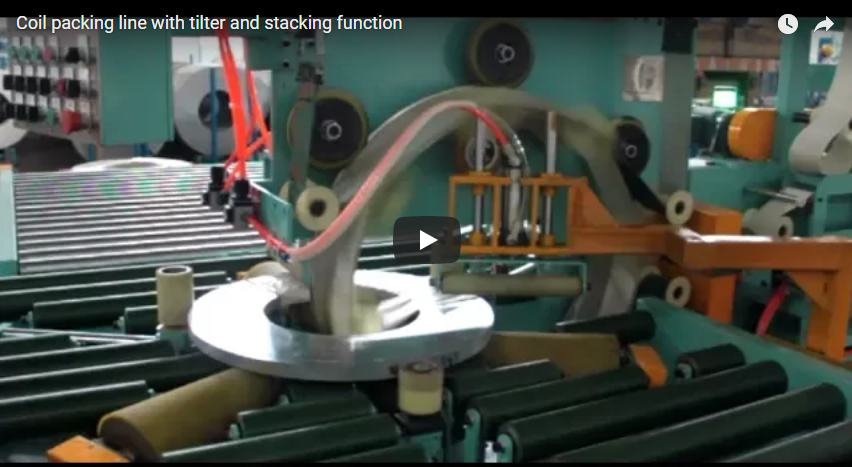
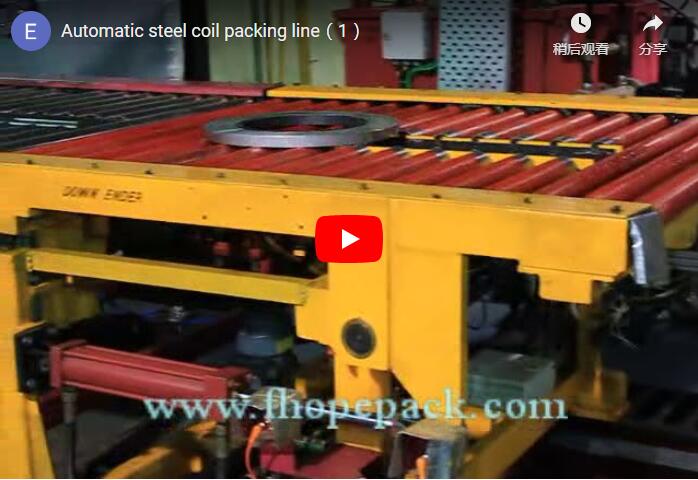
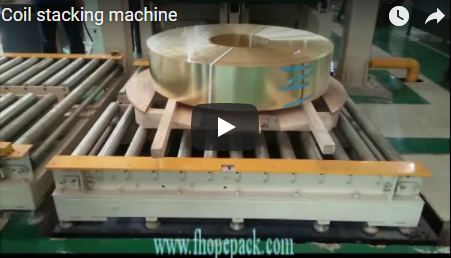
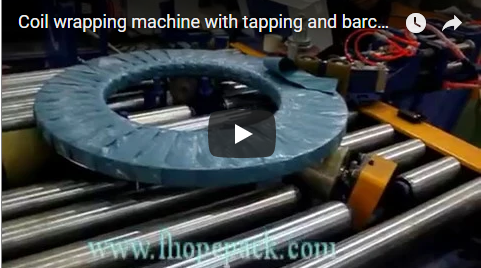
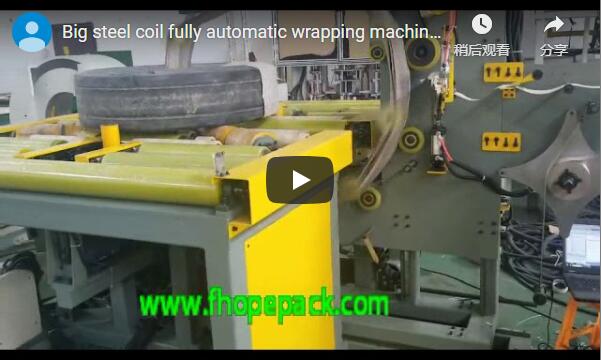
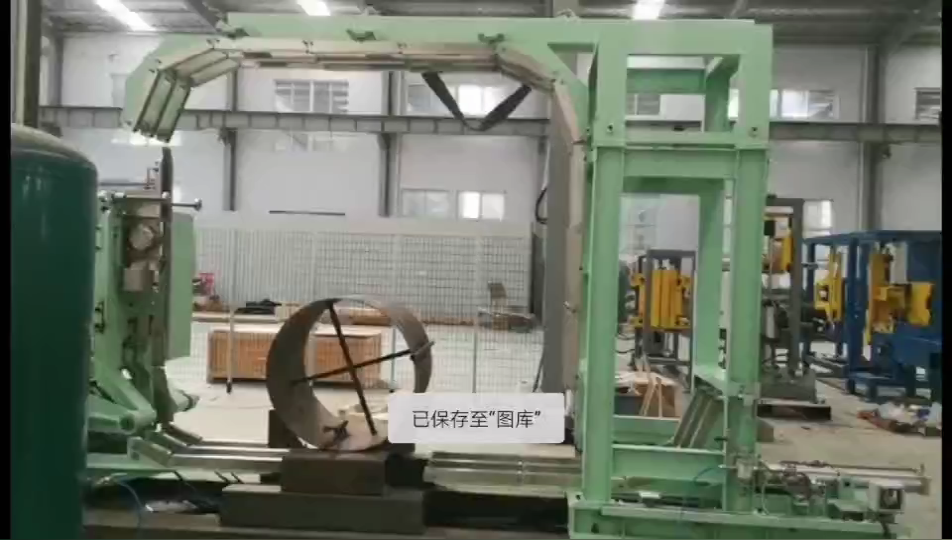
Executive summary This 24 s clip was filmed on an installed line running our equipment. It shows a tall coil upender station, an eye-through ring wrapping a flat steel coil on a roller conveyor, and a wide view of the hall. The safety case for a line like this is simple. It removes the two most dangerous manual jobs in coil packing, turning coils with a crane and wrapping them by hand.
Table of Contents
- What the clip shows
- The manual jobs a line replaces
- The coil upender: turning without a crane
- The eye-through wrapper: no hand wrapping
- Line layout and people flow
- Selection checklist for an upender and wrapping line
- Controls and safety
- Engineering FAQ
- Next step
- Related reading
- Sources
What the clip shows
| Clip time | What is on screen |
|---|---|
| 0–6 s | a tall blue upender frame with yellow arms holding a steel coil; a grey control cabinet with touchscreen beside it |
| 8–12 s | a flat steel coil on yellow powered rollers passes through a vertical wrapping ring that lays clear film through the eye |
| 14–24 s | the camera pans along the hall: conveyors, further packing stations and an overhead crane |
One operator works at the infeed side. The coil is moved and wrapped by the machines throughout.
The manual jobs a line replaces
In a plant without a packing line, two jobs carry most of the risk:
- Turning coils with a crane and slings. The coil swings as it passes its balance point, and people stand close to guide it.
- Hand wrapping. Operators walk around a heavy coil, threading film or paper through the eye.
A line, such as our automatic coil turnover, feeding and wrapping line, puts both jobs inside machines. People load, watch the screen and change film rolls. They do not stand next to a moving coil.
The coil upender: turning without a crane
A coil upender tilts a coil between horizontal and vertical on a fixed frame, at a controlled speed.
From our FPCT coil upender table:
| Model | Max. loading | Power | Turning time | Machine weight |
|---|---|---|---|---|
| FPCT-02 | 2 t | 1.5 kW | 50–70 s | 2.0 t |
| FPCT-05 | 5 t | 1.5 kW | 50–80 s | 2.5 t |
| FPCT-10 | 10 t | 3.2 kW | 60–90 s | 3.0 t |
| FPCT-20 | 20 t | 4.5 kW | 60–90 s | 3.5 t |
| FPCT-50 | 50 t | 11.5 kW | 60–100 s | 4.5 t |
The table size is made to the coil size. A turning time of 50–100 s is slow on purpose: the coil passes its balance point without a jolt. Like all our machines, each upender is built per project, so the figures can change.
The eye-through wrapper: no hand wrapping
In the clip the ring passes through the coil eye while the rollers turn the coil. Film covers the outside, the inside and both faces in one cycle.
On our coil packing lines, the PLC/HMI programs set centring, tension and overlap per coil type. The operator picks the coil type on the screen; nobody walks round the coil with a film roll. Film, paper or woven wrap can be used, and PET or steel strapping can follow.
Line layout and people flow
The wide shot at the end shows what a line does to a hall:
- One flow direction. Coils move along conveyors from station to station, not across the floor on forks.
- Fewer crane lifts. The crane loads the line and takes finished packs away.
- Clear walkways. People walk beside the line, outside the stations.
When we lay out a line, the walkways and the fence line are on the first drawing, not added later.
Selection checklist for an upender and wrapping line
- Coil weight, OD, ID and width, smallest and largest.
- Which way coils arrive and leave: eye horizontal or eye vertical.
- Coils per hour and the number of crane lifts you want to remove.
- Wrap material, strapping and labelling.
- Floor space, crane coverage and walkways.
- Who loads film and where they stand.
Controls and safety
The standards that apply depend on the destination market. For CE markets, ISO 12100 sets the risk-assessment method and EN 415-10 covers general requirements for packaging machines, which fixes guarding and the emergency-stop arrangement.
On this line each station has its own control cabinet with a touchscreen. Fencing, interlocks and stop circuits are fixed in the risk assessment for each layout.
Engineering FAQ
Q: Does the clip show the coil being turned? A: It shows the upender station holding a coil, then the wrapping ring at work. The full turning motion is not in this short clip.
Q: How heavy a coil can our upenders turn? A: Our FPCT table runs from 2 t up to 50 t, by model.
Q: How long does a turn take? A: From 50–70 s on the FPCT-02 to 60–100 s on the FPCT-50. The slow turn lets the coil pass its balance point without a jolt.
Q: Does the wrapper need an operator for each coil? A: No. The program sets centring, tension and overlap for each coil type, and the operator selects the type on the HMI.
Q: Which wrap materials can the line use? A: Film, paper or woven wrap, with PET or steel strapping as an option.
Next step
We plan an upender and wrapping line in three steps:
- Submit your layout drawing with coil sizes, weights and how coils arrive, to info@fhopepack.com.
- Receive a proposal within 48 hours, with the upender model, wrapper and conveyor layout.
- Book a site survey so we confirm crane coverage, walkways and floor space.
Related reading
- Stainless Steel Coil Packaging Line: Tilting, Eye-Through Wrapping, Labelling and Stacking
- Slit Coil Stretch Wrapping and Stacking Line: Eye-Through Ring to Gantry Stacker
- The ROI of Safety: 90-Degree Mold Upenders Instead of Crane Flipping
- Coil upender
Sources
- Machine in action: the video on YouTube (24 s)
- FPCT loading, power, turning time, machine weight, table size per coil, horizontal–vertical tilting: Coil upender
- PLC/HMI centring, tension and overlap; film, paper, woven wrap; PET or steel strap: Automatic coil packing line
- Standards scope: ISO 12100:2010; EN 415-10:2014
- Proposal timing: approved house CTA (proposal within 48 hours)
Last reviewed: 2026-10-06