Executive summary
The video shows a steel wire coil compactor squeezing a loose coil into a dense bundle. Strapping is part of the solution name, but the video does not show the strapping step — confirm it before buying. Use this article to check fit: coil size, press force, cycle time, and strap integration.
What the video shows
The video is a factory demonstration with background music and no narration. All descriptions below come from visual observation, sampled frame by frame.
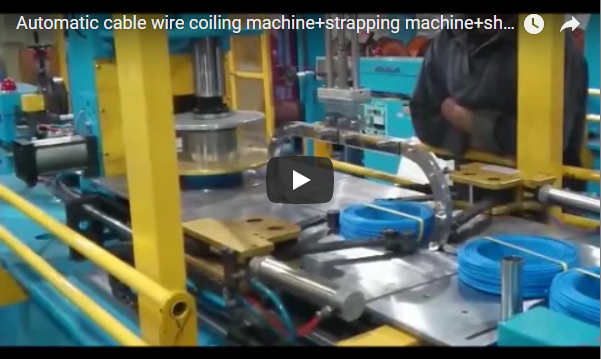
- The machine is blue and yellow, with a central blue column that houses the compaction mechanism.
- A large, tightly wound steel wire coil rotates on the right side and feeds the machine (0–12 s).
- The central column moves vertically and compresses the wire into a denser bundle.
- A close-up (12–16 s) shows the coil surface and the precision of the winding.
- The process appears continuous and automated.
Direct observation notes
- Machine: blue and yellow body with a central blue compaction column; heavy-duty steel frame; yellow safety railings.
- Product: large, tightly wound, dark grey steel wire coil.
- Process: feed → compact → hold for strapping (the strapping step itself is not shown).
- Markings: CE marking and a high-voltage warning label on the grey control panel; red emergency stop button.
What the video does not show
Honesty matters when you evaluate this machine. The footage does not show:
- Rated coil size, weight, or wire diameter.
- Press force and final density.
- The strapping station, despite the name “compactor and strapping solution”.
- Cycle time per coil.
- Model numbers, power requirements, or certifications beyond the CE mark.
- Maintenance requirements.
How to evaluate this solution
Use this framework instead of relying on the machine’s name or a generic brochure:
| Criterion | What to check | Why it matters |
|---|---|---|
| Coil range | Max/min weight, diameter, width | An oversized coil cannot enter the column |
| Density need | Press force and final density at your coil | Determines how much shipping space you save |
| Strap integration | Separate or inline strapping | Affects floor space and operator count |
| Throughput | Cycle time per coil | Must match your line’s production rate |
| Safety | Guards, interlocks, emergency stop, CE | Required for plant compliance |
Fit criteria
The solution fits best when:
| Condition | Confirm |
|---|---|
| Your coil size is within the machine envelope | Ask for the rated range |
| You need higher shipping density | Ask for the compaction ratio at your coil |
| Strapping is included or already in your line | Confirm the configuration |
| Cycle time matches your output | Match coils per hour to your line |
If your coils are outside the range, the machine will not be a fit. No amount of strapping fixes an undersized column.
What to verify with the manufacturer
- Coil envelope — maximum weight, diameter, and width.
- Compaction force — press force and the resulting density.
- Strap specs — material, width, and whether strapping is integrated.
- Cycle time — coils per hour at your coil size.
- Safety — guards, emergency stop, CE, and regional certifications.
- Support — spare parts, service, and training.
Buyer questions
What coil sizes can the compactor handle? Confirm the maximum and minimum range against your production mix.
What press force is available? Ask for the force and the resulting density, not just a nominal rating.
Is strapping integrated or separate? The video shows compaction only, so confirm how the bundle gets strapped.
What is the cycle time? Ask for coils per hour at your size, and how changeover affects it.
What maintenance does the machine need? Typical checks cover the compaction column, drive, hydraulics, and controls. Request the schedule and spare-parts list.
Why this matters in practice
Loose wire coils waste space and risk damage in transit. Compaction makes each coil denser, so more product fits per truck. Strapping then holds the compacted shape through lifting and stacking.
For wire producers, the payoff is lower shipping cost, fewer loose bundles, and less rework at the customer end. The catch is that the video proves the compaction step only; the strapping claim needs factory confirmation before you treat it as included.
Common applications
- Wire mills packaging finished coils for shipment.
- Wire drawing lines finalizing product before storage.
- Service centers preparing coils for delivery.
- Export operations optimizing truck and container loads.
How the machine fits into a production line
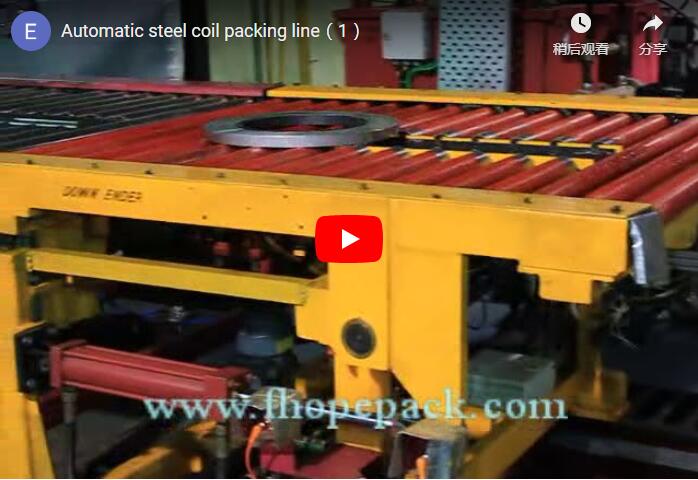
A compactor is not an island; it sits between the wire line and the shipping area. In the video, the coil feeds directly from a rotating platform into the compaction column, which points to an inline layout.
Typical line positions:
- After rewinding — finished coils move straight into the compactor.
- Before strapping — the compacted bundle stays under the column while straps are applied.
- Before wrapping — some lines add stretch film or paper after strapping.
- Before palletizing — compacted bundles are lifted onto pallets for storage.
Ask how your current equipment connects. The compacting step may run fine while the transfer between stations becomes the real bottleneck.
Operation and safety notes
- Center the coil. A centered coil compacts evenly and keeps the column stroke clean.
- Check the strap stock. Reload before it runs out so the line does not stop mid-cycle.
- Monitor the column. Confirm clean, full strokes on every cycle.
- Test the emergency stop. Confirm it works before each shift.
- Respect the high-voltage label. The control panel carries a warning; only trained personnel should open it.
- Keep railings closed. Yellow safety railings and interlocks protect operators while the column moves.
Alternative configurations
If the integrated version does not match your line, compare these options:
| Configuration | Compaction | Strapping | Best when |
|---|---|---|---|
| Manual handling | Loose | By hand | Low volume, simple coils |
| Compactor only | Dense | Separate step | Strapping already exists in your line |
| Compactor and strapping | Dense | Integrated | You want one flow, one supplier |
The integrated solution keeps both steps in one flow and one control panel. It also concentrates responsibility for the result in one machine, which simplifies service.
Source and method
This article is based on the embedded YouTube video, analyzed locally with a vision-language model on sampled frames. The video contains background music and no narration, so all observations are visual. Specifications that do not appear in the footage are marked as items to confirm with the manufacturer.
Related reading
- Steel Wire Coil Compactor and Strapping Solution
- Hydraulic Wire Coil Compacting Machine
- Automatic Steel Wire Coil Rewinding and Compacting Line
- Steel Coil Radial Strapping Machine: Complete Guide
Next step
Contact the FHOPE sales team with your coil sizes and density target for a fit assessment. Use the contact page to start the conversation.
Last updated: 2026-08-22.