Executive summary Loose wire from a large reel takes space and slips in transport, so wire mills rewind it into smaller coils, press them dense and strap them tight. Our line does this in stations: a rewinder, a vertical compacting press and a strapping station, all in blue and yellow, with a forklift taking the finished coil. Strap use follows from the coil height, the coil wall and the number of bands. All are set per project.
Table of Contents
- Line stations in the video
- How the line works
- Strap use per coil
- Why rewind and compact
- Controls and safety
- Selection checklist for a wire coil rewinding and compacting line
- Engineering FAQ
- Next step
- Related reading
- Sources
Line stations in the video
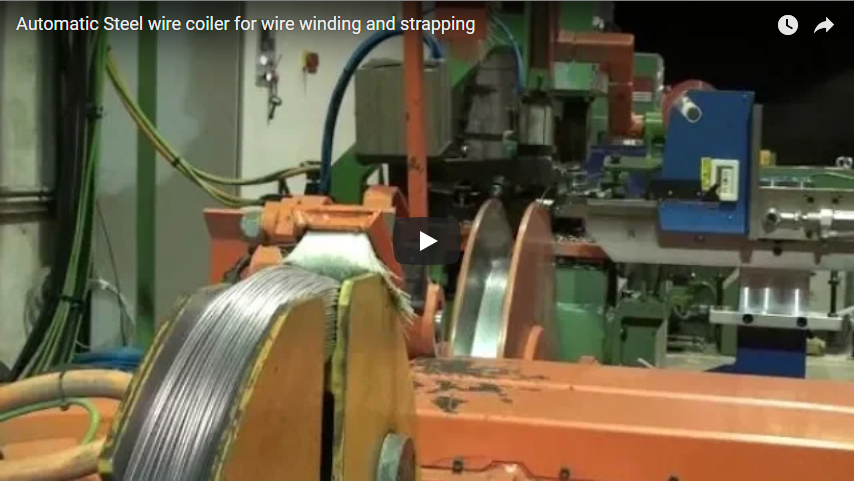
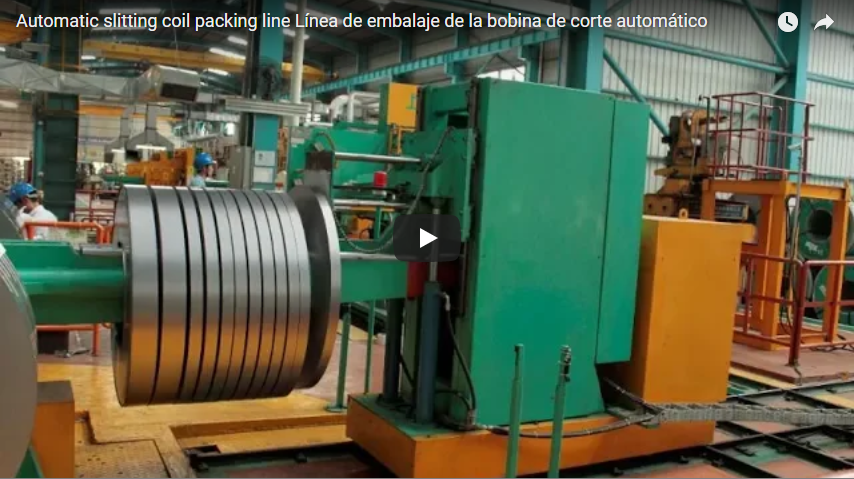
A blue and yellow rewinder draws steel wire off a large reel and winds it onto a turning mandrel into a smaller coil. A close-up shows the wire guided onto the coil.
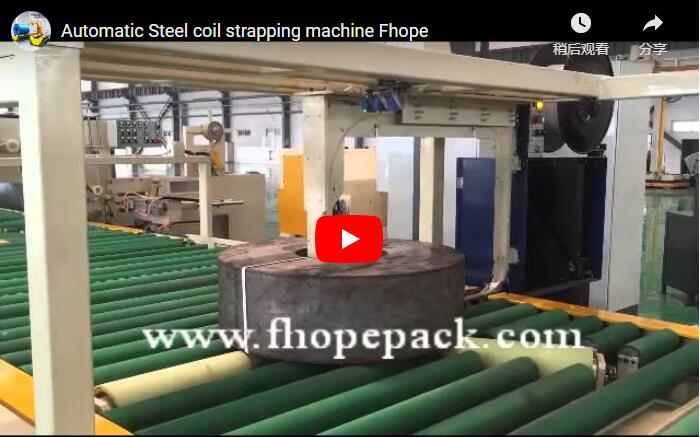
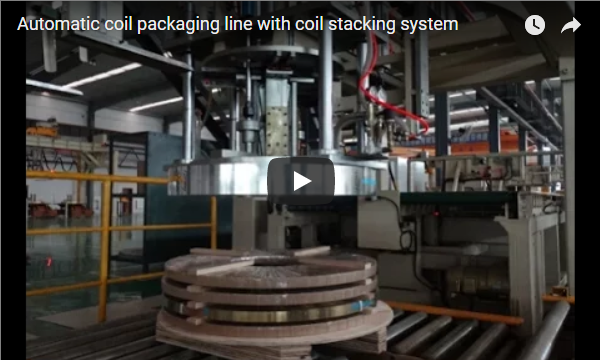
The new coil moves to a tall vertical press that compacts it into a dense cylinder. At the strapping station, straps go round the coil wall, and the operator panel shows the strapping screen with a coil count and total strap length. A forklift lifts the finished coil away.
How the line works
| Station | What it does |
|---|---|
| Rewinder | Draws wire off the supply reel and winds a smaller coil on a mandrel |
| Transfer | Moves the coil to the press |
| Compacting press | Presses the coil down to a dense, even height |
| Strapping | Bands the coil through the eye while it is held compact |
| Unload | A forklift takes the strapped coil away |
Strapping while the coil is held compact locks in the density. If the press opens first, the coil springs back and the straps go on loose.
Strap use per coil
Each radial band runs through the eye and around the coil wall. Its length is about the perimeter of the wall section:
Band length ≈ 2 × (coil height + wall), where wall = (OD − ID) ÷ 2
Illustrative example for a compacted coil of 1,000 mm OD, 500 mm ID and 800 mm high, with 4 bands:
| Item | Value |
|---|---|
| Wall, (1,000 − 500) ÷ 2 | 250 mm |
| Band length, 2 × (800 + 250) | 2,100 mm |
| Strap per coil, 4 × 2.1 m | about 8.4 m |
Add the seal overlap to each band when you order strap. The strapping screen’s count and total strap length let you check real use per coil over a shift.
Why rewind and compact
| Reason | Effect |
|---|---|
| Smaller coils | Easier to handle and to feed at the customer |
| Dense coils | Less volume per tonne in the truck or container |
| Even height | Coils stack straight and straps sit flat |
| Strapped while compact | Turns cannot slip or spring loose |
We match the coil size to your customers’ pay-off equipment. If the coils also need a film cover, see our steel wire coil wrapping machine.
Controls and safety
The rewinder, press and strapping head all move under power. Keep people outside the guarded stations while the line runs, and stop the station before clearing a wire or strap jam.
The standards that apply depend on the destination market. For CE markets, ISO 12100 sets the risk-assessment method and EN 415-10 sets general requirements for packaging machines.
Selection checklist for a wire coil rewinding and compacting line
- Wire diameter and grade.
- Supply reel size and weight.
- Finished coil OD, ID, height and weight.
- Bands per coil and strap type, and whether coils are also wrapped (see our economic wire wrapping machine).
- Coils per shift.
- Forklift or conveyor take-away and floor space.
Engineering FAQ
Q: Why rewind before compacting? A: To turn a large supply reel into smaller coils that suit handling and the customer’s pay-off.
Q: Why strap while the press holds the coil? A: So the coil cannot spring back; strapping after release leaves loose straps.
Q: How much strap does a coil take? A: About 8.4 m for four bands on a 1,000 mm OD, 500 mm ID, 800 mm high coil in our example, plus the seal overlap on each band.
Q: How do I track strap use? A: The strapping screen shows a coil count and total strap length, so you can check use per coil.
Q: What happens if the press opens before strapping? A: The coil springs back, the straps go on loose and the density is lost.
Q: How is the coil taken away? A: By forklift from the strapping station, as in our video.
Next step
We plan your wire coil line in three steps:
- Submit your layout drawing with wire sizes, coil sizes and output to info@fhopepack.com.
- Receive a proposal within 48 hours, with the station layout and strap plan.
- Book a site survey to check the line layout and take-away.
Related reading
- Video: automatic steel wire coiler for wire winding and strapping
- Video: automatic wire coil rewinding and tying machine
- Automatic coil packing line
Sources
- Machine content: FHOPE engineering team, 2026-10-04
- Strap example: our worked example, illustrative values
- Machine in action: our video on YouTube
- Standards scope: ISO 12100:2010, EN 415-10:2014
Last reviewed: 2026-10-04