Executive summary
Packaging equipment for an inline stream wraps products as they travel, so every piece leaves the line covered. This stretch wrapping machine feeds boxes on a conveyor into a wrapping area, where a cross arm lowers stretch film over the load and completes the wrap. The wrapped piece moves out and the next one enters, cycle after cycle. Packaging solutions for your industry, box size and film choice are confirmed per project.
Table of Contents
- Why inline stream packaging
- What the machine does
- Cross arm film head
- Inline conveyor feed
- What the footage shows
- Typical configuration
- Selection checklist
- Operation and safety
- Engineering FAQ
- Next step
- Related reading
- Sources and standards
Why inline stream packaging
A line that turns out boxed or bagged products still has to wrap each piece before it ships. Doing it by hand slows the line, and online wrapping keeps every piece covered at the same speed as the stream.
The machine wraps products as they move on a conveyor, so the line does not stop between cycles. Box size and line speed are confirmed per project.
What the machine does
The machine is an inline stretch wrapping unit. Products travel on a conveyor into a wrapping area, and a powered cross arm lowers stretch film over the load and completes the wrap, then rises for the next cycle.
The line feeds the next piece in as the wrapped piece moves out. Box size, film width and line speed are confirmed per project.
Cross arm film head
A vertical column at the side of the line carries the film head on a cross arm that moves along the top rail. The arm lowers over the load, covers it with stretch film and completes the cycle, then rises and returns.
The head applies the film from above, so the load stays on the conveyor through the cycle. Arm travel and film tension are confirmed per project.
Inline conveyor feed
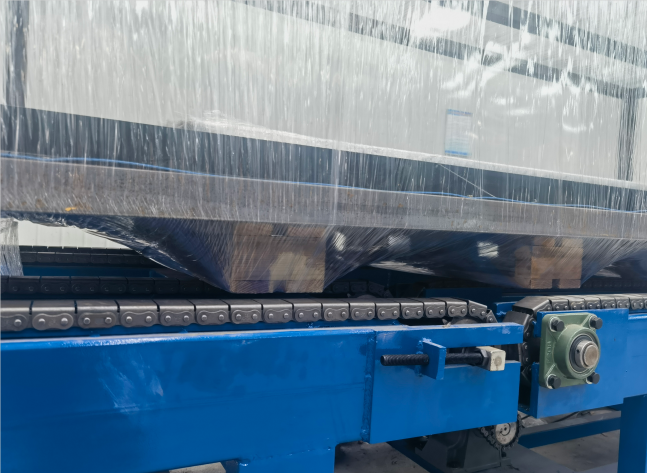
The conveyor carries the product into the wrapping area from the front and moves the wrapped piece out at the back. The cycle repeats as the next product enters, so the stream keeps moving.
The control panel on the column shows a running indicator light and push buttons for the operation. Conveyor height and the feed direction are confirmed per project.
What the footage shows
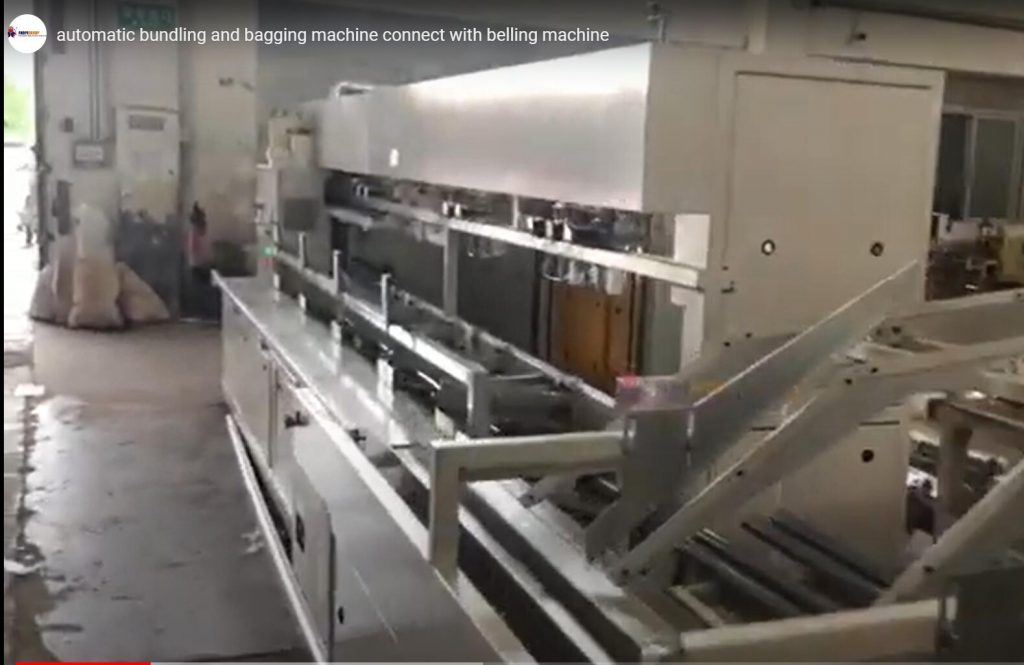
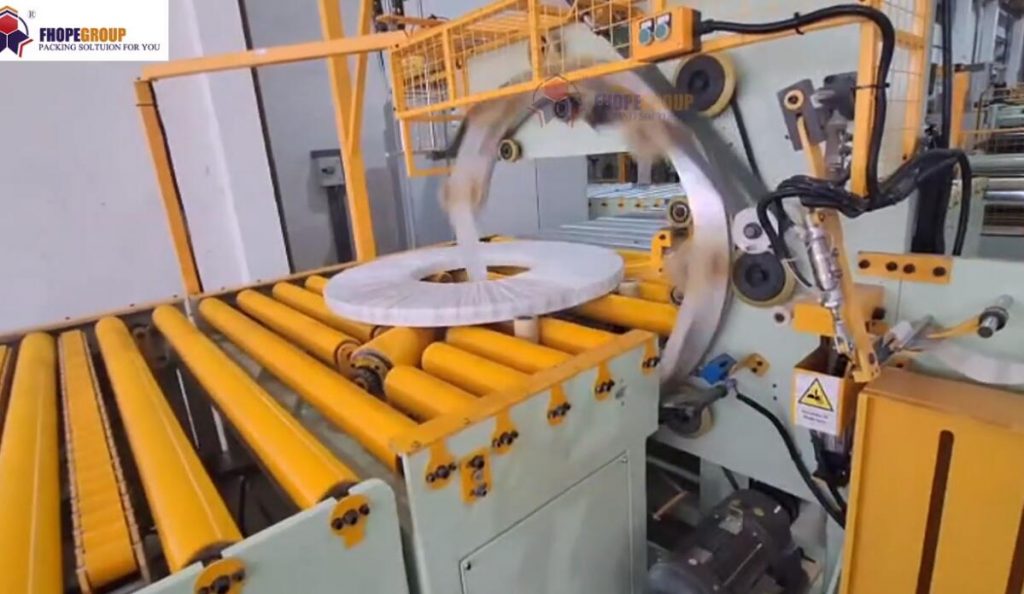
Our footage shows a boxed product on the conveyor, the cross arm lowering stretch film over it, and the wrapped piece leaving as the next one enters. It is a general demonstration, so your box size, film choice and line speed are confirmed with us per project.
Typical configuration
Figures below list functional design boundaries rather than numeric values, and are confirmed per project.
| Parameter | Typical range, confirmed per project |
|---|---|
| Load | boxes and packs on conveyor |
| Wrapping | cross arm with stretch film |
| Feed | inline conveyor, continuous |
| Control | panel with indicator light and buttons |
| Mount | floor, inline with the stream |
| Electrical supply | 380 V three phase 50 Hz, or 220 V single phase for light machines, selected per project |
Selection checklist
| Question | Confirm per project |
|---|---|
| Product range | size, weight, pack type |
| Film | width, thickness, stretch |
| Cycle | wrap time, head travel |
| Line | conveyor height, speed, direction |
| Site | floor space around the line |
| Electrical supply | voltage, phase and frequency on site |
Operation and safety
Start the line, let products feed into the wrapping area, and watch the cycle from a clear position while the arm moves over the load. Keep hands clear of the arm and the conveyor while the machine runs.
Routine checks cover the cross arm, the conveyor and the film supply, per the machine manual. Confirm the product is stable on the conveyor before each cycle.
Engineering FAQ
Q: What does this machine do? A: It wraps products with stretch film as they move on an inline conveyor.
Q: How does the wrap happen? A: A powered cross arm lowers stretch film over the load and completes the wrap, then rises.
Q: Does the line stop between pieces? A: No, the conveyor feeds the next piece in as the wrapped piece moves out.
Q: Can it handle different box sizes? A: The arm and film adapt within the machine range; your box size and line speed are confirmed per project.
Q: What does it suit? A: Boxed and bagged products on a stream line that need a consistent wrap before shipping.
Next step
- Email us at info@fhopepack.com with your box size and line speed.
- We send an inline packing proposal within 48 hours.
- We confirm the conveyor interface and film choice for your line.
Related reading
- Packaging Equipment: Solutions for Industry
- Sofa packing machine, furniture packaging line
- Integrated automatic band strapping machine for book, box, magazine
- FHOPE packing machinery product lines
Sources and standards
- ISO 12100:2010 Safety of machinery, general principles for design and risk assessment
- EN 415-10:2014 Safety of packaging machines, general requirements
- EN ISO 13849-1:2023 Safety of machinery, safety-related parts of control systems
FHOPE inline stretch wrapping demonstration video. Reviewed as a general demonstration; box size, film choice and line speed confirmed per project.
Last reviewed: 2026-10-11