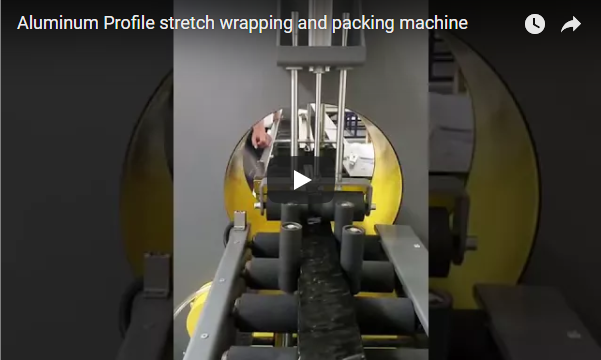
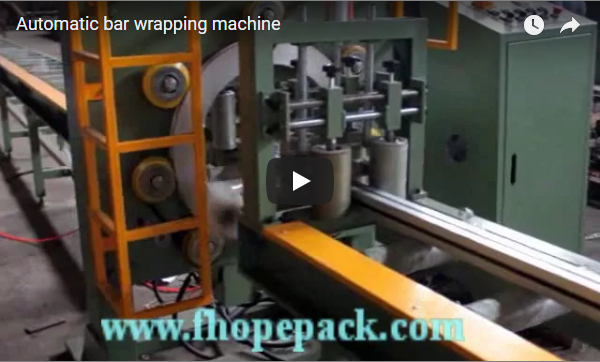
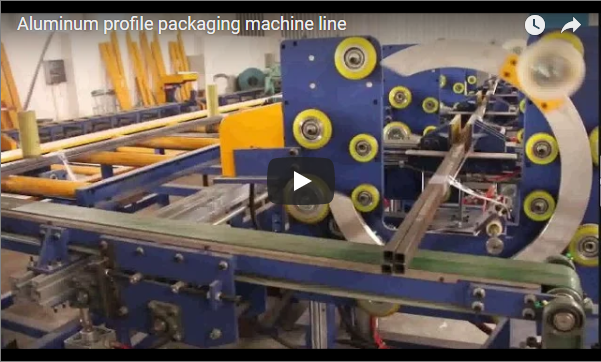
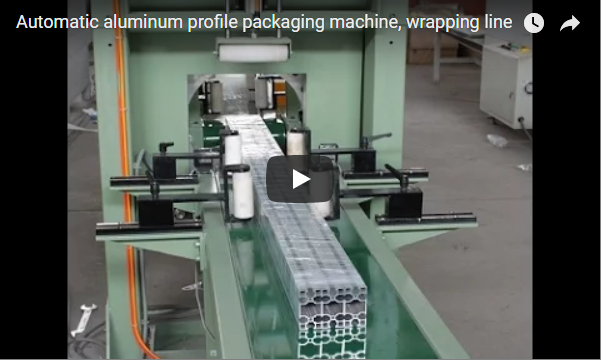
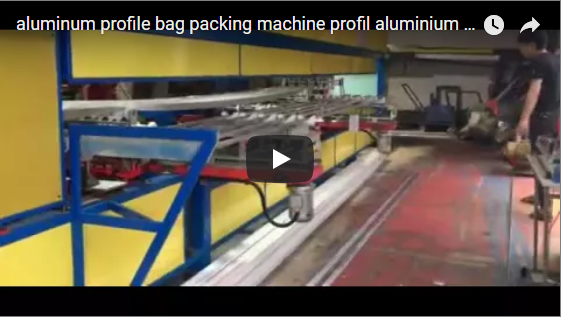
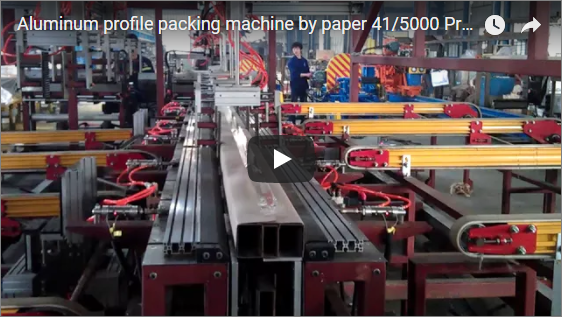
Executive summary A horizontal orbital stretch wrapping machine turns a film carriage round a ring while conveyors carry a long load through it, so the film wraps the load in a spiral. Our short clip, about 10 s long, shows the yellow film carriage turning round a large guarded ring over a roller conveyor, with the load held in place. Our E1000 orbital wrapper takes bundles of 400 to 1000 mm OD and 50 to 400 kg, with the ring at about 10 to 60 r/min.
Table of Contents
- What the clip shows, in order
- Cycle time on the clip
- How a horizontal orbital stretch wrapper works
- E1000 orbital wrapper specifications
- Takt check
- Selection checklist for an orbital stretch wrapper
- Controls and safety
- Engineering FAQ
- Next step
- Related reading
- Sources
What the clip shows, in order
The machine has a large light grey ring housing with a yellow mesh guard round its top. A roller conveyor runs through the ring, and a separate control cabinet stands to the left. Rolls of film, wooden crates and other machines stand in our workshop behind it.
- 0 to about 3 s. A long, silver-grey load lies on the conveyor at the ring. The yellow film carriage swings round the ring from the upper right.
- About 3 to 6 s. The carriage keeps turning, and film lays over the load.
- About 6 to 10 s. The carriage completes more turns, and the film layers build on the load, which stays in the same place.
Cycle time on the clip
| Step on the clip | Time window | Duration |
|---|---|---|
| First turns of the carriage | 0 to about 3 s | about 3 s |
| Film laid on the load | about 3 to 6 s | about 3 s |
| Layers build | about 6 to 10 s | about 4 s |
The clip is only about 10 s long, so it shows part of a wrap, not a full cycle. The times come from frames about 0.6 s apart.
How a horizontal orbital stretch wrapper works
The infeed conveyor carries the load into the ring. A photocell sensor sets the wrapping position, and the carriage turns round the ring, pulling stretch film off the roll. As the conveyors move the load forward, the film lays on it in a spiral, with the overlap set from 10% to 90%.
The wrap can be reinforced at both the head and the end of the load, set on the touch screen. While that happens the load stays in place, as it does on the clip. Press-down devices on the infeed and outlet conveyors hold the load steady, and side guides stop it shaking.
At the end, an automatic mechanical hand cuts the film, by heat or knife, and clamps it for the next wrap.
| Part | What it does |
|---|---|
| Reinforced aluminium ring, ring width up to 60 mm | Carries the film carriage round the load |
| Infeed and outfeed conveyors | Carry the load through the ring |
| Photocell sensor | Sets the wrapping position |
| Press-down devices | Hold the load during the wrap |
| Mechanical hand | Cuts and clamps the film |
| PLC, HMI and inverters | Set ring speed, roller speed and package size |
E1000 orbital wrapper specifications
| E1000 orbital stretch wrapper | Specification |
|---|---|
| Object length | Over 1000 mm |
| Bundle OD | 400 to 1000 mm |
| Weight | 50 to 400 kg |
| Infeed conveyor | 2000 mm long × 1200 mm wide |
| Outfeed conveyor | 2000 mm long × 800 mm wide |
| Conveyor speed | 3 to 12 m/min |
| Ring speed | About 10 to 60 r/min |
| Packing material | LLDPE stretch film, paper or woven |
| Machine size | About L 4800 × W 1800 × H 2000 mm |
| Power | About 4.5 kW, 380 V, 50 Hz, 3 phase |
Takt check
For an illustrative 3000 mm load at a conveyor speed of 6 m/min, the load passes the ring in 30 s. Adding about 10 s for the head and end reinforcement and the cut gives about 40 s, or up to 90 loads an hour.
A lower conveyor speed gives a closer overlap but a longer cycle. We set the speed against your load count per hour.
Selection checklist for an orbital stretch wrapper
- Load length, OD and weight, against over 1000 mm, 400 to 1000 mm and 50 to 400 kg.
- Loads per hour.
- Wrap material: stretch film, paper or woven.
- Head and end reinforcement.
- Heat or knife cutting.
Controls and safety
On the clip, nobody stands at the ring while the carriage turns, and the mesh guard covers the top of the ring. A person reaching into the ring area is the move to design out. The automatic wrapper keeps operators away from the moving parts, and the separate control panel stands clear of the ring.
Stop, isolate and lock out the wrapper before anyone reloads film, frees a load or reaches into the ring. The ring has soft start and jog, which are for set-up with the guard in place.
The standards that apply depend on the destination market. For CE markets, ISO 12100 sets the risk-assessment method, and EN 415-10 covers general requirements for packaging machines, which fixes guarding and the stop arrangement.
Engineering FAQ
Q: What loads fit the E1000? A: Loads over 1000 mm long, 400 to 1000 mm OD and 50 to 400 kg.
Q: How is the film cut? A: An automatic mechanical hand cuts it by heat or knife and clamps it for the next wrap.
Q: How fast does the ring turn? A: About 10 to 60 r/min, set by inverter, with the overlap from 10% to 90%.
Next step
We size a horizontal orbital stretch wrapping machine in three steps:
- Submit your layout drawing with the load sizes, weights and loads per hour, to info@fhopepack.com.
- Receive a proposal within 48 hours, with the wrapper model, the conveyor layout and the cycle check.
- Book a site survey so we confirm the infeed, the outfeed and the guarded area.
Related reading
- E1000 horizontal stretch wrapper
- Profile orbital wrapping machine with 90 degree transfer
- Horizontal wrapping machine for batten
Sources
- Machine specifications: E1000 horizontal stretch wrapper product page
- Clip timing: frame timings taken from our clip, about 0.6 s between frames
- Machine in action: our video on YouTube
- Standards scope: ISO 12100:2010, EN 415-10:2014
Last reviewed: 2026-10-05