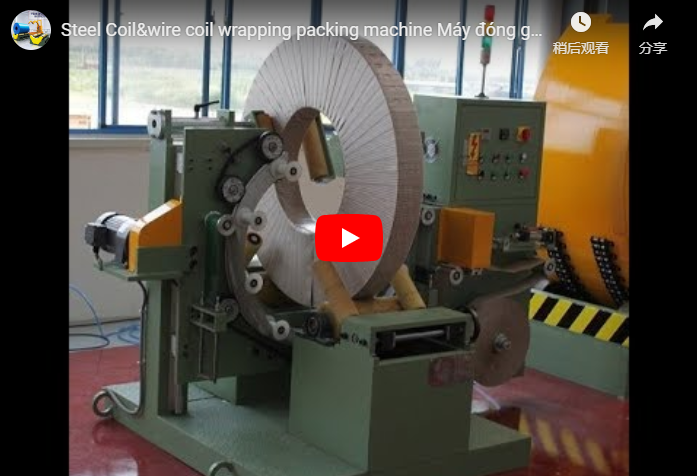
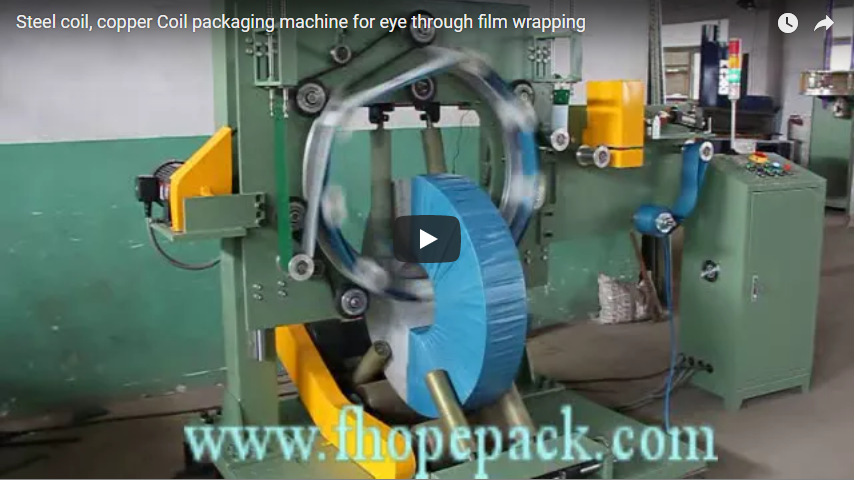
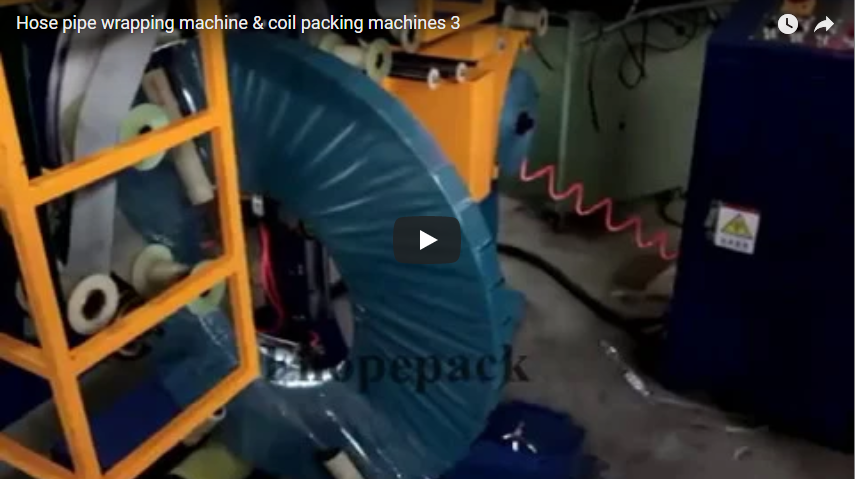
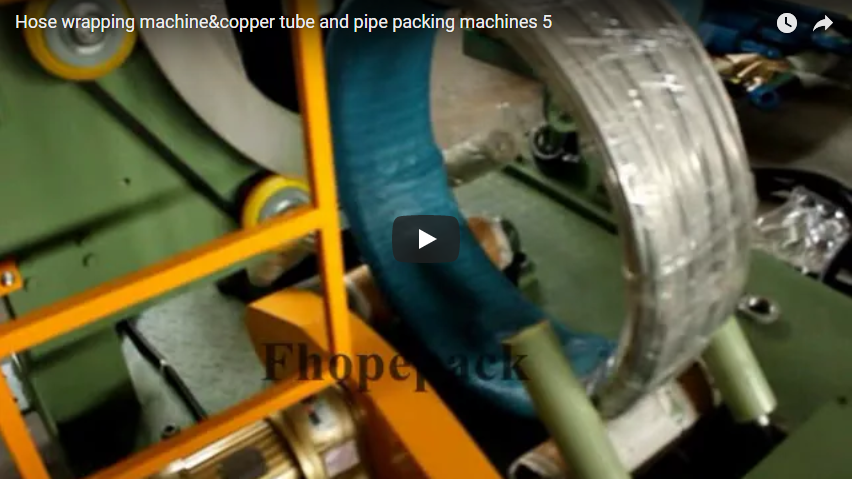
Executive summary A wire coil wrapping machine of the ring type lays a band of packing material through the eye of the coil and around its section, turn by turn. This 10-second clip shows a green paper band being laid onto a black wire coil while a curved guide arm holds it to the coil profile. Our equivalent solution, the FPW-300, wraps coils of 300 to 700 mm ID, 450 to 850 mm OD, 100 to 300 mm width and 10 to 250 kg, in paper or film.
Table of Contents
- What the clip shows, in order
- How a ring-type coil wrapper lays the band
- Why wrap wire coils in paper or film
- FPW-300 specifications
- Takt check for a manual-load coil wrapper
- Selection checklist for a wire coil wrapping machine
- Controls and safety
- Engineering FAQ
- Next step
- Related reading
- Sources
What the clip shows, in order
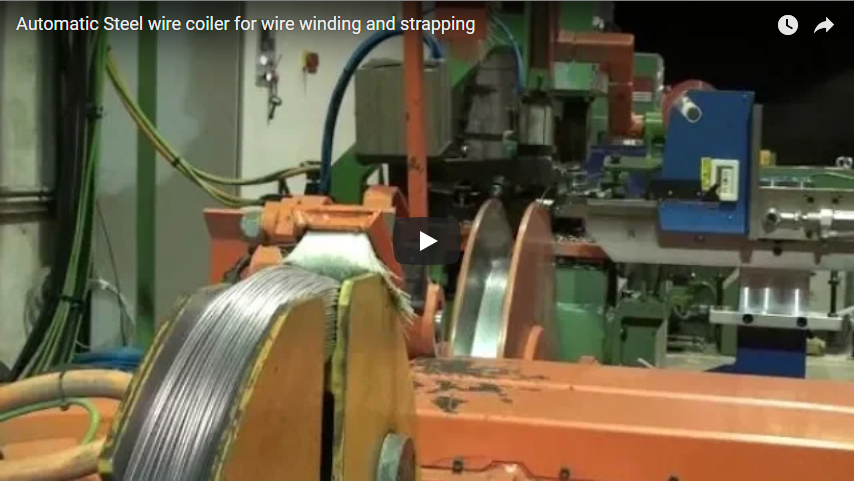
The machine has a dark green steel frame on a black base. A large black wire coil stands at the wrapping head, and a band of bright green paper runs into the head from the lower right.
- 0 to about 4 s. The machine is running. The green paper band feeds in from the right and a curved metal arm presses it into the space at the outside of the coil.
- About 5 to 7 s. The arm keeps pressing and runs along the outer edge of the coil, so the paper is laid onto the side of the coil. A person in a red cap walks away in the background, well clear of the machine.
- About 8 to 10 s. The arm returns after a local wrap, and the band keeps feeding. The machine runs on without a stop, and the wrapped section of the coil shows a smooth green cover.
The clip starts and ends mid-cycle, so loading, band cut and unloading fall outside it.
How a ring-type coil wrapper lays the band
A ring-type wrapper passes the packing material through the eye of the coil and back around the outside. As the coil is indexed round, the turns overlap and build a closed cover over the whole ring of wire.
Our FPW-300 is a ring wrapper built for this job. The operator ties the start of the band to the coil, and the machine then lays the band with an overlap set to the requirement. A brake on the band release keeps the tension even and stops the material from folding.
| Element on the FPW-300 | What it does |
|---|---|
| Ring with band holder | Carries the band through the coil eye and around the section |
| Adjustable ring height | Fits coils of different OD |
| Special brake on the band release | Keeps tension even, avoids folding |
| Overlap setting, 10% to 90% | Sets how much each turn covers the last |
| PLC with time relay, push-button panel | Manual and automatic working modes |
Why wrap wire coils in paper or film
A bare wire coil picks up dust and moisture in transport. A paper band closes the coil, protects the surface and keeps the turns together, so the coil can be stacked, strapped or packed again without loose ends.
The FPW-300 also runs PVC, LLDPE, PE or HDPE band, so one wrapper covers a paper wrap for one product and a film wrap for another.
FPW-300 specifications
| FPW-300 wire coil wrapping machine | Specification |
|---|---|
| Coil inner diameter | 300 to 700 mm |
| Coil outer diameter | 450 to 850 mm |
| Coil width | 100 to 300 mm |
| Coil weight | 10 to 250 kg |
| Packing material | PVC, LLDPE, PE, paper or HDPE |
| Material roll | 50 mm core, 100 to 250 mm OD, 100 to 120 mm wide |
| Overlap rate | 10% to 90% |
| Power | 1.5 kW, 380 V, 50 Hz, 3 phase |
| Air supply | Not required |
We confirm your coil range against this window first. A coil outside it moves to a larger ring.
Takt check for a manual-load coil wrapper
The clip covers part of one cycle, so it gives no full cycle time. We size the line from the target output instead.
For an illustrative target of 30 coils per hour, the takt is 3,600 ÷ 30 = 120 s per coil. Loading, tying the band, wrapping, cutting the band by hand and unloading all have to fit in that 120 s.
On the FPW-300, infeed and outfeed are manual and the band is cut by hand. Those manual steps, not the ring, usually set the pace. A higher overlap adds turns and lengthens the wrap. In the proposal we check the wrap time at your overlap against the takt.
Selection checklist for a wire coil wrapping machine
- Coil ID, OD, width and weight, against the FPW-300 window in the table above.
- Packing material: paper, PVC, LLDPE, PE or HDPE, and the roll size.
- Overlap rate and the number of layers needed for storage and transport.
- Output target per hour, and whether manual loading keeps up with it.
- Next step after the wrap: strapping, labelling, stacking or a second wrap.
Controls and safety
The ring and the guide arm move fast and close to the coil eye. On the clip nobody stands at the head while it runs, and the person in the background walks away from the machine. That is the arrangement we keep on our equivalent solution.
Our FPW-300 comes with guardrails, a soft start and a soft stop. An indicator alarm signals a fault and shows its cause, so the operator does not need to reach in to find it.
Tying the band at the start, cutting the band and loading or unloading the coil are done only with the machine stopped at rest. A hand near the ring while it turns is the move to design out. Stop, isolate and lock out the machine before anyone clears a band break, changes the material roll or works on the ring.
The standards that apply depend on the destination market. For CE markets, ISO 12100 sets the risk-assessment method and EN 415-10 covers general requirements for packaging machines, which fixes guarding and the stop arrangement.
Engineering FAQ
Q: What does a wire coil wrapping machine do? A: It lays a band of paper or film through the eye of the coil and around its section, turn by turn with an overlap, until the whole coil is covered.
Q: Which coils fit the FPW-300? A: Coils of 300 to 700 mm ID, 450 to 850 mm OD, 100 to 300 mm width and 10 to 250 kg.
Q: Can the same machine wrap in paper and in film? A: Yes. The FPW-300 takes PVC, LLDPE, PE, paper or HDPE band, with an overlap rate of 10% to 90%.
Next step
We size a wire coil wrapping machine in three steps:
- Submit your layout drawing with the coil ID, OD, width, weight, packing material and output target, to info@fhopepack.com.
- Receive a proposal within 48 hours, with the machine arrangement and the cycle check against your takt.
- Book a site survey so we confirm the loading method, the floor space and the operator position.
Related reading
- Wire coil wrapping machine FPW-300
- Wire coil wrapping machine FPW-500
- Razor wire packing machine
- Coil wrapping machine with taping and label printer
Sources
- Machine specifications and features: FPW-300 wire coil wrapping machine product page
- Clip timing: frame timings taken from the clip, 1 s between frames
- Machine in action: the video on YouTube
- Standards scope: ISO 12100:2010, EN 415-10:2014
Last reviewed: 2026-10-05