Overview
The FZ-H02 roll upender turns rolls up to 2,400 mm long, 1,000 mm OD and 1,600 kg through 90° in a fixed, controlled path on the floor. This guide covers how it works, what it handles, and how to specify one for your roll sizes and loading method.
Why rolls need turning
Rolls of paper, film, carpet and curtain material come off the winder lying on their side. Many are stored and shipped standing on end, which saves floor space and protects the roll edges from crushing. At the next process they often have to lie down again.
Turning a heavy roll by crane or by hand damages the edges and puts people near a swinging load. A roll upender does the turn on the floor, in a fixed path, with no crane and no suspended load over people.
How the roll upender works
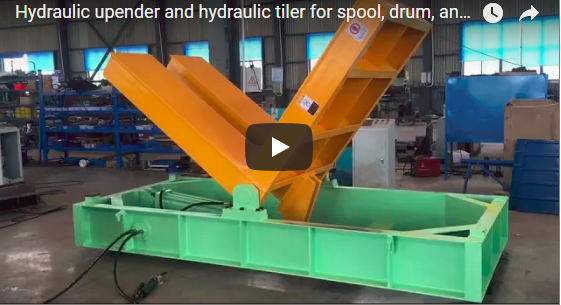
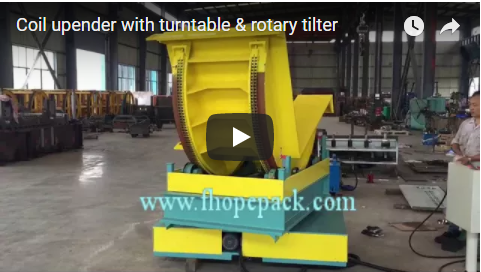
The roll sits on an L-shaped table with two faces. Hydraulic cylinders under the table push it over through 90° about a pivot on the base. The roll ends up resting on the second face, turned on end — or the other way round, back onto its side.
A hydraulic station drives the cylinders, and the turning speed is adjustable. Two-way back pressure keeps force on both sides of the cylinders, so the motion stays smooth. The machine stops automatically at the end of travel, and an independent electrical panel runs it.
The machine shown
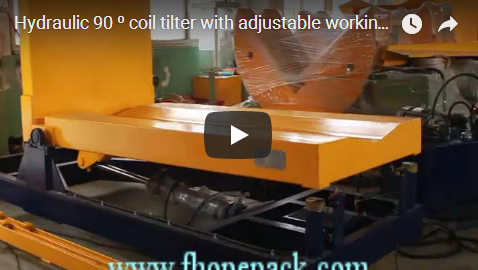
Our demonstration unit has an orange frame with two blue hydraulic cylinders under the table. It carries a large roll wrapped in clear film. The operator runs it from a hand-held remote, turning the roll from tilted to level and back to upright. The blue hydraulic power unit stands beside it, and more wrapped rolls wait on pallets behind.
FZ-H02 roll upender data
| Item | FZ-H02 |
|---|---|
| Load object | plastic film roll; paper, carpet and curtain rolls on request |
| Roll length | up to 2,400 mm |
| Roll OD | 1,000 mm |
| Roll weight | 1,600 kg |
| Capacity | 2,000 kg |
| Tilting angle | 90° |
| Turning time | about 10 s for 90° |
| Power | 2.0 kW |
| Supply | 220 V, 60 Hz, 3 phase |
| Noise | under 78 dB |
Size the job on the 1,600 kg roll weight; the 2,000 kg figure is the machine’s rated capacity. The table shape and size are made to your roll. The supply covers the tilter, the hydraulic station, spare parts and the manual.
Three ways to load and unload
Hand lifter. Manual or battery hand lifters work at floor level. So the upender table sits level with the floor, and a fork-type table lets the lifter drive in and set the roll down directly.
Forklift. A forklift can reach a raised table. The table needs space for the forks to go in and lift.
Conveyor. Rolls coming straight from the production line arrive on a conveyor. Then we build the upender to connect to it, with steel rollers or a PVC belt.
Worked example: roll weight and stability on end
A mill turns paper rolls of 1,000 mm OD on a 76 mm core, 2,000 mm long. It takes the wound paper at 750 kg/m³. These are illustrative customer figures.
Roll weight. The volume is π ÷ 4 × (1.0² − 0.076²) × 2.0 = 1.56 m³. At 750 kg/m³ the roll weighs 1.56 × 750 = 1,170 kg. That is under the 1,600 kg roll weight and the 2,000 kg capacity, and 2,000 mm is inside the 2,400 mm length.
Stability on end. Standing upright, the roll’s centre of gravity is half its length up, at 1.0 m. It tips over when tilted past the angle whose tangent is radius ÷ CG height: tan⁻¹(0.5 ÷ 1.0) = 26.6°. So a tall roll on end needs the table face behind it during the turn, and a flat, level floor after it.
Rolls per hour. The turn takes about 10 s. The real rate is 3,600 ÷ (10 + T_back + t_load), where T_back is the empty return and t_load your lifter or forklift time.
General rule. A roll is less stable on end the higher its length-to-diameter ratio. Above about 2 to 1, plan to keep it supported until it is set down.
Selection checklist: what to send us
- Roll material, OD, core ID and length.
- Heaviest roll weight.
- Turn direction: on side to on end, or both.
- Loading: hand lifter, forklift or conveyor.
- Rolls per hour.
- Supply voltage and frequency.
- Email your roll size, heaviest weight and loading method to info@fhopepack.com.
- We reply with a proposal after we confirm the details, including the table shape and model.
- We send a layout drawing for your roll handling area.
- Paper roll upender
- Customized roll upender
- Paper roll upender and paper roll tilter
- How does a coil upender work?
- Fully enclosed rolled carpet shrink packaging
- Specifications: FHOPE paper roll upender (FZ-H02) and customized roll upender product pages
- Machine video: paper roll upender demonstration video on YouTube
- Roll weight and stability: our worked example, illustrative roll figures
- Standards: EN 415-10 (packaging machines, general safety); ISO 12100:2010
Safety and EN 415-10
For CE markets we follow EN 415-10 as the design reference, with a risk assessment to ISO 12100 as the risk-assessment method. The main hazards are the turning table and the roll on it, and crush points between table and base. Certification of a delivered machine is confirmed in the project ordering agreement.
Under the EN 415-10 risk-assessment method, the safety features are project-configurable engineering options selected for your application, not fixed standard fitment. Depending on your risk assessment, our roll upenders can be configured with a fence and light beam round the working area, factory-set pressure relief valves, maintenance lockout pins and warning labels. The upender stops when the button is released, and limit switches end the turn. We anchor the base to the floor. The final safety configuration and the certification of the delivered machine are confirmed in the supply technical agreement.
Engineering FAQ
Can it handle carpet and curtain rolls as well as paper?
Yes. We build roll upenders for paper, film, carpet and curtain rolls, with the table shaped to the roll.
How fast does it turn?
About 10 s for 90° on the FZ-H02, and the speed is adjustable.
How high is the table?
It depends on loading. Hand lifter loading needs the table level with the floor, while a forklift can reach a raised table. Tell us how rolls arrive and we will design the height.
Which standards do you build to?
EN 415-10 as our design reference, with an ISO 12100 risk assessment.