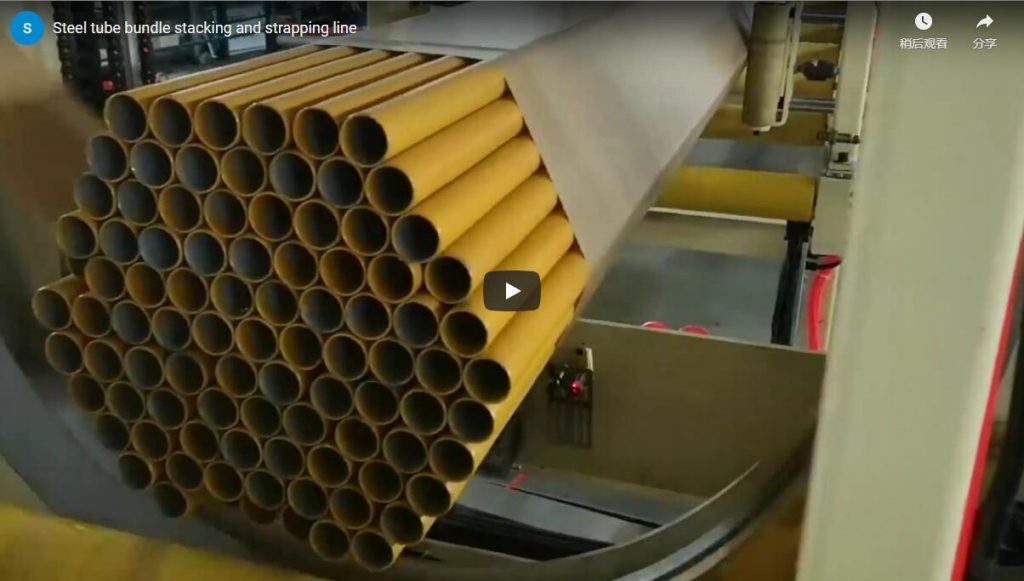
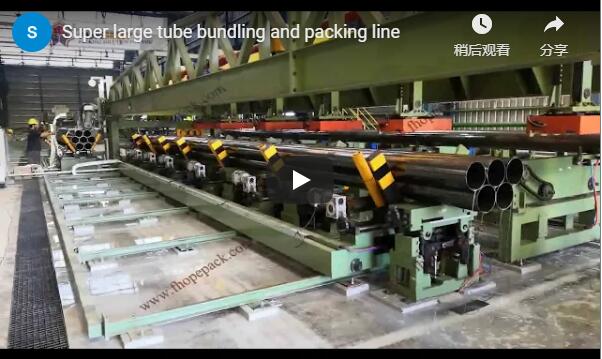
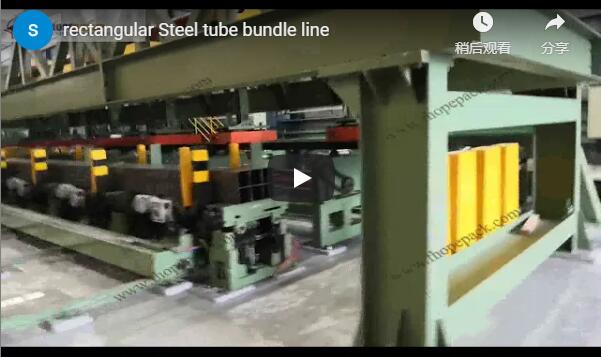
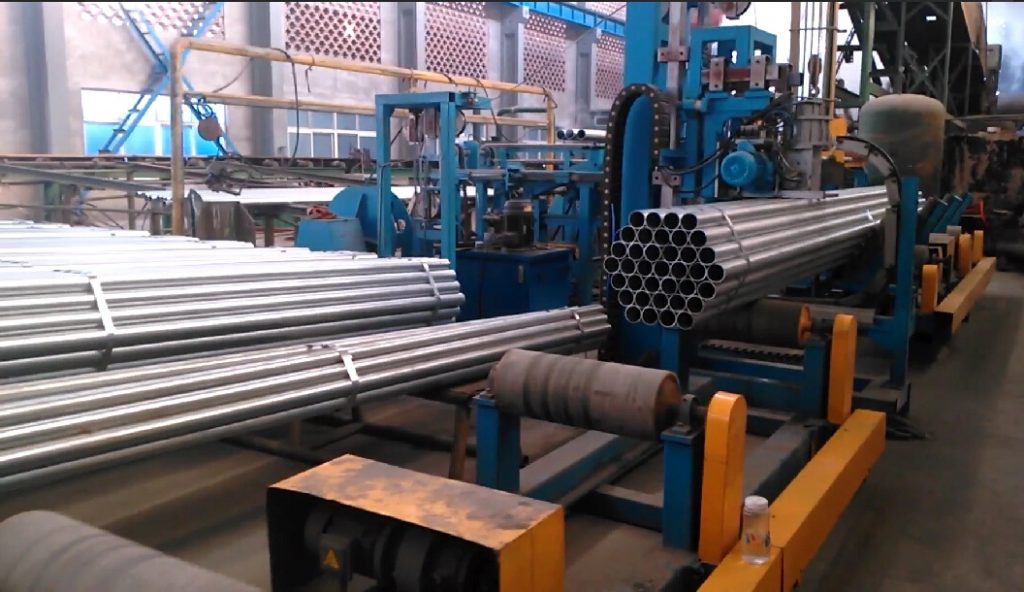
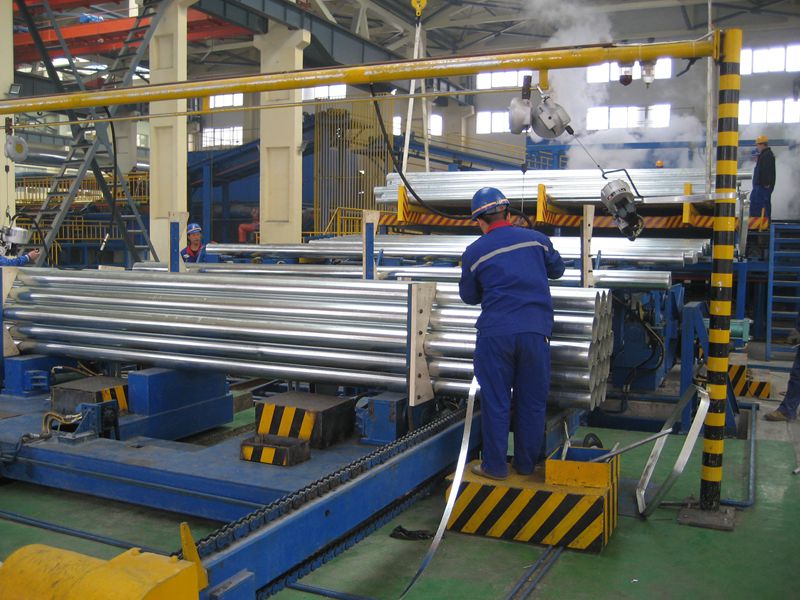
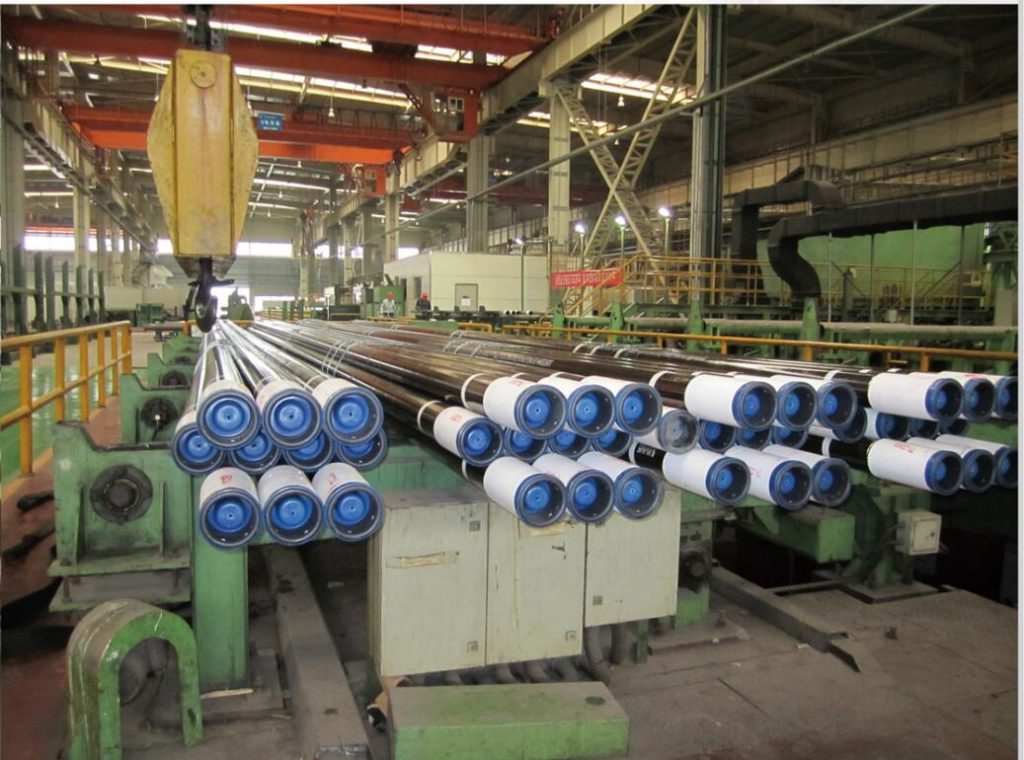
Executive summary This clip shows a steel tube bundle forming line at the end of a tube mill. Tubes run out on a roller table, a chain deck moves them sideways, and a yellow forming station gathers them layer by layer into a tight hexagonal bundle ready for strapping. The footage was shared with us; our equivalent solution forms and straps tube bundles in the same way, with the bundle shape, tube count and strapping matched to your mill.
Table of Contents
- What the clip shows
- Why a hexagonal bundle
- Hexagonal bundle formula and tube count
- What we set per mill
- Selection checklist
- Safety
- Engineering FAQ
- Next step
- Related reading
- Sources
What the clip shows
| Step | What you see |
|---|---|
| Run-out | Cut tubes travel along a long roller table in the mill bay |
| Transfer | A chain deck carries the tubes sideways, one layer at a time |
| Forming | A yellow V-shaped forming station with side arms gathers the tubes |
| Bundle | Tubes build up into a hexagonal bundle held in the former |
| Discharge | The formed bundle sits ready for the strapping step |
Why a hexagonal bundle
- Stable shape. In a hexagon each tube rests on the tubes below, so the bundle does not roll apart.
- Dense pack. A hexagon holds more tubes for a given width than a square stack of round tubes.
- Even strap load. The strap bears on a near-round outline, so the load spreads over the outer tubes.
- Easy lifting. A compact bundle is easier to lift with slings and to stack in the yard.
Hexagonal bundle formula and tube count
Worked example (illustrative). A full hexagon with n tubes on each side holds 3n(n − 1) + 1 tubes.
| Tubes per side (illustrative) | 3n(n − 1) + 1 | Tubes per bundle | Widest row, 60 mm tubes |
|---|---|---|---|
| 4 | 3 × 4 × 3 + 1 | 37 | 7 × 60 = 420 mm |
| 5 | 3 × 5 × 4 + 1 | 61 | 9 × 60 = 540 mm |
| 6 | 3 × 6 × 5 + 1 | 91 | 11 × 60 = 660 mm |
For 60 mm tubes (illustrative) at 5 per side, the bundle measures (2 × 5 − 1) × 60 = 540 mm across the widest row.
So moving from 5 to 6 tubes per side adds 30 tubes per bundle; we use this to set bundle weight against your crane limit.
What we set per mill
| Setting | Depends on |
|---|---|
| Former size | Tube diameter and tubes per bundle |
| Bundle shape | Hexagonal, square or round, per your yard |
| Transfer pitch | Tube diameter and mill speed |
| Strapping | Number of straps, steel or PET strap |
Selection checklist
- Tube diameter and wall thickness.
- Tube length range.
- Tubes per bundle and bundle shape.
- Bundle weight and crane limit.
- Mill output in tubes per minute.
- Straps per bundle and strap type.
Safety
- Keep clear of the chain deck and the forming arms while the line runs.
- Lock out the former before clearing a jammed tube.
- Use guarding and light curtains around the forming station.
- For CE markets, the machine is designed to ISO 12100 and EN 415-10.
Engineering FAQ
Q: What does a tube bundle forming machine do? A: It gathers cut tubes from the mill into a fixed bundle shape, ready for strapping.
Q: Why a hexagonal bundle? A: Each tube rests on the tubes below, so the bundle is stable, dense and easy to strap.
Q: How many tubes are in a hexagonal bundle? A: 3n(n − 1) + 1 for n tubes per side; 61 tubes for 5 per side in the worked example.
Q: Can it make square bundles? A: Yes. We set the former for hexagonal, square or round bundles per your yard.
Q: Can you build this configuration? A: Yes. We build equivalent tube bundle forming lines matched to your mill speed, bundle shape and strapping.
Q: What comes after forming? A: The formed bundle goes on to strapping, then to the yard.
Q: Which standards apply? A: For CE markets, ISO 12100 and EN 415-10.
Next step
We match a tube bundle forming line in three steps:
- Submit your layout drawing with tube sizes, lengths, tubes per bundle and mill speed, to info@fhopepack.com.
- Receive a proposal within 48 hours with the machine data and layout.
- Book a site survey so we confirm the mill run-out layout.
Related reading
- Steel Tube Bundle Strapping with a Travelling Head
- Steel Tube Bundle Strapping with Timber Blocks
- Steel Tube Bundle Strapping Machine with Seal Joint
- Steel tube strapping machines
Sources
- Machine content: FHOPE engineering team, 2026-10-10
- Clip: the video on YouTube
- Tubes per bundle: our worked example, illustrative values
- Standards scope: ISO 12100:2010; EN 415-10:2014
- Proposal timing: approved house CTA (proposal within 48 hours)
Last reviewed: 2026-10-10