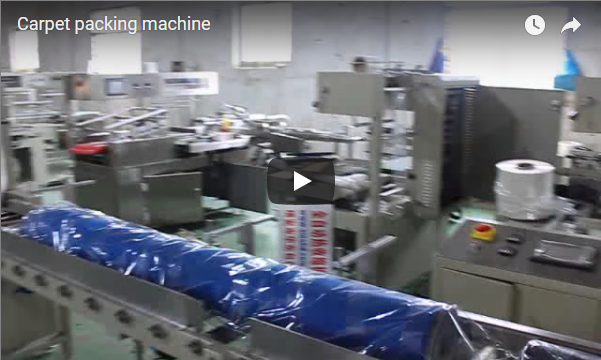
Executive summary We pack a carpet roll by forming a continuous film tube around it, then sending that sleeve through an enclosed heat tunnel. The film shrinks onto the body and the ends, so the pack leaves closed. The clip is 65 s and follows one roll from the green belt to the finished pack. We size the sleeve from roll OD and length, not from a chamber-sealer film chart.
Table of Contents
- What the clip shows, in order
- Why the sleeve closes the roll before heat
- How we run the enclosed heat tunnel
- Sleeve film sizing for a cylindrical roll
- Sleeve-and-tunnel or a chamber sealer
- Selection checklist for a carpet roll sleeve shrink line
- Controls and safety
- Engineering FAQ
- Next step
- Related reading
- Sources
What the clip shows, in order
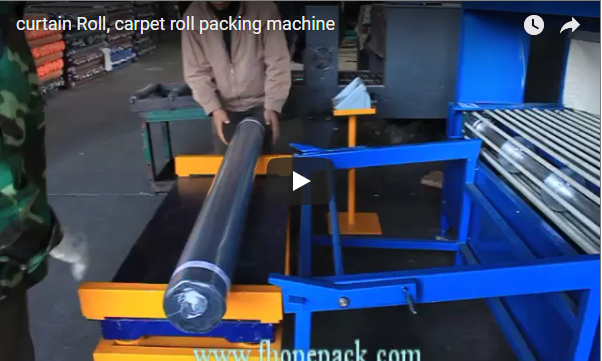
We built this short line for rolled carpet and rugs. An operator presents one roll to a green belt with the roll axis along the travel direction.
The first station is a horizontal film-sleeve unit. Film feeds from above the forming area and becomes a continuous film tube around the moving carpet. There is no L-bar and no chamber jaw: the pack is a sleeve, not a three-side bag.
The sleeved roll then enters a white tunnel with a red heating chamber. At the exit the film has pulled tight. The last view is the finished pack on a white table: body covered, ends closed.
The recording lasts 65 s. That is not a rated cycle. We time a live line from your roll length and the tunnel setting.
Why the sleeve closes the roll before heat
A carpet roll has two open ends. Barrel wrap alone still leaves those faces open. A film sleeve starts longer than the roll; when it shrinks, the extra film at each end collapses inward and closes the faces.
A chamber or L-bar makes a three-side bag. That suits a compact roll, and the line in our carpet roll shrinking machine post is built that way. A continuous sleeve does not need a jaw as long as the roll. The forming box only has to clear the diameter; the belt carries the length through.
We set the sleeve from roll diameter (OD) and from roll length plus end overhang. Film grade is a later setting.
How we run the enclosed heat tunnel
Heat makes the sleeve contract. Because the tube already surrounds the roll, one pass tightens the barrel and pulls the overhang onto the ends.
Belt speed and shrink-tunnel temperature are a pair: too fast and the overhang stays loose; too slow and the film wrinkles or scorches. Both are locked on the panel for that film and roll size. The same pairing appears on our automatic POF shrink wrapping machine with heat tunnel.
Tunnel power is configured per project. We write the figure on the proposal.
Sleeve film sizing for a cylindrical roll
For a sleeved cylinder we start with circumference, then the laid-flat width of the collapsed tube. We do not copy a chamber-sealer film chart onto this machine.
Circumference (mm) = roll OD (mm) × 3.14.
Laid-flat sleeve width (mm) = circumference / 2.
Sleeve length (mm) = roll length + left overhang + right overhang.
The table is an illustrative customer example, not a measurement of the roll in the clip.
| Item | Value |
|---|---|
| Example roll OD | 350 mm |
| Circumference (350 × 3.14) | 1099 mm |
| Laid-flat sleeve width (1099 / 2) | 550 mm |
| Example roll length | 1200 mm |
| End overhang, each end | 80 mm |
| Sleeve length (1200 + 80 + 80) | 1360 mm |
The 550 mm figure is the collapsed-tube (laid-flat) width, not automatically the width of the film roll on the stand. If we form the tube from a single-wound web and close a longitudinal seal, the web is wider; we add that seal margin on the proposal.
Sleeve-and-tunnel or a chamber sealer
Use the sleeve-and-tunnel line when a jaw sealer would be too long, or when you want the ends closed by shrink. Use the chamber-sealer line when the roll is compact and you already run centre-folded film — that family is in the carpet roll shrinking article.
A PE bagger with a high seal bar, the path on our carpet packing machine post, closes a bag and can feed a tunnel after it. It is not the sleeve former in this clip.
Send the OD, the length range, and whether the ends must be closed. That sets the station order.
Selection checklist for a carpet roll sleeve shrink line
- Largest roll OD on this setup, plus length range and the overhang you want after shrink.
- Roll weight and how it arrives: hand load, or a conveyor from the rolling station.
- Film family and thickness you already buy, or a film we should pair with the tunnel.
- Target rolls per hour from the slowest station, not from a short clip.
- Belt infeed height, discharge height, and floor length for the sleeve unit, the tunnel, and a film-change gap.
- Supply for the tunnel, and air if the seal or film clamp needs it.
- Who changes the film after the line is stopped.
Controls and safety
The standards that apply depend on the destination market. For CE markets, ISO 12100 sets the risk-assessment method and EN 415-10 covers general requirements for packaging machines, which fixes guarding and the emergency-stop arrangement.
The forming box and the tunnel mouth are the running hazards. Once the belt is moving we keep people out of both openings. Film change and jam clearing wait until the line is stopped.
Engineering FAQ
Q: When do we specify a film sleeve instead of a three-side chamber sealer? A: When roll length would force a very long jaw, or when you want the ends closed by shrink overhang. Compact rolls that already run on centre-folded film stay on the chamber-sealer line.
Q: How do I calculate the sleeve film for my roll? A: Multiply OD by 3.14 to get the circumference, then halve it for laid-flat tube width. Add left and right overhang to the roll length. On a 350 mm × 1200 mm example that is 1099 mm around, 550 mm laid-flat, and 1360 mm long with 80 mm overhang each end.
Q: What happens if tunnel speed and temperature do not match? A: If the belt is too fast, the overhang on the ends stays loose. If it runs too slow, the film wrinkles or scorches. We lock both settings for that film and roll size.
Q: Does the sleeve need end seals before the tunnel? A: Not on this layout. The tube is longer than the roll; heat pulls the extra film onto the ends. If the overhang cannot fold in, we add an end-seal station or we switch to a bagger.
Q: How do we set rolls per hour? A: Rolls per hour = 3600 ÷ seconds per roll at the slowest station. On this pair the tunnel usually sets the pace. Send the roll length and the film; we close the number on the proposal.
Next step
We size a carpet-roll sleeve-and-tunnel line in three steps:
- Submit your layout drawing with the roll OD, length, weight, film type and output target, to info@fhopepack.com.
- Receive a proposal within 48 hours, including the sleeve station, the heat tunnel and the conveyor match.
- Book a site survey so we confirm the infeed height, the line direction and the space for film change.
Related reading
- Carpet Roll Shrinking Machine: Compact Line for 400 mm Rolls, Film Sizing and Setup
- Automatic Roll Packing Machine and Carpet Packing Machine
- Automatic POF Shrink Wrapping Machine with Heat Tunnel
- Bundle Sleeve Shrinking Machine
Sources
- Line view, sleeve station, enclosed tunnel and finished pack: the video on YouTube (65 s; @Fhopepack)
- Contrast lines: carpet roll shrinking machine (chamber sealer); carpet packing machine (PE bagger); automatic POF shrink wrapping machine with heat tunnel
- Family page (sealer table not applied to this clip): Carpet shrinking machine
- Standards scope: ISO 12100:2010; EN 415-10:2014
- Proposal timing: approved house CTA (proposal within 48 hours)
Last reviewed: 2026-10-05