Executive summary
A floor-level pallet changing machine transfers unit loads from one pallet to another without manual unstacking or load de-palletization. Engineered as an ergonomic ground-access system, the machine clamps the cargo, tilts it back 95° onto a reinforced structural back plate to transfer product weight away from the base, and lowers the freed pallet to floor level for direct removal via manual pallet jack or forklift. The FHOPE FPFZ-CH01 handles payload capacities up to 1,500 kg (1.5 t) with pallet dimensions of 1,200 × 1,000 mm and load heights from 1,000 to 1,800 mm, executing the mechanical cycle in 30–50 seconds. While pallet changers tilt loads 95° to maintain top-side orientation upon return, 180° pallet inverters invert the entire load completely for turning products or accessing bottom tiers.
The FPFZ-CH01 floor-level pallet changer stabilizes cased goods, pharmaceutical containers, or raw food ingredients during horizontal transfer. By tilting the load carriage past 90° to a 95° rearward incline, gravity securely pins the stack against the rigid structural backrest. This design isolates the lower pallet, allowing the independent hydraulic bottom plate to return to zero elevation at floor level for effortless pallet extraction without high-lift handling equipment.
Table of Contents
- Why change pallets
- The pallet change cycle
- 95° changer or 180° inverter?
- Machine data
- Loads per hour
- Selection checklist
- Safety
- Engineering FAQ
- Next step
- Related reading
- Sources
Why change pallets
Modern automated storage, cleanroom environments, and cross-border logistics demand rapid pallet transfers without disrupting product integrity.
| Reason | Operational Driver | Typical Transfer |
|---|---|---|
| Cleanroom & Hygiene Compliance | Food and pharmaceutical GMP protocols prohibit unsterilized wooden pallets in hygiene zones. | Wooden raw-material pallet out → Plastic / aluminum hygienic pallet in |
| Export Regulations | ISPM-15 phytosanitary rules govern international wood packaging transport. | Internal warehouse pallet out → Heat-treated / fumigated export pallet in |
| Pallet Maintenance & Safety | Broken deckboards or protruding nails cause warehouse conveyor jams and rack failures. | Damaged / broken pallet out → Structural sound pallet in |
| Pallet Pool Cost Control | High rental and exchange fees occur when captive pool pallets leave internal distribution loops. | Leased pooling pallet (CHEP/LPR) out → Low-cost one-way shipping pallet in |
| Warehouse Standardization | Mismatched pallet dimensions cause automated guided vehicle (AGV) or ASRS pocket rejects. | Irregular pallet out → Standardized captive warehouse pallet in |
The pallet change cycle
The FPFZ-CH01 executes a safe 6-stage mechanical sequence governed by an integrated PLC:
- Floor-Level Infeed: A hand pallet truck, electric walkie, or standard forklift sets the loaded pallet directly onto the ground-flush base receiver table.
- Two-Way Secure Clamping: The hydraulic side-holding guides align the flanks while the top containment platen descends to apply regulated downward pressure, securing the cargo without box deformation.
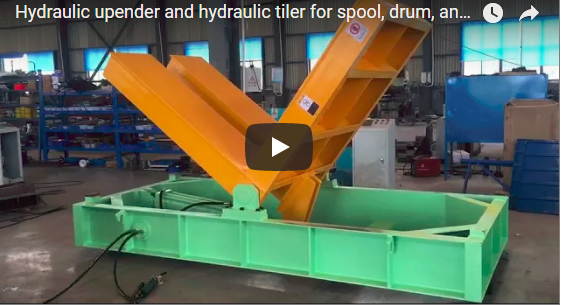
- 95° Tilt-Back Gravity Transfer: Heavy-duty hydraulic cylinders pivot the L-shaped cradle backward to a 95° incline. Tilting 5° beyond vertical transfers the entire vertical load mass from the pallet onto the heavy steel back plate.
- Independent Pallet Separation: With the cargo resting securely on the back plate, the independent bottom fork/table lowers under hydraulic control back down to floor level, leaving the pallet completely unloaded. The operator pulls the old pallet straight out across the floor.
- Pallet Exchange & Reset: The operator inserts the replacement pallet onto the lowered receiver table. The table raises to clamp the new pallet against the bottom of the load, and the cradle tilts back 95° to the upright position.
- Release & Outfeed: Side and top clamp platens retract to their standby positions, and the pallet truck removes the ready-to-ship unit load.
Electro-mechanical limit switches, inductive proximity sensors, and hard mechanical end-stops restrict cradle rotation precisely to 95°. All actions are commanded from an ergonomic pedestal console or an industrial radio-frequency (RF) remote controller.
95° changer or 180° inverter?
Selecting between tilting and complete inversion depends on whether the cargo orientation must stay upright.
| Technical Parameter | FPFZ-CH01 Pallet Changer | FPFZ-H02 Pallet Inverter |
|---|---|---|
| Kinematic Angle | 95° (110° on specialized models) | 180° Full Inversion |
| Rated Load Capacity | Up to 1,500 kg (1.5 t) | 800–1,500 kg (1.5 t) |
| Acceptable Pallet Dimensions | 1,200 × 1,000 mm (customizable) | 1,000–1,200 × 800–1,000 mm |
| Permissible Load Height | 1,000–1,800 mm | 1,000–1,800 mm |
| Mechanical Cycle Time | Approximately 30–50 s | Approximately 45–60 s |
| Installed Drive Power | 5.0 kW (Hydraulic Power Unit) | 7.5 kW (Rotary Gearmotor / Hydraulic) |
| Cargo Orientation Result | Remains top-side up (upright) | Rotated 180° upside down |
| Best Application Match | Rapid pallet swapping where cartons, liquids, or open containers cannot be tipped upside down. | Recovering bottom damaged bags, aerating frozen goods, or unsticking bulk ingredients. |
Engineering Rule: Use the 95° pallet changer whenever the load orientation must remain upright (e.g., liquids, loose-capped containers, oriented cartons, or fragile displays). Use the 180° pallet inverter when direct access to the bottom layer is required, or when swapping both top and bottom pallets simultaneously.
Machine data
The structural, mechanical, and electrical baseline parameters for the standard FPFZ-CH01 are detailed below:
| Machine Parameter | Specification / Engineering Standard |
|---|---|
| Standard Pallet Footprint | 1,200 × 1,000 mm (Options for 1,300 × 1,100 mm and 1,200 × 1,200 mm) |
| Load Height Clearance | 1,000–1,800 mm (Extended chassis options: 550–2,200 mm) |
| Maximum Payload | 1,500 kg (1.5 metric tons) |
| Mechanical Sequence Time | 30–50 s (excluding manual pallet handling) |
| Pallet Exchange Mode | Floor-level manual transfer (or optional automatic magazine integration) |
| Chassis Fabrication | Heavy-gauge welded A3 / Q235 structural steel profiles |
| Mounting Requirement | Free-standing dead-weight base plate (no deep foundation pit or floor anchor bolts required) |
| Floor Loading Requirement | Flat concrete slab (tolerance ≤ 5 mm over 2 m, load-bearing ≥ 3.5 t/m²) |
| Control Architecture | Siemens PLC with independent console pushbuttons and RF wireless remote |
| Hydraulic Drive Unit | 5.0 kW motor, system pressure 10–14 MPa, with dual pilot-operated check valves |
| Standard Electrical Supply | 380 V AC, 50/60 Hz, 3-Phase (custom 220 V / 440 V / 480 V configurations available) |
| Warranty & Lifecycle | 2-year complete machine warranty, 10-year structural integrity guarantee |
Loads per hour
Total cycle efficiency depends on machine motion plus staging and pallet swap speeds:
| Cycle Step | Estimated Process Time |
|---|---|
| Automated Machine Cycle | 40 s (mid-range of 30–50 s tilt, clamp, and return motions) |
| Pallet Swap & Staging | 60 s (manual pallet pull-out, insert, and forklift/pallet truck travel) |
| Total Takt Time per Load | 100 s |
| Continuous Throughput | 3,600 s ÷ 100 s = 36 loads / hour |
| Nominal 8-Hour Shift Output | 8 h × 36 loads/h = 288 loads / shift |
Design Result: At a standard operational target of 30 loads per hour (120 s total cycle budget), a single operator with an electric pallet jack comfortably meets production goals. High-speed distribution centers exceeding 40–60 loads per hour require conveyor-integrated automation with an automated pallet dispenser/stacker, as demonstrated in our automatic pallet changing system.
Selection checklist
To configure the correct machine frame, clamp profile, and hydraulic force:
- Pallet Specifications: Dimensions (L × W × H), bottom-deck board orientation, and construction (wood, HDPE plastic, metal, slip-sheet).
- Payload Envelope: Maximum and minimum load height, gross load mass, and product center-of-gravity (CG) offsets.
- Packaging Characteristic: Corrugated cartons, heavy valve bags, steel drums, rigid pails, or loose multi-packs.
- Throughput Target: Target pallets per hour and current staging bottlenecks.
- Loading Equipment: Hand pallet truck, electric walkie, counterbalanced forklift, or automated conveyor.
- Facility Infrastructure: Site supply voltage, ambient cleanroom or cold-chain temperatures (down to -25°C), and floor flatness.
Safety
The FPFZ-CH01 complies with the European Machinery Directive 2006/42/EC, EN ISO 12100:2010 (Risk Assessment & Reduction), EN 415-10 (Packaging Machines Safety), and EN 60204-1 (Electrical Safety).
Primary hazard zones—the tilting quadrant and the vertical clamping stroke—are protected by heavy-duty perimeter steel mesh fences on both lateral sides. Dual pilot-operated hydraulic check valves prevent carriage descent or clamp release in the event of an unexpected pressure drop or power outage. Machine control requires intentional operator input from the external console positioned outside the operational radius, or via the keyed wireless remote control equipped with an active Category 0 Emergency Stop. Integrated floor-level photocells halt operation if personnel breach the operating envelope during cycle execution.
Engineering FAQ
Q: Does cargo need to be unstacked or restrapped before changing pallets? A: No. The unit load remains intact. The hydraulic top platen and side walls clamp the full stack, holding every layer in position while the 95° tilt shifts the load weight away from the pallet.
Q: How fast does the machine complete a pallet exchange? A: The mechanical movement takes 30 to 50 seconds. Including pallet entry, manual swap, and pickup, total floor-to-floor cycle time averages 90 to 120 seconds.
Q: Does the installation require floor excavation or expansion anchors? A: No pit excavation is necessary. The FPFZ-CH01 rests directly on the industrial floor. Its wide-stance structural chassis utilizes dead-weight engineering to counteract tilting overturning moments. Anchor bolts are optional and recommended only in seismic zones.
Q: How does the system prevent crushing fragile corrugated cartons? A: The hydraulic circuit incorporates proportional pressure regulator valves. Clamping pressure is dialed in specifically for the product profile, delivering sufficient friction containment without exceeding cardboard edge-crush test (ECT) thresholds.
Q: What is the primary operational difference between a pallet changer and an inverter? A: A pallet changer tilts the cargo 95° onto its side and returns it to its original orientation, keeping cartons right-side up. An inverter turns the load a full 180°, placing the top of the stack onto the new bottom pallet.
Q: Can the equipment accommodate oversized or extra-tall pallets? A: Yes. Custom heavy-duty chassis configurations accommodate load heights up to 2,200 mm and pallet footprints up to 1,300 × 1,200 mm upon engineering review.
Next step
- Submit Parameters: Email your pallet dimensions (old vs. new), load height envelope, gross weight, and required hourly throughput to
info@fhopepack.com. - Engineering Selection: Our packaging machinery team evaluates your load stability and determines platen geometry, clamping forces, and staging layout.
- Formal Proposal: Receive an engineering drawing, functional specification, and budget quotation within 24 to 48 hours.
Related reading
- Load inverter (product)
- C-shape pallet inverter
- FHOPE pallet inverter with dual clamper and floor base operation
- V-shape pallet changer
- Automatic pallet changing system with new pallet dispensing
Sources
- FHOPE Pallet Changer Technical Specifications (FPFZ-CH01 Series) and 180° Inverter Design Documentation (FPFZ-H02)
- EN ISO 12100:2010: Safety of machinery — General principles for design — Risk assessment and risk reduction
- EN 415-10: Safety of packaging machines — General requirements
- EN 60204-1: Safety of machinery — Electrical equipment of machines — Part 1: General requirements
Last reviewed: 2026-10-19