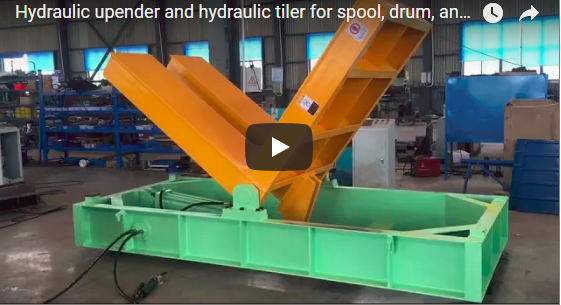
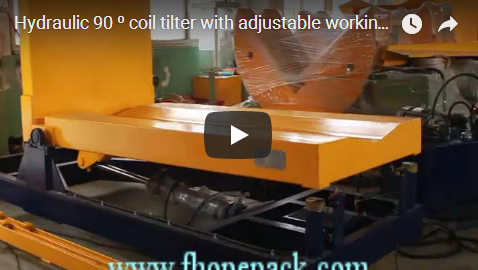
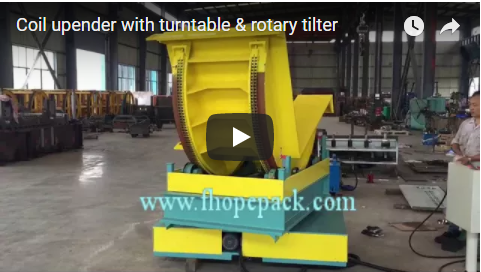
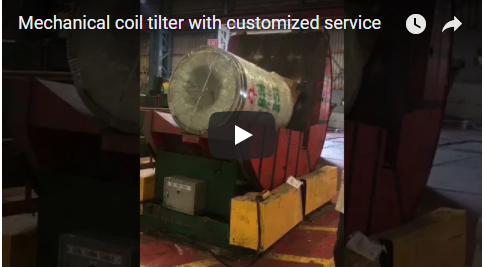
Summary: A mid-sized steel service center transitioned from manual crane tilting to a floor-mounted 10T hydraulic coil upender, standardizing 180-degree inversion cycles while eliminating pit excavation requirements. The system utilizes opposing radial clamping arms with programmable pressure limits, preventing edge deformation on loosely wound coils and enabling direct slip-sheet conversion for export logistics.
[VIDEO PLACEHOLDER]
🛠️ Operational Context & Facility Requirements
Floor-mounted coil upenders eliminate pit excavation by distributing dynamic load forces across reinforced concrete slabs, enabling rapid standardized horizontal-to-vertical orientation changes for 5–10 ton cold-rolled and galvanized coils while preserving overhead clearance and minimizing operational workflow footprint modifications.
Modern steel service centers and metal processing facilities frequently operate within constrained footprints where traditional pit-mounted inverters are structurally unfeasible. Facilities handling 5,000 to 10,000 kg cold-rolled, galvanized, or stainless steel coils typically require overhead clearances between 4.5 and 6.0 meters. Floor-mounted coil upenders address this constraint by anchoring directly to a minimum 200 mm reinforced concrete slab, transferring rotational torque and dynamic load vectors into the foundation rather than requiring subfloor excavation. This configuration allows seamless integration with existing roller conveyors, cut-to-length lines, and slitting machines without disrupting adjacent production zones or requiring costly civil engineering modifications.
🏗️ Engineering Constraints & Handling Challenges
Manual coil inversion generates unpredictable center-of-gravity shifts that cause edge telescoping and operator exposure to suspended loads, whereas hydraulic upenders with dual-arm radial clamping maintain structural integrity during rotation and reduce cycle times to under four minutes.
Traditional manual turning relies on overhead cranes, taglines, and unsecured load manipulation, creating significant safety liabilities and material degradation. As a coil rotates from horizontal to vertical, its center of gravity shifts dramatically, often exceeding the stabilizing capacity of single-point clamps or manual rigging. This instability frequently results in edge telescoping, outer wrap deformation, and operator pinching injuries. Furthermore, variable inner diameters (typically 508 mm to 610 mm) and inconsistent winding tension make fixed mandrel systems impractical for multi-grade processing environments. Hydraulic coil upenders resolve these constraints by applying controlled, opposing radial force directly to the coil’s outer sidewall, neutralizing gravitational torque and maintaining wrap integrity throughout the inversion sequence.
🔗 Related: Explore more solutions
📈 Technical Architecture & System Configuration
The 10T coil upender employs a dual-hydraulic arm cradle with rubber-coated contact pads and a programmable torque limiter, ensuring uniform clamping force across variable outer diameters while maintaining 180-degree rotational accuracy within ±2 degrees for precise downstream processing alignment.
The core mechanical architecture of a 10T coil upender prioritizes load stability, operational safety, and material preservation. Key technical specifications and their direct business impact include:
-
10,000 kg Load Capacity: Handles standard automotive and construction-grade coils without requiring multiple handling passes or auxiliary lifting equipment.
-
180° ±2° Rotational Accuracy: Ensures consistent vertical orientation for automated packaging, slip-sheet insertion, and downstream slitting or cut-to-length integration.
-
Dual Hydraulic Arm Cradle: Replaces single-point clamping with opposing radial arms that contact the coil at 120° intervals, preventing collapse on loosely wound or high-tension material.
-
Programmable Pressure Control (PLC/HMI): The programmable logic controller (PLC) acts as an automated command center, allowing operators to set maximum clamp force via a human-machine interface (HMI) to prevent edge compression beyond the coil’s tensile limit.
-
400V/50Hz or 480V/60Hz Power: Standard industrial three-phase electrical compatibility ensures seamless integration into North American and global manufacturing grids.
-
Integrated Slip-Sheet Magazine: Automatically feeds 1.2 mm corrugated cardboard beneath the coil post-rotation, converting pallet-dependent loads to slip-sheet format for cost-effective ocean freight shipping.
🛡️ Integration Protocol & Safety Compliance
Installation requires zero excavation, utilizing laser-level alignment to existing roller conveyors while integrating redundant mechanical locks and optical safety barriers that halt rotation upon operator proximity, ensuring compliance with ISO 12100 machinery safety standards.
Deployment follows a standardized integration sequence designed to minimize production downtime and ensure regulatory compliance. Facilities typically allocate 5–7 days for site preparation, electrical routing, and commissioning. The machine is positioned using laser alignment tools to match existing conveyor elevations, eliminating manual transfer steps. Electrical connections require a dedicated 400V/100A circuit routed from the main distribution panel, with the HMI mounted on a swing-arm bracket at ergonomic operator height.
Safety architecture adheres to ISO 12100 risk assessment guidelines and includes:
-
Optical Safety Barriers (Light Curtains): Infrared sensor arrays that instantly halt rotation if an operator or foreign object breaches the safety perimeter.
-
Redundant Mechanical Locks: Physical detents that engage at 0° and 180° positions, preventing unintended movement during maintenance or power loss.
-
Torque Limiting Clutch: Automatically disengages hydraulic pressure if clamping force exceeds pre-set thresholds, protecting both the coil and machine components.
-
Emergency Stop Circuits: Hardwired kill switches positioned at multiple access points, ensuring immediate shutdown under fault conditions.
Note: Integration timelines and safety configurations vary by manufacturer. Always verify electrical requirements and compliance certifications with the original equipment manufacturer (OEM) prior to procurement.
🔗 See Also: Related equipment
⚙️ Performance Outcomes & Operational Impact
Automated coil inversion standardizes cycle times, eliminates manual crane coordination, and reduces edge damage by maintaining consistent clamping pressure, directly increasing shift throughput and minimizing rework costs associated with telescoped or crushed coil edges.
Transitioning from manual crane tilting to automated coil upending yields measurable operational improvements across safety, throughput, and material quality. Industry benchmarks indicate that automated inversion reduces cycle times from 10–15 minutes to 3–4 minutes per coil, effectively tripling shift throughput without additional labor. By eliminating manual tagline manipulation and crane dependency, facilities reduce operator fatigue and remove high-risk suspended load exposure from daily workflows.
Material preservation improves significantly as programmable clamping pressure prevents edge compression and telescoping, which typically account for 4–7% scrap rates in manual handling environments. Additionally, integrated slip-sheet dispensers streamline export packaging, reducing material handling steps and lowering freight preparation costs. These qualitative benefits compound over time, driving consistent improvements in overall equipment effectiveness (OEE) and workplace safety metrics.
🛠️ Procurement Strategy & Financial Evaluation
Capital expenditure for industrial coil upenders typically ranges from $60,000 to $120,000, with standard payback periods of 12–24 months driven by labor optimization, scrap reduction, and compliance with workplace safety regulations, rather than direct revenue generation.
Financial evaluation of coil upending equipment should focus on operational efficiency gains rather than direct production output. Industry-standard capital investment ranges from $60,000 to $120,000, depending on capacity, automation level, and optional integrations like slip-sheet dispensers or conveyor synchronization. Payback periods typically fall between 12 and 24 months, calculated through:
-
Labor Reallocation: Reducing crane operator dependency and manual handling crews frees personnel for higher-value processing tasks.
-
Scrap & Rework Reduction: Consistent clamping pressure minimizes edge damage, lowering grinding, rewinding, and customer rejection costs.
-
Safety & Compliance Savings: Reduced suspended load exposure decreases workers’ compensation claims, insurance premiums, and regulatory audit findings.
-
Packaging Efficiency: Automated slip-sheet conversion cuts material waste and accelerates outbound logistics preparation.
Disclaimer: Financial projections are illustrative and based on standard industry benchmarks. Actual ROI will vary based on facility volume, labor rates, material grades, and regional safety regulations. Conduct a site-specific cost-benefit analysis before capital approval.
🏗️ Purchase-Decision Checklist
Before committing to a coil upender, verify these parameters with the supplier:
-
[ ] Coil weight range – Specify min/max; machine must handle worst-case load without hydraulic overload.
-
[ ] Coil OD and ID – Ensure cradle arms can engage outer diameter; verify clearance for variable inner diameters.
-
[ ] Rotation angle – 90° (vertical to horizontal) or 180° (full invert) based on downstream packaging needs.
-
[ ] Floor condition – Concrete thickness ≥200 mm with proper reinforcement for floor-mount units.
-
[ ] Power supply – Confirm voltage/frequency; request 60Hz option if operating in North America.
-
[ ] Safety features – Verify light curtains, pressure limiters, mechanical locks, and emergency stop placement.
-
[ ] Integration capability – Confirm compatibility with existing roller conveyors, cut-to-length lines, or slitting machines.
-
[ ] Warranty & service – Request hydraulic cylinder warranty terms and local technician response SLAs.
-
[ ] Spare parts kit – Demand recommended maintenance consumables for continuous 24/7 operation.
📈 Frequently Asked Questions
Q: Can the same upender handle steel coils and plastic film rolls? A: Yes, provided the weight and diameter specifications overlap. Rubber-coated clamping pads and adjustable pressure limits make the system suitable for sensitive materials. Verify with the supplier that the HMI allows pressure reduction for lighter loads to prevent surface marking.
Q: Do I need a pit for floor-mount models? A: No. Floor-mounted coil upenders are engineered to sit flush on reinforced concrete slabs. They distribute rotational forces directly into the foundation, eliminating the need for excavation, ramps, or subfloor modifications.
Q: How often does hydraulic maintenance happen? A: Standard maintenance intervals occur every 2,000 cycles or 12 months, whichever comes first. Tasks include hydraulic oil replacement, seal inspection, and pressure transducer calibration. The PLC automatically logs cycle counts to streamline predictive maintenance scheduling.
Q: Is the machine compatible with slip-sheet formats? A: Yes. Many 10T models include an integrated slip-sheet dispenser that automatically feeds corrugated cardboard beneath the coil post-rotation. For pallet-exchange or alternative packaging formats, consult the supplier for specialized rotating upender variants.
Q: What is the typical lead time? A: Custom-configured units typically require 8–12 weeks for fabrication and testing. Standard 10T, 180° models may ship in 4–6 weeks. Confirm lead times with the manufacturer based on your specific electrical, dimensional, and integration requirements.
🛡️ Glossary of Industrial Terms
-
Mandrel: A cylindrical tool inserted into a coil’s inner diameter to provide internal support during handling or processing. Floor-mounted upenders often eliminate mandrel dependency by clamping the outer sidewall.
-
PLC (Programmable Logic Controller): An industrial computer that automates machine sequences, monitors sensor inputs, and executes safety protocols without continuous human intervention.
-
Light Curtain: An optical safety device that creates an invisible infrared beam barrier. If the beam is interrupted, the machine immediately halts to prevent operator injury.
-
Telescoping: A defect where individual coil wraps shift outward due to improper tension or unstable handling, resulting in edge damage and material waste.
-
Slip-Sheet: A thin, rigid cardboard or plastic sheet placed between a load and its pallet. It enables forklift attachment via a specialized push-pull attachment, reducing pallet costs and optimizing container space.