If you run a pipe, tube or aluminium profile line and you are weighing a semi-automatic horizontal orbital stretch wrapper against manual strapping, the decision comes down to three numbers: your bundle cross-section against the 450 mm ring, your bundle weight against the 5–50 kg range of this semi-automatic model, and your hourly output against what a single operator can push through the ring by hand. This article is written for the plant or production engineer and the purchasing manager who needs to answer those three questions before requesting a quotation. It explains how the machine spirals stretch film around a bundle that is moving axially through a rotating ring, how to calculate overlap and film consumption from wrapping speed and ring speed, and which material-specific practices keep thin-wall pipe round, decorative aluminium faces scratch-free and copper tube free of moisture stains.
Overview
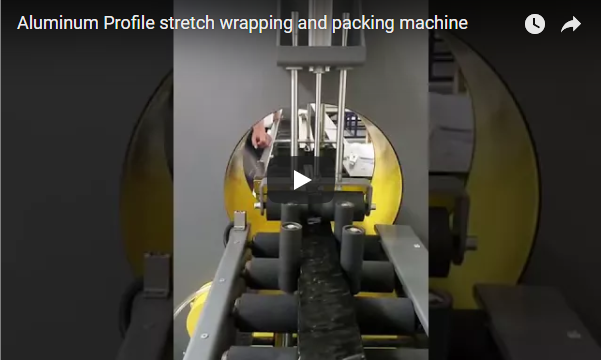
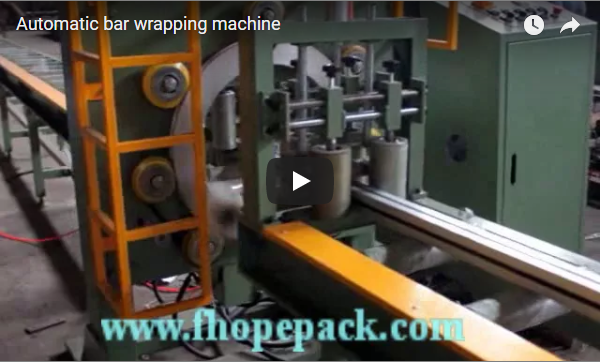
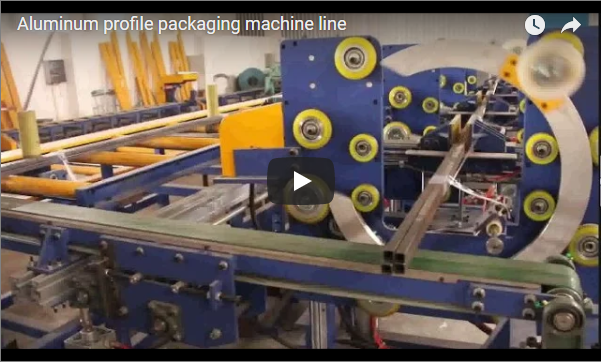
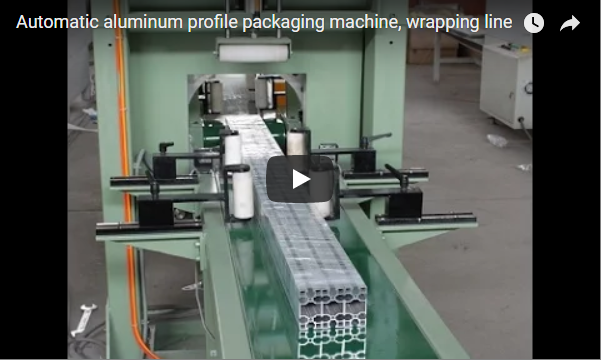
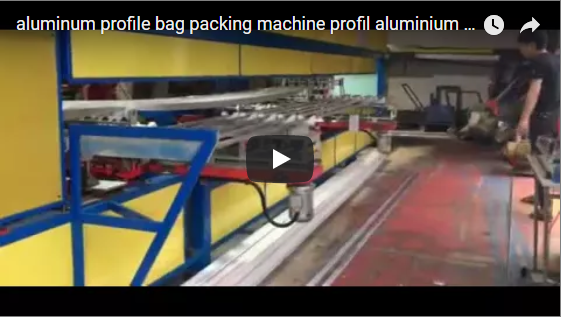
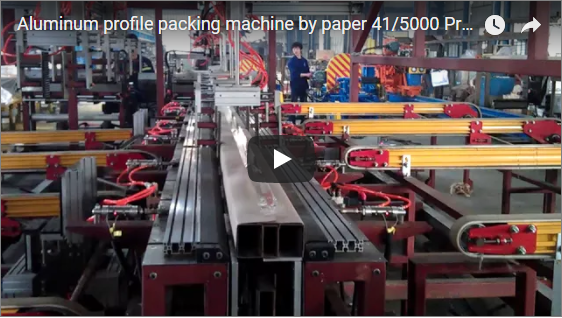
The video above shows the working principle in practice: a long bundle of extruded product travels through a ring that turns around it, laying stretch film in a continuous spiral. The core idea is simple — the bundle moves, the ring turns — and every parameter that matters (feed per turn, overlap, film per metre) follows from the ratio between those two motions.
How the horizontal orbital wrapper works: five points that matter
1. Ring drive and speed control. The ring is driven through a friction wheel, and the friction is adjustable so the drive can be tuned rather than forced. Ring speed is set by an inverter, with soft start and soft stop. For long goods this matters more than it sounds: a ring that jerks up to speed can drag the film and pull a light plastic pipe bundle sideways as it enters.
2. Film carriage riding on the ring. The film carriage is mounted on the ring itself, and film tension is adjustable. Correct tension is what makes the film lie flat against round pipe surfaces and flat profile faces instead of bridging or digging in. Tension is set once per product family and checked whenever you change bundle size.
3. Unpowered roller tables. A 500 mm roller table sits in front of the ring and another behind it. The operator pushes the bundle through at a steady pace — there is no powered feed on this semi-automatic model. The human hand is effectively the wrapping-speed control, which is why the overlap maths below treats feed speed as the variable the operator sets.
4. Photocell and PLC sequencing. A photocell detects the bundle as it enters the ring area; the PLC starts the ring and stops it again when the bundle clears, returning the ring to a reset position so the next cycle begins identically. The operator does not time anything.
5. Optional film cutter and feeder. With the optional cutter and feeder, the machine clamps the film tail, cuts it at the end of the wrap and holds the film ready for the next bundle. Without it, the operator tucks and cuts the tail manually — acceptable at low output, worth specifying if bundles per hour is a serious number.
S300 quotation data
Use this table to cross-check your own product against the machine envelope. The two rows to scrutinise first are ring diameter and bundle weight.
| Parameter | S300 value |
|---|---|
| Ring diameter | 450 mm |
| Bundle length | 800 mm to unlimited |
| Bundle weight | 5–50 kg |
| Ring speed | 100–120 r/min |
| Wrapping speed | 10–16 m/min rated (manual push sets the actual feed) |
| Power | approx. 0.75 kW |
| Supply | 380 V, 3 phase, 50/60 Hz |
| Film roll OD / width / core | 100–200 mm / 100–150 mm / 50 mm |
| Overlap | adjustable 15–90% |
| Roller tables | 500 mm infeed and outfeed |
| Floor load | over 1 t/m² |
Pass-through — the number that decides feasibility. The bundle cross-section must pass through the 450 mm ring with enough clearance for the film carriage to orbit it. That means the bundle’s diagonal — not just its width or height — must stay well under 450 mm. A bundle that measures 300 × 300 mm has a diagonal of roughly 424 mm and will be tight or impossible; a 250 × 250 mm bundle (diagonal ≈ 354 mm) leaves room for the carriage and film. Confirm your net maximum bundle width and height at quotation stage rather than estimating from nominal pipe size.
Overlap and film consumption: the maths that ties push speed to ring speed
Three formulas connect the operator’s push speed, the ring speed and the film width:
- Feed per ring turn (mm) = wrapping speed (mm/min) ÷ ring speed (r/min)
- Overlap (%) = (1 − feed per turn ÷ film width) × 100
- Film per metre of bundle (m) ≈ bundle perimeter (m) × turns per metre
Worked example (estimation only). Suppose the operator pushes the bundle at 10 m/min and the ring runs at 120 r/min. The bundle advances 10,000 ÷ 120 ≈ 83 mm per ring turn. With 150 mm film, the overlap is (1 − 83 ÷ 150) × 100 ≈ 45%. If the bundle has a perimeter of 0.6 m, it receives 1,000 ÷ 83 ≈ 12 turns per metre, so film consumption is approximately 0.6 × 12 ≈ 7.2 m of film per metre of bundle — before stretch. Stretching the film at the carriage reduces actual consumption; treat the unstretched figure as a conservative budgeting number.
The practical reading of these formulas: if you want more overlap, either slow the push or speed up the ring. If you want to cut film cost, a wider film at the same feed per turn raises overlap for free — or lets you push faster at the same overlap, raising output.
Best practices for pipe and tube surfaces
Plastic pipe. Keep film tension low. Thin-wall pipe can oval under concentrated wrapping pressure, and an ovalsed bundle is a customer complaint before it is a packaging defect. Set tension so the film conforms without compressing.
Aluminium profile. Run a higher overlap on decorative faces, and add paper or foam interlayers on sharp edges. Film alone on a mill edge will find the corner; the interlayer takes the point load.
Copper and steel tube. Wrap dry tube only. Moisture trapped under stretch film is the classic cause of staining and tarnish on copper — the wrap that protects the bundle from dirt can hold condensation against the surface. If tube comes off the line warm, let it cool and dry before wrapping.
Long bundles. Support the bundle on rollers on both sides of the ring. An unsupported span sags as it passes through, and a sagging bundle twists the spiral — you get a dense wrap at the ends and a loose one in the middle.
Bundle ends. Leave the ends open so the bundle can breathe, unless dust is the bigger risk for your product — in that case, cap the ends before wrapping.
Selection checklist before you request a quotation
- Product: plastic pipe, aluminium profile, or copper/steel tube
- Bundle width, height and length (check the diagonal against the 450 mm ring)
- Bundle weight — 5–50 kg on this semi-automatic model
- Bundles per hour
- Film only, or paper plus film
- Manual push, or powered conveyors for heavier or faster duty
Safety: design references, not a certificate claim
The ring area is guarded, and the ring uses soft start and soft stop to limit unexpected movement. On standards: EN ISO 12100, EN 415-10 and EN 60204-1 are used as design references and risk-assessment methods — they are not a unit certificate. CE documentation and the guarding scope are agreed per project in the order agreement. Confirm the exact protective documentation delivered with your machine per project.
Engineering FAQ
Can I wrap a single long pipe, or only bundles? Both work. Single long pipes and bundles from 800 mm long upward are fine, provided the cross-section passes through the 450 mm ring with carriage clearance.
What is the weight limit? 5–50 kg on this semi-automatic model. Heavier bundles move to the powered conveyor version — confirm the configuration per project.
How is overlap adjusted? From 15% to 90%, by changing the push speed, the ring speed, or both — the formulas above tell you which lever to move.
What about the electrical supply? Standard supply is 380 V, 3 phase, 50/60 Hz, changeable to local voltage — confirm per project.
Next step
Send us your pipe or tube sizes, bundle weight and required output. We confirm the ring size and conveyor configuration for your product, then send a proposal and quotation. No testing or delivery promises are made here — the numbers in your enquiry decide the machine.
Related reading
- Aluminum profile packing line with robat timber feeder (product)
- Aluminum horizontal wrapping machine with spacer feeder
- Aluminum packing machine
- Copper sheet and bronze bar wrapping machine
Sources
- FHOPE-S300 semi-automatic horizontal stretch wrapping machine quotation — official quotation document for the S300 model; source of the machine envelope and specification figures in this article (ring diameter, bundle weight range, ring and wrapping speeds, power, supply, film roll dimensions, overlap range, roller table lengths, floor load).
- fhopepack.com published data — official overlap and film-consumption formulas and the worked example used in this article (feed per ring turn, overlap percentage, film per metre of bundle).
- EN ISO 12100:2010; EN 415-10; EN 60204-1 — cited strictly as design references and risk-assessment methods for the machine design described in this article. These standards are not a unit certificate; CE/protective documentation and guarding scope are agreed per project in the order agreement.