Executive summary
A hose coil wrapping and strapping machine sits over a roller conveyor and wraps each coil of flexible hose in transparent film as the coil is held in place. When the inline strapping stage is configured for the project, transport straps are applied over the wrapped coil before discharge, and the wrapped coil is ready for the next step. Wrapping each coil in place keeps the hose protected and the coil stable while it is handled. Coil size, film choice and cycle time are confirmed per project.
Table of Contents
- Why wrap hose coils
- What the machine does
- Roller conveyor and wrap arm
- Wrap cycle and control
- What the footage shows
- Typical configuration
- Selection checklist
- Operation and safety
- Engineering FAQ
- Next step
- Related reading
- Sources and standards
Why wrap hose coils
A coil of flexible hose can loosen, scuff or pick up dirt while it is stored, handled or shipped. Wrapping the coil in film holds the turns together and keeps the hose clean until it reaches the end customer.
Wrapping on a machine applies the cover in one pass, so every coil leaves the line with the same protection. Coil size and film choice are confirmed per project.
What the machine does
The machine is a wrapping unit mounted over a roller conveyor. A coil of hose travels in on the conveyor, the machine lowers a tray and clamp into position, and the wrap arm winds transparent film around the coil to form a closed cover.
The wrapped coil stays on the conveyor and moves out for the next step. Coil diameter and cycle time are confirmed per project.
Roller conveyor and wrap arm
A roller conveyor carries the coil through the wrapping area. The machine stands above the line, with a wrap arm that reaches down to the coil and a tray that places itself under the coil to position it for the wrap.
A roll of film on the arm is pulled around the coil as the wrap arm moves, and a cutting and sealing fixture closes the end of the film. Film width and wrap travel are confirmed per project.
Wrap cycle and control
The cycle starts when the coil sits on the roller conveyor in the wrapping area. The tray lowers under the coil, the wrap arm winds the film around it, and the cutting and sealing fixture finishes the cover.
Once the wrap is complete, the arm returns to its starting position and the wrapped coil continues out on the conveyor. The control panel on the machine carries the start controls for the cycle. Cycle time and wrap pattern are confirmed per project.
What the footage shows
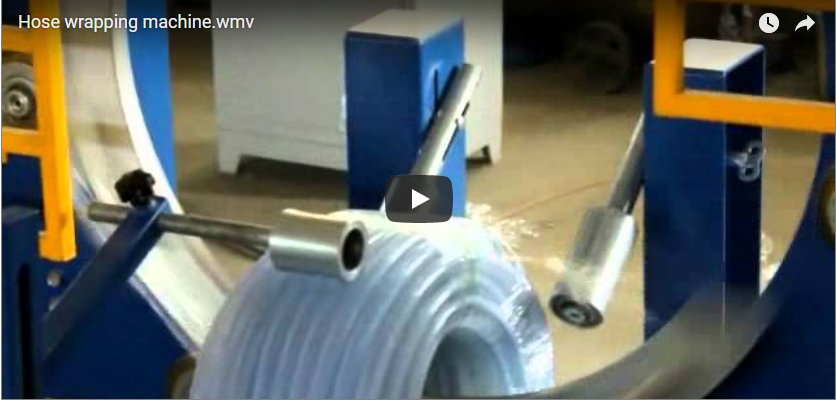
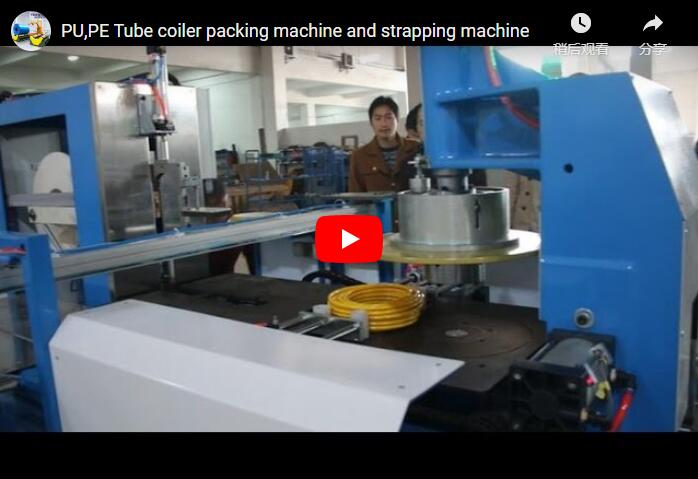
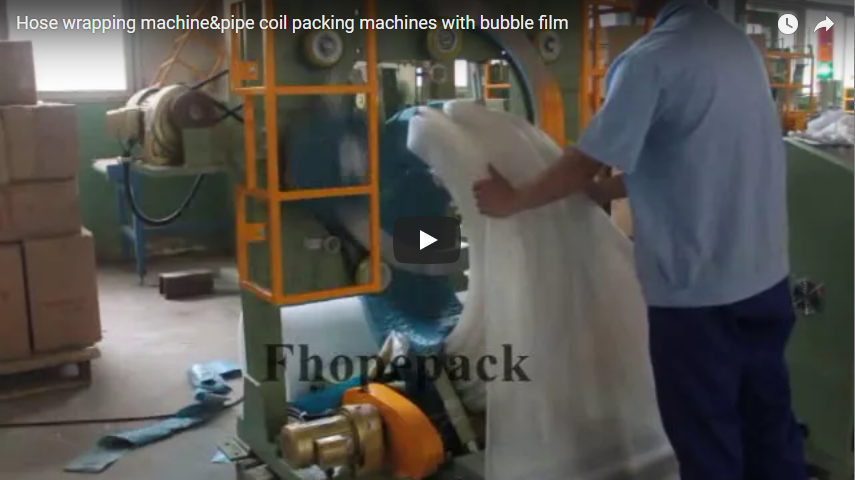
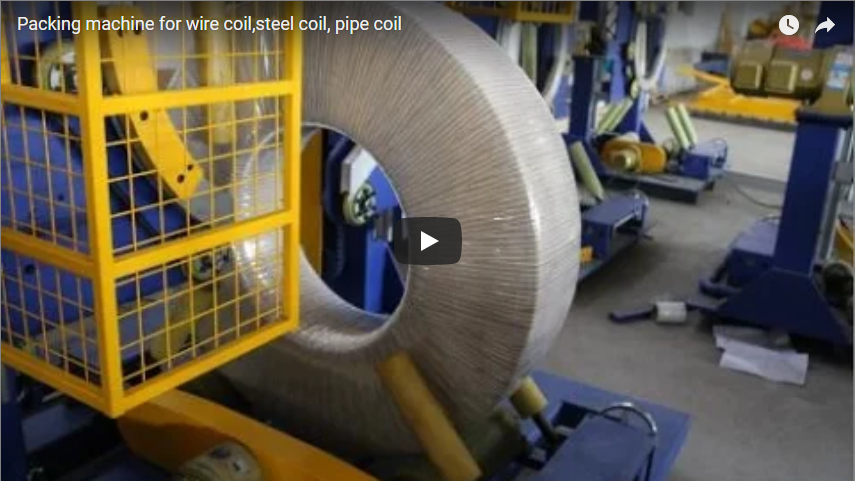
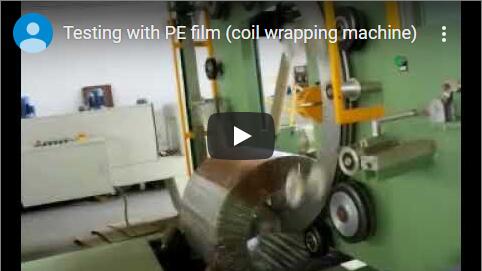
Our footage shows a black flexible hose coil on the roller conveyor as the machine lowers a tray under it and positions the coil for wrapping. The wrap arm winds transparent film around the coil, the cutting and sealing fixture closes the cover, and the wrapped coil remains on the conveyor. It is a general demonstration, so your coil size, film choice and cycle time are confirmed with us per project.
Typical configuration
Figures below list functional design boundaries rather than numeric values, and are confirmed per project.
| Parameter | Typical range, confirmed per project |
|---|---|
| Load | flexible hose coils on the roller conveyor |
| Process | transparent film wrapped around the coil |
| Positioning | tray and clamp lower under the coil |
| Sealing | cutting and sealing fixture closes the cover |
| Transfer | roller conveyor in, wrapped coil out |
| Control | control panel with cycle start |
| Guarding | mesh fence around the wrapping area |
| Mount | floor, straddling the conveyor line |
| Electrical supply | 380 V three phase 50 Hz, or 220 V single phase for light machines, selected per project |
Selection checklist
| Question | Confirm per project |
|---|---|
| Coil range | outer diameter, width, weight |
| Film | width, thickness, stretch |
| Cycle | wrap time, seal time, total time |
| Line | conveyor height, in and out interfaces |
| Guarding | fence layout around the machine |
| Electrical supply | voltage, phase and frequency on site |
Operation and safety
Place the coil on the conveyor, start the wrap cycle, and let the machine position and wrap the coil while it is held in place. Keep clear of the mesh fence and the wrap arm while the machine is running.
Routine checks cover the conveyor, the wrap arm and the sealing fixture, per the machine manual. Confirm the coil is seated before each cycle.
Engineering FAQ
Q: What does this machine do? A: It wraps each coil of flexible hose in transparent film as the coil is held on the roller conveyor.
Q: How is the coil held during the wrap? A: A tray and clamp lower under the coil to position it while the wrap arm winds the film around it.
Q: Do we load each coil by hand? A: The footage shows a coil on the conveyor; upstream feeding can be arranged for higher rates per project.
Q: Does the line also apply strapping over the wrapped coil? A: Yes, when the inline strapping stage is configured for the project, transport straps are applied over the wrapped coil before discharge; coil dimensions and wrap settings are confirmed per project.
Q: Can it handle different coil sizes? A: The tray and wrap arm adapt within the machine range; your coil dimensions are confirmed per project.
Next step
- Email us at info@fhopepack.com with your coil size and cycle time.
- We send a coil wrapping proposal within 48 hours.
- We confirm the conveyor interface and film choice for your line.
Related reading
- Hose Coil Wrapping and Strapping: Operation and Applications
- Pipe Coil Wrapping and Strapping: Solutions for Industry
- Partial film wrapping and packing by orbital wrapper
- FHOPE packing machinery product lines
Sources and standards
- ISO 12100:2010 Safety of machinery, general principles for design and risk assessment
- EN 415-10:2014 Safety of packaging machines, general requirements
- EN ISO 13849-1:2023 Safety of machinery, safety-related parts of control systems
FHOPE hose coil wrapping and strapping demonstration video. Reviewed as a general demonstration; coil size, film choice and cycle time confirmed per project.
Last reviewed: 2026-10-12