Executive summary Our V-shape pallet changer takes a pallet load straight from a pallet truck at floor level, clamps it, and tilts it 90 degrees so the load rests on its side and the pallet can be pulled out and replaced. The standard build is rated for 1.5 t, and a hydraulic drive completes the tilt in about 20–30 s. Loads from 600 to 2,000 mm high fit, and heavier builds are made to your product weight.
Table of Contents
- How the V-shape changer works
- V-shape, 180° or push type
- Does your load fit
- Estimate pallets per hour
- V-shape changer data
- Safety and installation
- Selection checklist
- Engineering FAQ
- Next step
- Related reading
- Sources
How the V-shape changer works
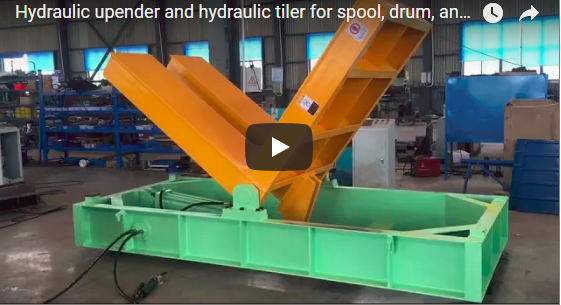
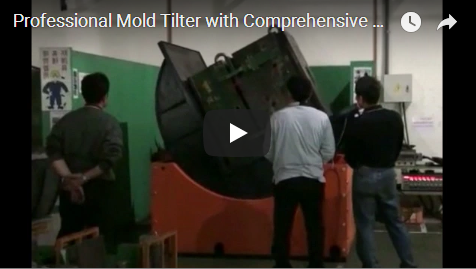
The cradle is two plates welded at a right angle, like a V lying on its back. The operator runs the pallet into the cradle with a pallet truck, so no forklift is needed. A scissor-type pressing device closes on the goods and holds them in the cradle. Hydraulic cylinders then tilt the whole cradle through 90 degrees. The weight of the goods moves onto the back plate, and the pallet stands upright on its edge.
Once the goods rest on the back plate, the pallet carries no load. The press eases off, and the operator slides the pallet out and puts in a replacement, such as a plastic pallet for a hygiene area or an export pallet. The cradle then tilts back, the press opens, and the pallet truck takes the load out on its new pallet.
In our video, we tilt a loose stack of black tyres, a load with nothing tying the layers together. The stack lies down on the back plate without sliding, because the press keeps it clamped while its centre of gravity moves over onto the back plate.

V-shape, 180° or push type
| Machine | How it frees the pallet | Typical load |
|---|---|---|
| V-shape changer | Tilts the load 90° onto its side | 1.5 t standard; usually under 2 t, up to 3 t on special builds |
| 180° inverter (FPFZ-1) | Turns the load upside down | Up to 1.2 t |
| Push-type changer | Pushes the goods off one pallet onto another | 1,000 kg |
A 90° tilt is gentler than a full inversion, because the goods only lie on their side and never hang upside down. That is why the V-shape suits frangible goods such as glass bottles and ceramics. A push-type changer has no tilt at all, but the goods slide across the pallet surface, which creates friction at the base. Choose it only if the bottom layer can take that rubbing.
Does your load fit
| Check | V-shape changer |
|---|---|
| Load height | 600–2,000 mm |
| Load weight | 1.5 t standard |
| Heavier loads | Built to product weight, usually under 2 t, up to 3 t |
| Loading | Pallet truck at floor level |
Check your heaviest and your tallest pallet. For example, a pallet of 48 cartons at 25 kg each is 1,200 kg, which is inside the standard 1.5 t rating. If your loads go above that, we size the cradle, the cylinders and the base for your product weight instead of stretching a standard machine.
Estimate pallets per hour
Illustrative cycle at the middle of the 20–30 s tilt range, with 60 s of pallet truck handling and 40 s to swap the pallet by hand:
| Step | Time |
|---|---|
| Tilt down, 25 s | 25 s |
| Old pallet out, new pallet in (illustrative) | 40 s |
| Tilt back, 25 s | 25 s |
| Pallet truck in and out (illustrative) | 60 s |
| Total cycle | 150 s |
| Pallets per hour | about 24 |
Add a few seconds for the press to close and open. The hydraulic tilt is only a third of the cycle. Handling the pallet truck and the pallet swap take the rest, so a roller infeed or a second operator raises output more than a faster tilt would.
V-shape changer data
| Item | V-shape pallet changer |
|---|---|
| Tilt angle | 90° |
| Rated load | 1.5 t standard |
| Custom builds | Usually under 2 t, up to 3 t |
| Tilt time | About 20–30 s |
| Drive | Hydraulic |
| Load height | 600–2,000 mm |
| Clamping | Scissor-type pressing device |
| Loading | Pallet truck at floor level, no forklift needed |
Safety and installation
The operator starts the cycle with one button from a control point away from the cradle, so nobody stands near the load during the tilt. The press holds the goods for the full stroke, which is what keeps a tall stack from shifting. The compact cradle needs little floor space, and we lay out the machine to fit the pallet truck path you already have.
The standards that apply depend on the destination market. For CE markets, ISO 12100 sets the risk-assessment method and EN 415-10 sets general requirements for packaging machines.
Selection checklist for a V-shape pallet changer
- Heaviest load, and whether it is above 1.5 t.
- Load height, smallest to largest.
- Pallet length and width.
- Can the goods lie on their side?
- Fragile goods, or goods that must not rub.
- Pallets per hour needed.
- Local power supply.
Engineering FAQ
Q: How heavy a load can the V-shape changer tilt? A: The standard build is rated for 1.5 t. We build to your product weight, usually under 2 t and up to 3 t for special builds.
Q: How long does the tilt take? A: About 20–30 s each way with the hydraulic drive. A pallet swap needs one tilt down and one tilt back.
Q: Why choose a 90° tilt instead of a 180° inverter? A: The goods only lie on their side and never go upside down, which suits fragile goods such as glass bottles and ceramics.
Q: Do I need a forklift to load it? A: No. The cradle sits at floor level and a pallet truck runs the load in and out.
Q: What load heights fit? A: Loads from 600 to 2,000 mm high.
Next step
We plan your V-shape pallet changer in three steps:
- Submit your layout drawing with your pallet sizes and load weights to info@fhopepack.com.
- Receive a proposal within 48 hours, with the rated load and cycle plan.
- Book a site survey to check the floor and the pallet truck path.
Related reading
- V-shape pallet changer
- Pushing type pallet changer
- 180° pallet inverter
- Video: C-type 180° pallet turnover and pallet inverter
Sources
- Load height, 90° down-ending, scissor press, floor-level loading: V-shape pallet changer page
- Rated load, tilt time, hydraulic drive and custom range: FHOPE engineering team, 2026-10-04
- 180° inverter comparison: 180° pallet inverter page
- Machine in action: our V-shape pallet changer video on YouTube
- Standards scope: ISO 12100:2010, EN 415-10:2014
Last reviewed: 2026-10-04