Executive summary
A C-shape pallet inverter holds the load in the opening of a round C frame and turns it 180°, so the bottom face ends up on top. We build this C-type tilter for pallets, steel sheet stacks, molds and dies. A hydraulic scissor clamp adapts to the load height, a double chain drive with a worm reducer turns the frame, and the frame locks at any angle on emergency stop.
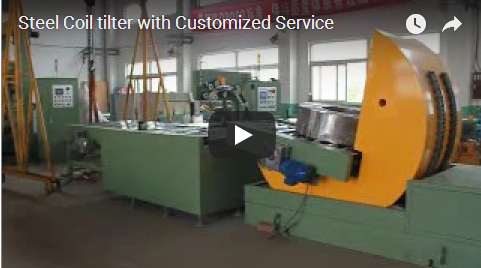
Here the yellow C frame on its green base carries a stack of steel sheets in a fixture. The two halves of the frame, marked A and B, clamp the stack and turn it over, and the operators run the machine from the green control cabinet beside it.
Table of Contents
- Why a C-shape frame
- Machine structure
- Working cycle
- Worked example: steel sheet stack
- Specifications
- Applications
- Selection checklist
- Safety: EN 415-10 and ISO 12100
- Engineering FAQ
- Next step
- Related reading
- Sources
Why a C-shape frame
A round C frame rolls on its rim on rollers in the base, rather than swinging on a centre axle. The load turns about the centre of the ring, so its centre of gravity stays low and close to the turning centre. The drive works on the large rim radius, and the machine needs little more height than the ring itself.
The open side of the C lets a forklift or loading truck put the load in and take it out. With the optional base rotating drive, the C-type tilter can load and unload from the same side, which saves floor space in a narrow aisle.
Machine structure
| Part | Function |
|---|---|
| C frame (A and B halves) | one rigid ring assembly that rolls on rollers in the base and turns the load 180° |
| Hydraulic scissor clamp | long-reach scissors clamp a wide range of load heights |
| Double chain drive with helical gear and worm reducer | turns the frame |
| Inverter control | fast, stable and safe speed control |
| Two displacement restrictors | travel limit devices that end the rotation at each end position |
| Locking | the frame locks at any angle on emergency stop |
| Electronic control panel | separate from the frame |
| Base rotating drive (option) | turns the machine to load and unload from one side |
Working cycle
- Load. A forklift sets the pallet or stack into the opening of the C frame.
- Clamp. The scissor clamp closes onto the load from above.
- Turn. The frame rolls 180° on its base, driven by the chains.
- Release. The clamp opens; the load now rests on what was its top face.
- Unload. The forklift takes the load out, from the far side or, with the base rotating option, from the same side.
Worked example: steel sheet stack
Before turning a stack, check its weight against the inverter rating. Steel density is about 7,850 kg/m³.
| Step | Calculation | Result |
|---|---|---|
| One sheet, 2,400 × 1,200 × 2 mm | 2.4 × 1.2 × 0.002 m³ × 7,850 | about 45 kg |
| Stack of 40 sheets | 40 × 45 | about 1,800 kg |
| Stack height | 40 × 2 mm | 80 mm, plus the fixture |
| With a 200 kg fixture (illustrative) | 1,800 + 200 | about 2,000 kg |
Result. A modest-looking stack of 40 thin sheets already weighs about 2 t with its fixture. Total weight, footprint and stack height decide the inverter size and the clamp stroke, and the rated capacity is confirmed at quote.
Specifications
| Item | Figure |
|---|---|
| Turn | 180° |
| Drive | double chain, helical gear and worm reducer |
| Clamp | hydraulic scissor, adjusts to load height |
| Speed control | inverter |
| Safety | two displacement restrictors; locks at any angle on emergency stop |
| Control | electronic panel |
| Option | base rotating drive for same-side loading |
| Capacity, load size, power | confirmed at quote |
Applications
- Pallet loads: changing a pallet or reaching the bottom layer.
- Steel sheet stacks: turning to inspect or process the underside.
- Molds and dies: turning for assembly, service or storage.
- Steel, wire, aluminium and copper coils, and wheel spools.
Selection checklist
- Heaviest load including fixture or pallet.
- Load footprint and height range.
- Loading from one side or both sides.
- Turns per hour.
- Floor space and forklift access.
Safety: EN 415-10 and ISO 12100
Load inverters are covered by EN 415-10, with the risk assessment to ISO 12100:2010. The rolling C frame, the scissor clamp and the chain drive are the main hazards. The operator stays at the separate panel, outside the turning zone, during the turn. Two displacement restrictors end the travel, and the frame locks at any angle on emergency stop. Guarding and CE documents are agreed per project.
Engineering FAQ
Q: Can the C-shape inverter handle steel sheets as well as pallets? A: Yes. It is built for pallets, steel sheet stacks, molds and dies.
Q: What happens if the emergency stop is pressed mid-turn? A: The frame locks at that angle.
Q: Can I load and unload from the same side? A: Yes, with the optional base rotating drive.
Q: How is the load held? A: A hydraulic scissor clamp closes onto the load and adapts to its height.
Q: Does it need a pit? A: No. The base stands on the floor, and the forklift loads into the C opening at base height.
Next step
- Send your load size, weight and the reason for turning to info@fhopepack.com.
- We size the C frame, clamp and drive.
- We reply within 24 hours with a proposal and quotation.
Related reading
- Load inverter (product)
- C-type 180° pallet turnover and pallet inverter
- Steel sheet upender for 180° turning
- 180° rotation pallet inverter with double clamper
- Steel sheet pallet inverter
- Rotatable 180° automatic multipurpose tilter
Sources
- FHOPE product page: load inverter (C-type tilter)
- EN 415-10; ISO 12100:2010
- Our C-shape inverter shown above
Last reviewed: 2026-10-19