Executive summary
A mold maintain rotator and flipping table tilts and flips large, heavy molds on a platform so maintenance crews can reach every face without lifting the mold by hand. The platform rotates the mold toward a working angle while a collapsible bellows guard shields the operator side, and the table returns the mold to level at the end of the cycle. Mold size, weight and rotation angle are confirmed per project.
Table of Contents
- Why handle molds on a table
- What the machine does
- Platform and bellows guard
- Cycle and control
- What the footage shows
- Typical configuration
- Selection checklist
- Operation and safety
- Engineering FAQ
- Next step
- Related reading
- Sources and standards
Why handle molds on a table
Large molds are heavy to lift and awkward to turn by hand, and each maintenance pass means rolling or winching the mold again. A slow, controlled tilt brings every face up to a working height, so the crew can clean, inspect or dress the mold without climbing over it.
The table keeps the mold on its own platform through the cycle, so the mold stays under control at every angle. Mold size and rotation angle are confirmed per project.
What the machine does
The machine is a rotator and flipping table built around a rectangular platform. A mold is placed on the platform, and the table tilts the platform toward one side or rotates it over while a collapsible bellows guard covers the operator side of the work zone.
The platform returns to level at the end of the cycle, ready for loading or unloading. Mold size and travel angle are confirmed per project.
Platform and bellows guard
The platform is a flat steel table that carries the mold through the tilt. A corrugated bellows guard on one side extends as the platform tilts and folds back when the table returns to level, so the moving side of the work zone stays covered.
A floor-mounted control cabinet with push buttons and indicator lamps sits beside the table. Platform size and guard travel are confirmed per project.
Cycle and control
A typical cycle starts with the mold level on the platform. The operator starts the run from the control cabinet, and the platform tilts the mold to the working angle while the bellows guard extends. The table returns the mold to level when the pass is complete.
The footprint of the guard and the travel direction are arranged for your line layout. Cycle speed and travel angle are confirmed per project.
What the footage shows
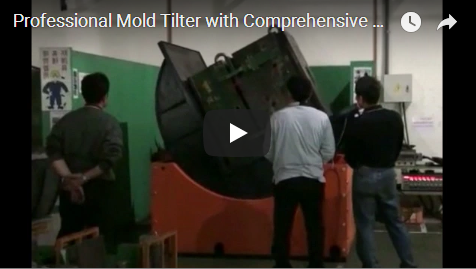
Our footage shows a large metal mold on the platform while the table tilts it toward one side and back to level. The corrugated bellows guard extends across the work zone as the platform tilts and folds back again on the return. A worker at the control cabinet starts the run.
It is a general demonstration, so your mold size, weight and working angle are confirmed with us per project.
Typical configuration
Figures below list functional design boundaries rather than numeric values, and are confirmed per project.
| Parameter | Typical range, confirmed per project |
|---|---|
| Load | heavy mold on the platform |
| Tilt | platform tilts the mold to the working angle |
| Guard | bellows guard extends across the work zone |
| Control | push buttons and indicator lamps on the cabinet |
| Mount | floor, with access around the table |
| Electrical supply | 380 V three phase 50 Hz standard for the rotation and tilt drives; 220 V single phase for control and auxiliary circuits, selection per project |
| Capacity | mold size and weight confirmed per project |
| Output | mold returned to level after the cycle |
Selection checklist
| Question | Confirm per project |
|---|---|
| Mold range | length, width, height, weight |
| Travel | tilt angle, flip direction, clear height |
| Guard | bellows extent, access for loading |
| Control | panel layout, safety devices |
| Site | floor space, pit or foundation |
| Electrical supply | voltage, phase and frequency on site |
Operation and safety
Seat the mold square on the platform and make sure the load is within the rated travel before starting. Start the run from the control cabinet and stand behind the bellows guard while the platform is moving.
Routine checks cover the platform, the bellows guard and the tilt drive, per the machine manual.
Engineering FAQ
Q: What does this machine do? A: It tilts and flips a large mold on a platform so every face can be reached for maintenance without lifting the mold by hand.
Q: How is the mold turned? A: The platform tilts the mold toward the working angle while the bellows guard extends, and returns it to level when the pass is complete.
Q: Can it flip a mold fully over? A: Yes, if the maintenance step needs the underside, the platform rotates the mold over in a single pass.
Q: Do we load the mold by forklift? A: The footage shows the mold already on the platform; loading by forklift or crane is arranged per project for your floor layout.
Q: What does it suit? A: Large molds and castings that need to be tilted or flipped for cleaning and inspection when maintenance is due.
Next step
- Email us at info@fhopepack.com with your mold size and weight.
- We send a rotator and flipping table proposal within 48 hours.
- We confirm the platform size and travel angle for your molds.
Related reading
- Mold Maintain Rotator And Flipping Table: Operation and Applications
- Coil Upending and Turning: Solutions for Industry
- Partial film wrapping and packing by orbital wrapper
- FHOPE packing machinery product lines
Sources and standards
- ISO 12100:2010 Safety of machinery, general principles for design and risk assessment
- EN 415-10:2014 Safety of packaging machines, general requirements
- EN ISO 13849-1:2023 Safety of machinery, safety-related parts of control systems
FHOPE mold maintain rotator and flipping table demonstration video. Reviewed as a general demonstration; mold size, weight and working angle confirmed per project.
Last reviewed: 2026-10-12