Executive summary
This page shows how a coil wrapping machine is loaded and unloaded. A coil is placed on the rotating fixture, the machine spins the coil while the wrapping head lays protective film around it, and the wrapped coil is lifted off by hand when the run stops. Loading and unloading stay with the operator while wrapping runs automatically. Coil size, film width and wrap speed are confirmed per project.
Table of Contents
- Why load and unload coils
- What the machine does
- Rotating fixture and wrapping head
- Cycle and control
- What the footage shows
- Typical configuration
- Selection checklist
- Operation and safety
- Engineering FAQ
- Next step
- Related reading
- Sources and standards
Why load and unload coils
When coils change in size and weight across runs, a manual load and unload point keeps the wrapping line simple. The operator places each coil on the table, the machine wraps it, and the operator lifts the finished coil off. The wrapping step itself runs automatically, so the manual part is only the load and unload.
Coil size and weight are confirmed per project so the table and fixture match your range.
What the machine does
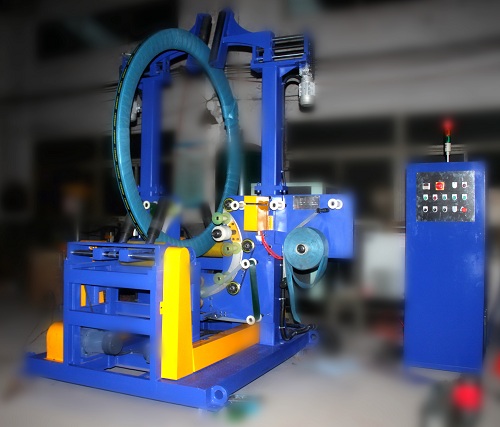
The machine is a coil wrapping unit with a rotating fixture at the centre of the table. A coil is placed on the fixture by hand, and the machine spins the coil while the wrapping head carries film from the roll above around the outside of the coil. The wrapped coil is lifted off when the run stops.
The control panel beside the machine carries the push buttons and indicator lamps for the cycle. Coil size and wrap speed are confirmed per project.
Rotating fixture and wrapping head
The rotating fixture holds the coil in the horizontal plane and turns it while the wrap is laid. The wrapping head works above the coil and feeds film from a roll mounted over the machine, so the film stays taut as the coil rotates.
The control panel on the side of the machine carries the start and emergency stop functions for the run. Fixture size and film width are confirmed per project.
Cycle and control
A normal cycle runs in three steps: the operator places the coil on the fixture, starts the run, and the machine rotates the coil while the wrapping head applies the film. When the wrap is complete the rotation stops and the operator lifts the coil off the table.
The panel on the side of the machine carries the start button and the emergency stop for the machine. Cycle sequence and panel layout are confirmed per project.
What the footage shows
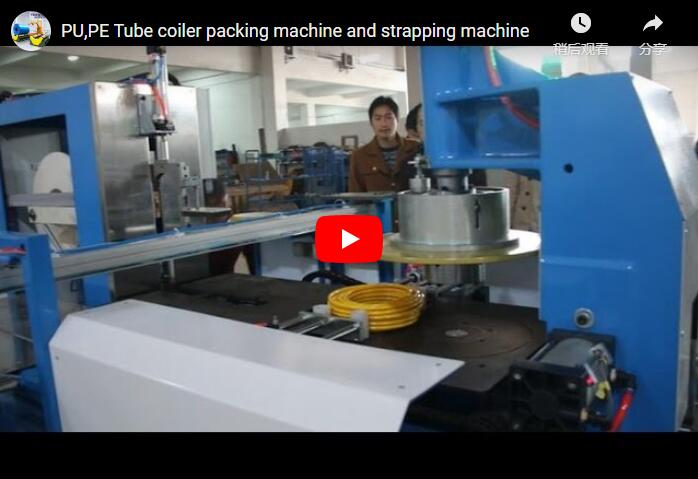
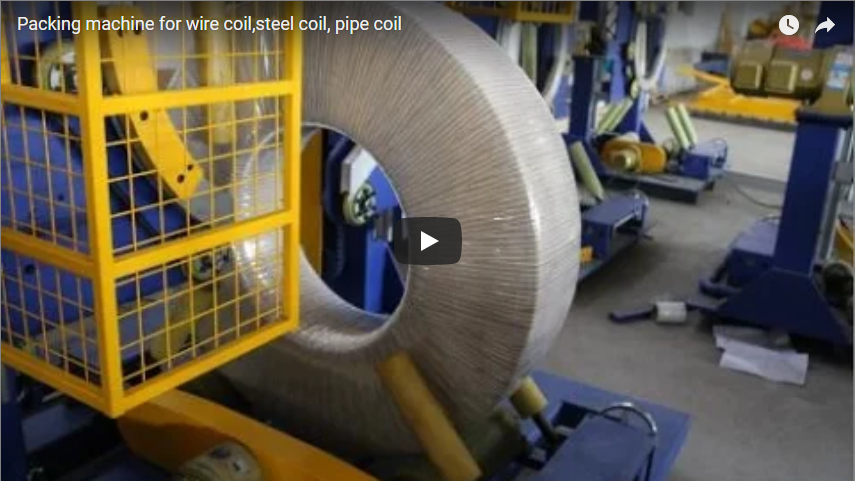
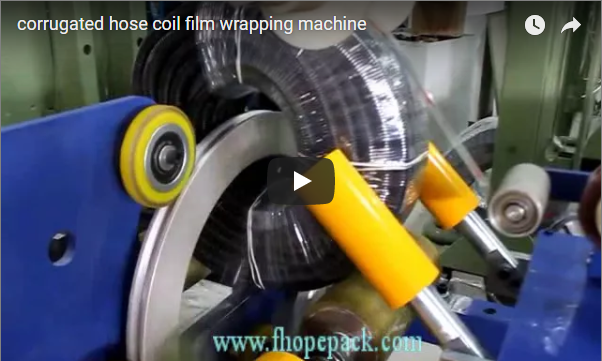
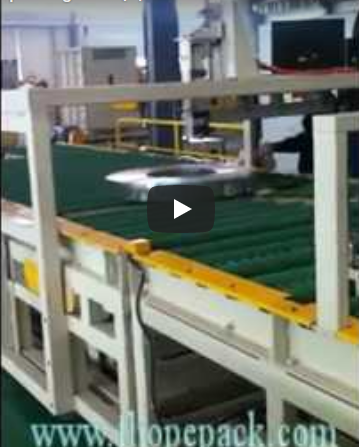
Our footage shows an operator placing a ring-shaped coil on the rotating fixture. The machine spins the coil while the wrapping head carries film from the roll above around the outside of the coil, and the operator supervises the wrap while it runs. When the wrapping is finished the coil is lifted off and set on a stand beside the machine.
It is a general demonstration, so your coil size, film width and wrap speed are confirmed with us per project.
Typical configuration
Figures below list functional design boundaries rather than numeric values, and are confirmed per project.
| Parameter | Typical range, confirmed per project |
|---|---|
| Load | coil placed on the rotating fixture by hand |
| Wrap | film wound around the coil by the head from above |
| Rotation | fixture rotates the coil in a horizontal plane |
| Film | roll mounted above the machine |
| Control | start and emergency stop on the side panel |
| Mount | floor, with clearance for loading |
| Electrical supply | 380 V three phase 50 Hz, or 220 V single phase for light machines, selected per project |
| Output | wrapped coil lifted off by hand |
Selection checklist
| Question | Confirm per project |
|---|---|
| Coil range | outer diameter, width, weight |
| Film | type, width, grid texture |
| Wrap | number of layers, overlap, wrap speed |
| Control | panel layout, emergency stop position |
| Site | floor space, access for loading |
| Electrical supply | voltage, phase and frequency on site |
Operation and safety
Place the coil square on the fixture and make sure it is seated before starting the run. Keep clear of the rotating fixture and the wrapping head while the machine is running, and use the emergency stop if the load shifts.
Routine checks cover the fixture, the wrapping head and the film roll, per the machine manual.
Engineering FAQ
Q: What does this machine do? A: It wraps a ring-shaped coil in protective film on a rotating fixture, with the coil loaded and unloaded by hand.
Q: How is the film applied? A: The wrapping head feeds film from the roll above while the fixture rotates the coil through the wrap.
Q: Do we load and unload by hand? A: Yes, the footage shows the coil placed on the fixture and lifted off by hand when the run stops.
Q: Does the wrap run automatically? A: The wrap runs automatically when the cycle is started after the coil is loaded onto the fixture.
Q: What does it suit? A: Ring-shaped coils that need a protective wrap for storage and transport when loading stays with the operator.
Next step
- Email us at info@fhopepack.com with your coil size and film width.
- We send a coil wrapping proposal within 48 hours.
- We confirm the fixture size and wrap pattern for your coils.
Related reading
- The way to load and unload coil by the device of coil wrapping machine
- PET WRAPPING MACHINE
- Partial film wrapping and packing by orbital wrapper
- FHOPE packing machinery product lines
Sources and standards
- ISO 12100:2010 Safety of machinery, general principles for design and risk assessment
- EN 415-10:2014 Safety of packaging machines, general requirements
- EN ISO 13849-1:2023 Safety of machinery, safety-related parts of control systems
FHOPE coil wrapping machine load and unload demonstration video. Reviewed as a general demonstration; coil size, film width and wrap speed confirmed per project.
Last reviewed: 2026-10-12