Executive summary
Plants move pallets, crates and sheet stacks that must be turned end-over-end, or set onto a fresh pallet. By fork truck and overhead crane that routine is slow and risky: each swing can shift a stack, and a person can end up in the path of an unguided load.
A hydraulic pallet upender tilts the complete unit load under control, holds it at any angle for access, and lowers it again. This article covers how it works, the specified envelope, and how to choose between an upender and a pallet changer.
Table of Contents
- What This Machine Solves
- How the Upender Works
- Specified Capability
- Choosing a Type for Your Job
- Selection Checklist
- Layout and Integration
- Controls and Safety
- Engineering FAQ
- Next Step
- Related Reading
- Sources
What This Machine Solves
The recurring cost in palletised handling is re-orientation. A load arrives on a pallet, but the strapper, inspector or despatch line needs it standing on end. A crate stored on its long side must be presented upright. A stack that slumped in transit has to be re-registered before banding.
A damaged pallet has to be exchanged without re-stacking the goods by hand. These jobs used to be done by lifting a single edge with a fork truck, by slinging the load to a crane, or by re-stacking piece by piece. Each method was slow and a source of misalignment and damage.
The upender accepts a complete unit load on a tilt table, keeps the stack registered, and rotates it under machine control. Typical loads are palletised boxes and crates, stacked sheets, panels, moulds and other heavy unit loads whose orientation changes between process stages. Pallet and crate opening height is confirmed from your layout, sized per project.
How the Upender Works
The load is placed on the tilt table with a pallet truck or fork truck. Hydraulic cylinders rotate the table through a controlled arc while the load stays registered against the table face. For illustration, an average tilt speed of 6 degrees per second moves the table through a 90° turn in 15 seconds.
At the end of the arc the table holds its position. The operator works on or removes the load while the table is stationary. Tilt angle, speed and holding positions are configured per project rather than fixed by a single catalogue setting.
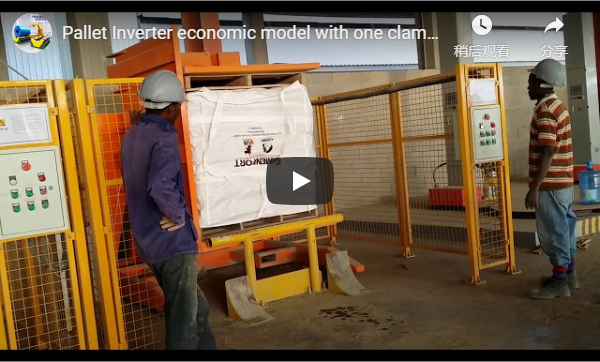
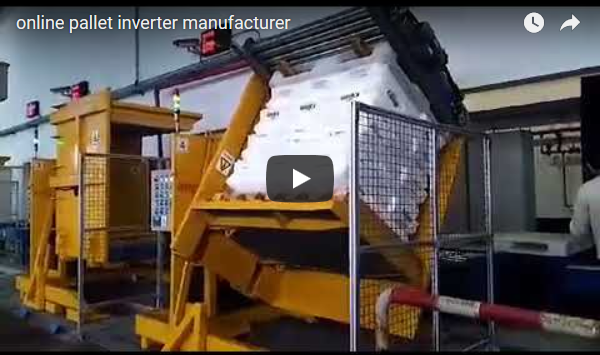
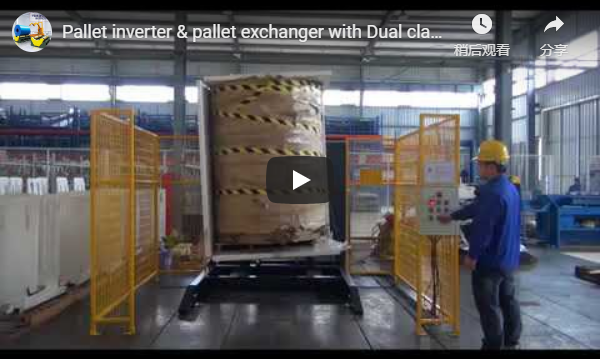
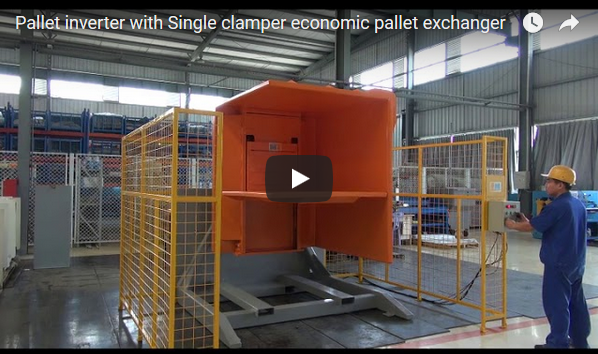
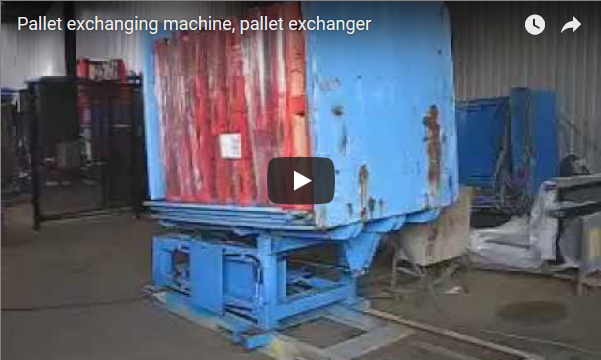
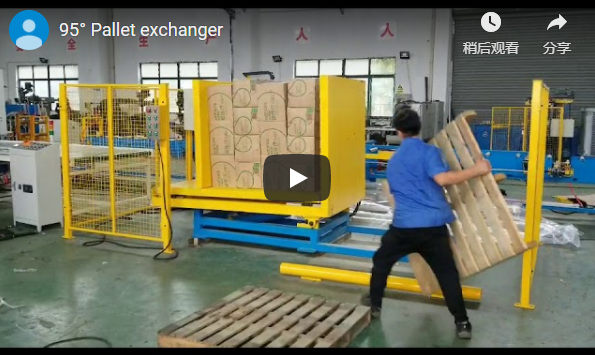
A reference video of a pallet upending and inverting line accompanies this article.
Specified Capability
Our steel-sheet upender line is specified for the ranges below, configured per project. Values are project ranges, not a rating of any single unit, so figures vary by layout.
| Parameter | Range |
|---|---|
| Max. operating pressure | 14 MPa |
| Load length (L) | 100 to 3000 mm |
| Load width (W) | 250 to 1850 mm |
| Load height (H, sheet stacks) | 10 to 350 mm |
| Rated load weight | 15 tonnes |
| Drive motor / Hydraulic system | 2.5 kW (drive) / 4.5 kW (hydraulic) |
| Machine size (approx.) | 3000 × 2200 × 2600 mm |
Table values apply to sheet stacks. Pallet and crate vertical clearances exceed 350 mm and are sized per project.
For illustration, the weight force of a 12-tonne tilting load is 12 × 9.81 = 117.72 kN. Hydraulic pressure, motor duty and footprint are confirmed from the submitted layout rather than assumed from catalogue figures alone. The 2.5 kW drive motor runs the powered tilt drive. The 4.5 kW hydraulic system powers the cylinders. Motor duty is confirmed per project based on cycle speed and load mass.
Choosing a Type for Your Job
Not every handling step needs the same machine. Pick the type that matches the working condition.
- Floor-level pallet replacement. If the pallet must be exchanged with the load staying low, the V-Shape Pallet Changer uses a 90° hydraulic tilt. It seats the new pallet on the ground. Choose it for line ends and low-clearance stations.
- Pallet swap without tilting. If the load is fragile or top-heavy and must not be tilted or clamped, the Push-Type Pallet Changer slides the load sideways onto a fresh pallet. Choose it for delicate or unstable stacks.
- Turning loads on end. If the job is to stand a stack, crate or panel up at an angle for inspection, packaging or feeding, the hydraulic upender/tilter is the direct choice. Choose it for repetitive re-orientation that occupies a crane.
- Coils and custom builds. The same hydraulic tilting engineering is also offered as a coil upender specified for 10-tonne coils. Heavier or longer builds are selected per project from your layout; send the drawing and we advise.
Selection Checklist
- Load length, width and height.
- Load weight and centre of gravity.
- Tilt angle and required cycle time.
- Floor layout and approach space.
- Safety standard for the destination market.
Layout and Integration
The table needs approach space on both sides so a pallet truck or fork truck can deliver and remove loads. Clearance for the full tilt arc is also required. The machine footprint is 3000 × 2200 × 2600 mm, and loads sit within the envelope in the table above.
Confirm these dimensions against your aisle and floor layout before manufacture. We advise on floor preparation, approach direction and any conveyor integration per project.
Controls and Safety
The standards that apply depend on the destination market. For CE markets, ISO 12100 sets the risk-assessment method and EN 415-10 is cited for tilting and upending equipment of this kind. The control package provides a stop function, hold-to-run operation and guarding in line with that assessment.
Operators stay clear of the tilt and fall zone while the table is moving. Stop the cycle and isolate power before anyone works at the load. Do not stand under a tilted or raised load. Do not reach into the pivot zone during a cycle. Follow the site lock-out/tag-out procedure before service.
Engineering FAQ
Q: What is the difference between an upender, an inverter and a pallet changer? A: An upender stands a unit load on end or presents it at an angle. An inverter rotates the load through a larger arc so both faces become reachable. A pallet changer replaces the support beneath the load. Choose by what you need: orientation, access, or a pallet exchange.
Q: How are different box and crate sizes handled on the same table? A: The table is sized around the largest unit in the production range. Position smaller and mixed loads flush against the supporting table face so the centre of gravity stays within the tilt arc. No re-tooling is needed for common size changes.
Q: How do we get a machine matched to our site? A: Send your layout drawing and load specification. We return a proposal within 48 hours covering table size, tilt angle, speed and layout fit. A site survey is booked as the next step.
Q: Can the same unit handle coils? A: No. While built on the same hydraulic tilting platform, handling coils requires a dedicated V-cradle deck variant specified for 10-tonne coils. Heavier ratings are selected per project from the actual coil weight and dimensions.
Q: Which safety standard applies in Europe? A: For CE markets the applicable framework is ISO 12100 for risk assessment, combined with EN 415-10 for tilting and upending equipment. The machine carries a stop function and guarding by design.
Next Step
- Submit your layout drawing.
- Receive a proposal within 48 hours.
- Book a site survey.
Contact us at info@fhopepack.com.
Related Reading
- V-Shape Pallet Changer: Hydraulic 90° Tilt for Floor-Level Pallet Swaps
- Push-Type Pallet Changer: Swapping Pallets Without Tilting or Clamping
- Multipurpose & Automatic Coil Tilter with Slide Table
- The ROI of Safety: 90-Degree Mold Upenders Instead of Crane Flipping in the Toolroom
- Electric Clamper Pallet Changer: Changing Pallets Under Paper Rolls
- Large and Long Coil Upenders in Real-World Operation
Sources
- Steel-sheet upender product page: load envelope, motor and hydraulic ratings.
- Equipment standards: ISO 12100, EN 415-10 (CE risk-assessment framework for tilting and upending equipment).
- Reference video: mobile pallet changer mobile pallet inverter (YouTube).
Last reviewed: 2026-10-07