Executive summary
A pallet inverter with a single clamper re-palletizes a loaded pallet without unloading it by hand. A fork truck places the full pallet on the tilting platform, two workers set an empty pallet on top, and the machine holds the stack together and turns it, so the load comes to rest on a fresh pallet. Pallet size, load weight and tilt angle are confirmed per project.
Table of Contents
- Why a pallet inverter
- What the machine does
- Tilting platform and clamp
- Cycle and control
- What the footage shows
- Typical configuration
- Selection checklist
- Operation and safety
- Engineering FAQ
- Next step
- Related reading
- Sources and standards
Why a pallet inverter
A pallet carries a load through production, but the pallet itself wears, breaks or needs to change before dispatch. Unloading and reloading by hand is slow and risks the product. An inverter turns the whole stack so the load moves onto a fresh pallet in one operation.
The single-clamper design grips the two pallets together during the turn, so a tall or heavy stack turns as one unit. Pallet condition and load weight are confirmed per project.
What the machine does
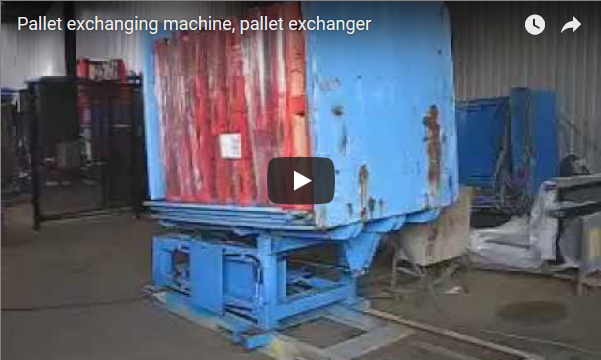
The machine is a tilting-platform pallet inverter. A fork truck places a loaded pallet on the platform, and workers put an empty pallet on top before the cycle starts. The machine holds the stack and tilts the platform, turning the load onto the pallet that was above it.
When the cycle finishes, the platform returns to horizontal and a fork truck picks the load up on its fresh pallet. Platform width and access height are confirmed per project.
Tilting platform and clamp
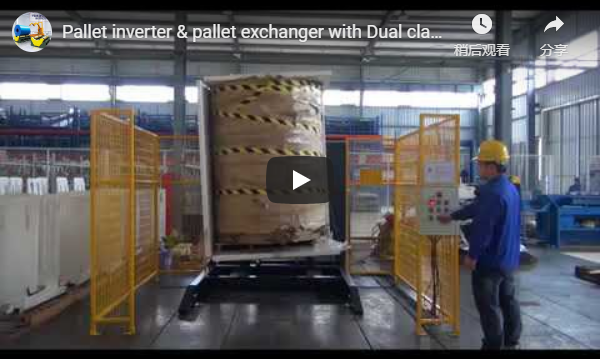
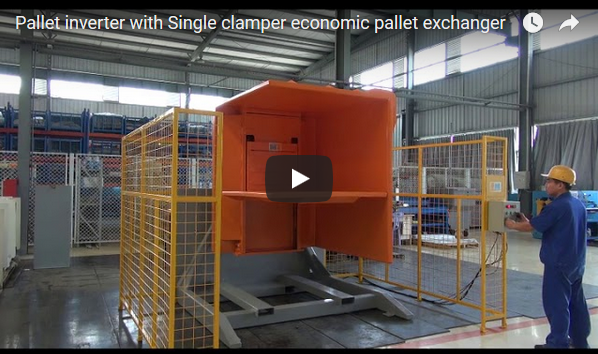
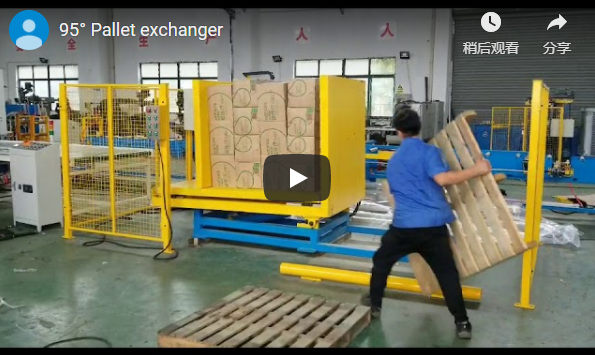
The main structure is a painted metal platform that tilts around a turning frame at its base, with a clamping frame that holds the two pallets together. A yellow metal mesh safety fence stands on either side of the work area, and the control panel is mounted on the fence.
The control panel carries the push buttons and indicator lamps for the cycle. Platform length, pallet footprint and fence layout are confirmed per project.
Cycle and control
The cycle runs in clear steps: the fork truck sets the loaded pallet on the platform, two workers place an empty pallet on top, and the operator starts the turn from the control panel. The platform holds the stack, tilts it and returns to horizontal for removal.
The control panel on the fence carries the buttons and lamps for the cycle, and the lamp lights while the machine runs. Cycle start and stop are handled at the panel, per project.
What the footage shows
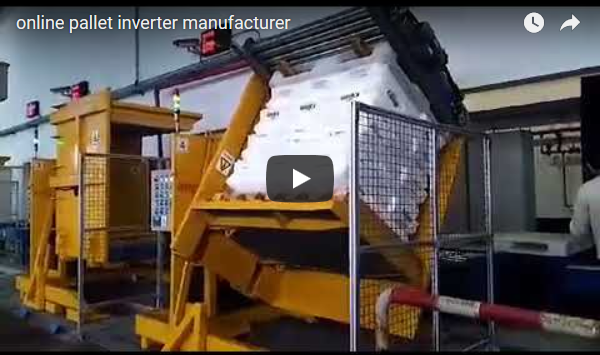
Our footage shows a fork truck placing a palletized load in a white bag on the tilting platform, and two workers setting an empty wooden pallet on top of it. The machine then holds the stack together and tilts the platform, turning it and bringing it back to horizontal, and the fork truck returns to collect the load. It is a general demonstration, so your pallet size, load weight and tilt angle are confirmed with us per project.
Typical configuration
Figures below list functional design boundaries rather than numeric values, and are confirmed per project.
| Parameter | Typical range, confirmed per project |
|---|---|
| Load | palletized load in a bag on a wooden pallet, placed by fork truck |
| Turn | platform tilts the loaded stack and returns to horizontal |
| Clamp | single clamping frame holds the pallets together during the turn |
| Control | push buttons and indicator lamps on the fence-mounted control panel |
| Guarding | yellow metal mesh safety fence around the work area |
| Mount | floor mounted, level access from the fork truck side |
| Electrical supply | 380 V three phase 50 Hz, or 220 V single phase for light machines, selected per project |
Selection checklist
| Question | Confirm per project |
|---|---|
| Pallet | footprint, height and pallet condition |
| Load | weight and stack height of the bagged load |
| Turn | required tilt angle and cycle |
| Access | fork truck aisle, platform height and clearance |
| Guarding | fence layout and control panel position |
| Electrical supply | voltage, phase and frequency on site |
Operation and safety
Set the loaded pallet on the platform, place the empty pallet on top, and start the cycle from the control panel. Keep clear of the platform and the fence opening while the stack is turning, and do not enter the fenced area during the cycle.
Routine checks cover the clamping frame, the platform and the control panel, per the machine manual. Confirm the pallets are seated and the load is stable before each turn.
Engineering FAQ
Q: What does this machine do? A: It turns a loaded pallet so the load ends up on a fresh pallet, without unloading it by hand.
Q: Why use it? A: A damaged or worn pallet is swapped in one operation, which avoids rehandling and keeps the load protected through the turn.
Q: How do we feed it? A: A fork truck sets the loaded pallet on the platform, then two workers place an empty pallet on top before the cycle starts.
Q: What sizes can it handle? A: Pallet size, load weight and tilt angle are confirmed per project before we quote the machine.
Q: What does it suit? A: Bagged or boxed pallet loads that need a fresh pallet before storage or dispatch, handled indoors by fork truck.
Next step
- Email us at info@fhopepack.com with your pallet size and load weight.
- We send a pallet inverter proposal within 48 hours.
- We confirm the platform size, fence layout and electrical supply for your site.
Related reading
- Fhope pallet inverter single clamper
- Coil Upending and Turning: Technology and Best Practices
- Partial film wrapping and packing by orbital wrapper
- FHOPE packing machinery product lines
Sources and standards
- ISO 12100:2010 Safety of machinery, general principles for design and risk assessment
- EN 415-10:2014 Safety of packaging machines, general requirements
- EN ISO 13849-1:2023 Safety of machinery, safety-related parts of control systems
FHOPE pallet inverter demonstration video. Reviewed as a general demonstration; pallet size, load weight and tilt angle confirmed per project.
Last reviewed: 2026-10-12