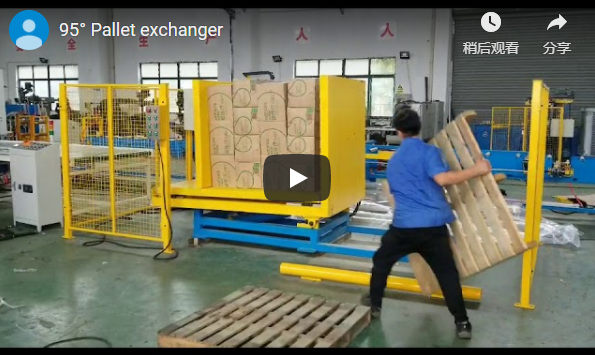
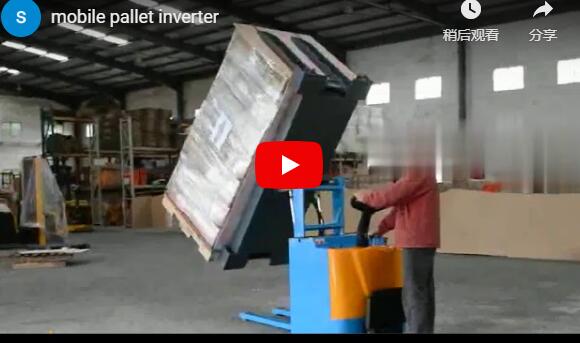
Executive summary Our FPFZ-01L pallet exchanger swaps the pallet under a load without unstacking it. The hydraulic frame tilts the load 90 to 95 degrees, the old pallet comes out and a new one goes in, and the frame returns upright. One change takes 20 to 35 s, for loads up to 2,000 kg. A worked example checks a stack of glass bottles against the limits and works out pallets per hour.
Table of Contents
- Why swap the pallet under a load
- The tilt and swap cycle
- Why the frame tilts past 90 degrees
- FPFZ-01L specifications
- Worked example: a stack of glass bottles
- Selection checklist: what to send us
- Safety and EN 415-10
- Engineering FAQ
- Next step
- Related reading
- Sources
Why swap the pallet under a load
Many plants keep clean plastic pallets inside the factory and ship on wooden ones. Others must take a broken pallet out from under a load before it jams a conveyor. Restacking hundreds of bottles or cartons by hand to do this is slow and risks breakage.
A pallet exchanger does the swap with the load intact. The goods stay stacked and wrapped. Only the pallet underneath changes, from plastic to wood, wood to plastic, or damaged to sound.
The tilt and swap cycle
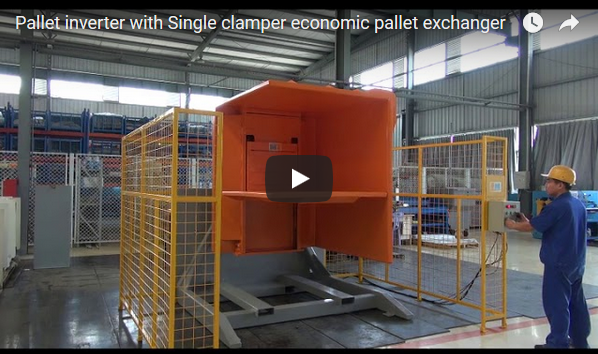
- Load. A forklift sets the wrapped load in the frame.
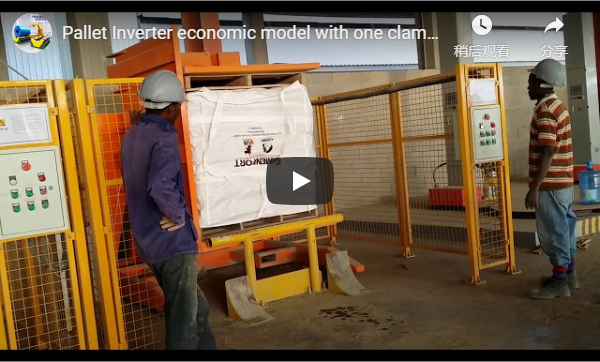
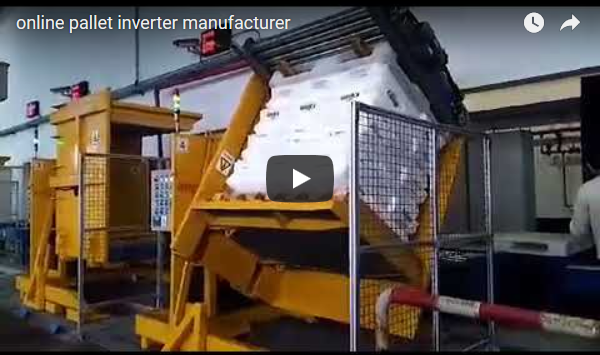
- Tilt. The operator starts the cycle from the panel or the remote. The hydraulic frame tilts the load over, so it rests on its side against the back plate.
- Swap. The operator pulls the old pallet away from the base of the load and pushes a new pallet into its place by hand.
- Return. The frame tilts back, and the load stands upright on the new pallet.
- Remove. The forklift takes the load away, and the old pallet goes back to its own pool.
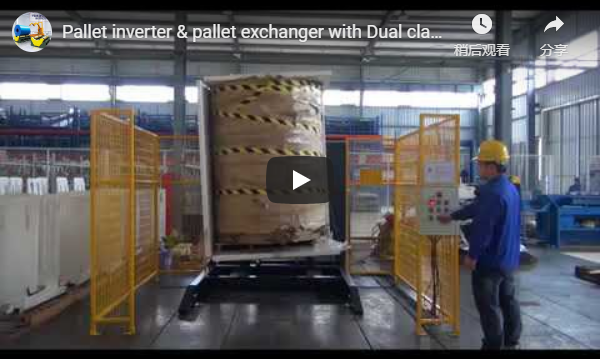
Stretch film round the stack holds the goods together while they lie on their side.
Why the frame tilts past 90 degrees
At exactly 90 degrees, a load on its side is balanced on the edge between the platform and the back plate. Tilting a few degrees further, up to 95, leans the load’s weight onto the back plate. The old pallet then carries no weight and slides out freely.
The same lean keeps the load steady while the new pallet goes in. That is why the exchanger suits fragile goods such as glass bottles and ceramics.
FPFZ-01L specifications
| Item | FPFZ-01L |
|---|---|
| Load length | 1,000–1,200 mm |
| Load width | 1,000–1,200 mm |
| Load height | 1,000–2,000 mm |
| Maximum load | 1,000 kg or 2,000 kg version |
| Changing time | 20–35 s |
| Tilt angle | 90–95° |
| Drive | hydraulic |
| Control | panel or remote |
| Power | 4.5 kW |
| Safety | fence or light beam |
Worked example: a stack of glass bottles
Take a stack of bottled drinks on a plastic pallet, 1,200 × 1,000 mm and 1,600 mm high. It has 7 layers of 80 bottles, each about 0.55 kg full. These are illustrative customer figures.
Size. 1,200 × 1,000 mm is inside the 1,000–1,200 mm footprint. The 1,600 mm height is inside the 1,000–2,000 mm range.
Weight. 7 × 80 = 560 bottles weigh 560 × 0.55 = 308 kg, plus the pallet. The 1,000 kg version has ample margin.
Pallets per hour. One change takes 20–35 s. The forklift trips in and out add time t at your site. If t is 60 s, an illustrative figure, a 35 s change gives 3,600 ÷ (35 + 60) = 38 pallets an hour. A 20 s change gives 3,600 ÷ 80 = 45.
Per shift. Over an 8-hour shift at 38 pallets an hour, that is up to 8 × 38 = 304 pallets swapped without unstacking a bottle.
Selection checklist: what to send us
- Load length, width and height.
- Load weight and how fragile the goods are.
- Pallet types going in and coming out.
- Pallets per hour.
- Forklift or pallet truck loading.
- Power supply at site.
Safety and EN 415-10
We design the pallet exchanger to EN 415-10 for packaging machines and assess risks to ISO 12100. The tilting frame and the hydraulic drive are the main hazards. The operator stays outside the tilting zone during the cycle, using the panel or the remote. A fence or a light beam guards the working area.
Engineering FAQ
Q: Does the load need to be wrapped? A: Loose goods should be stretch-wrapped first, so they move as one block when the frame tilts.
Q: Can it change plastic pallets for wooden ones? A: Yes. It swaps any pallet within the size range, in either direction.
Q: What if my load is taller than 2,000 mm? A: Send us the size. Our floor-level and V-shape pallet changers cover other ranges.
Q: Which safety standards apply? A: ISO 12100 for the risk assessment and EN 415-10 for the machine, in CE markets.
Next step
- Email your load sizes, weights and pallets per hour to info@fhopepack.com.
- We reply within 24 hours with a proposal naming the model and load version.
- We send a layout drawing with forklift access and guarding.
Related reading
- 95 degree pallet exchanger FPFZ-01L
- Floor-level pallet changer
- Pallet changer: how to operate it for pallet changing
- Cold storage pallet inverter, frozen product pallet changer
- V-shape pallet changer
- Push type pallet changing machine
Sources
- Specifications: FHOPE 95 degree pallet exchanger FPFZ-01L and floor-level pallet changer product pages
- Machine video: pallet exchanger on YouTube
- Weight and output: our worked example, illustrative load figures
- Standards: EN 415-10 (packaging machines, general safety); ISO 12100:2010
Last reviewed: 2026-10-17