Executive summary
The pallet under a load changes without the load being hand-stacked. An online pallet inverter clamps the load, rotates it and sets it down on a fresh pallet right in the conveyor line, so exchange happens without stopping the flow or restacking by hand. This guide covers the operating cycle, the guarding and the boundary with coil handling. Load and pallet sizes are confirmed per project.
Table of Contents
- What the machine does
- Why exchange online
- How the cycle runs
- Guarding and emergency control
- Load flexibility and motion
- The pallet versus coil boundary
- Typical configuration
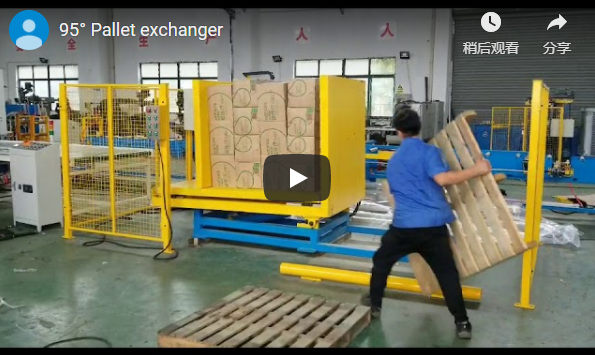
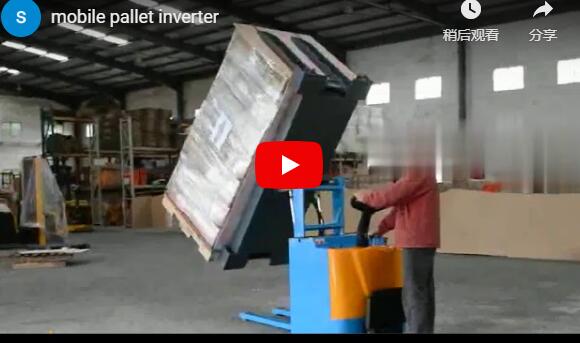
- What the video shows
- Selection checklist
- Controls and safety
- Engineering FAQ
- Next step
- Related reading
- Sources and standards
What the machine does
An online pallet inverter exchanges the pallet under a load without manual restacking. The load is clamped between two platens, lifted clear of the old pallet, rotated and set down on a fresh pallet, then released. Because the transfer happens inside the conveyor line, the load keeps its position and orientation while the bottom support changes.
Why exchange online
Manual pallet swapping takes floor space, takes labor hours and exposes workers to repetitive strain. An online inverter does the exchange automatically at line speed, so the product stays on the conveyor through the change instead of being staged, unloaded and re-stacked. That keeps the flow continuous and puts the load transfer in the machine rather than in the operator’s hands.
How the cycle runs
A sequence of moves makes up the exchange. The load arrives on its current pallet and stops in the machine. The clamping assembly holds the load from above and below, the unit lifts and rotates it, a fresh pallet is presented, and the load is lowered onto it and released. A programmable controller runs the motion, so the cycle repeats the same way for each load in the line.
Guarding and emergency control
A pallet inverter is heavy machinery with a rotating axis, so guarding is part of the machine rather than an option. Physical guards cover the rotating zone, an emergency stop is marked and reachable from the operator positions, and the electrical enclosure is rated for the warehouse environment. As with any line machinery, the equipment is supplied to the applicable machinery safety framework, with the machine manual kept with the unit.
Load flexibility and motion
Modern inverters handle a range of load heights without stopping for a setup change. A hydraulic or electro-mechanical clamp, selected per project, adjusts to the pallet in front of it, and the motion is profiled so rotation does not throw the product. The controller matches the move to the load, and the machine is sized to the line’s pallet types per project.
The pallet versus coil boundary
An inverter deals with palletized loads. Ring-shaped logistics units, such as steel coils, are not pallet exchange jobs: they need a dedicated coil upender that controls orientation without stressing the coil structure. If your load is cylindrical and handled without a pallet, the right equipment is a coil handler, not a pallet inverter, and that is confirmed per project.
Typical configuration
Figures below list functional design boundaries rather than numeric values, and are confirmed per project.
| Parameter | Typical range, confirmed per project |
|---|---|
| Load | footprint, height and weight |
| Pallet | incoming and outgoing types |
| Cycle | clamp, rotate, lower, release |
| Control | PLC with profiled motion |
| Safety | guarding, emergency stop, enclosure rating |
| Electrical supply | 380 V three phase 50 Hz, or 220 V single phase for light machines, selected per project |
What the video shows
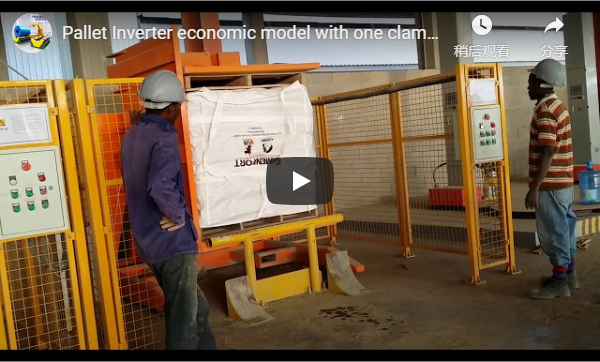
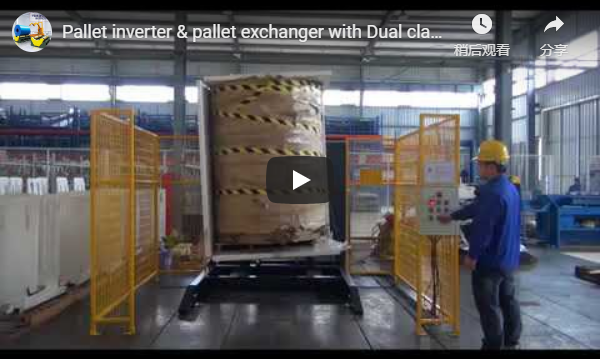
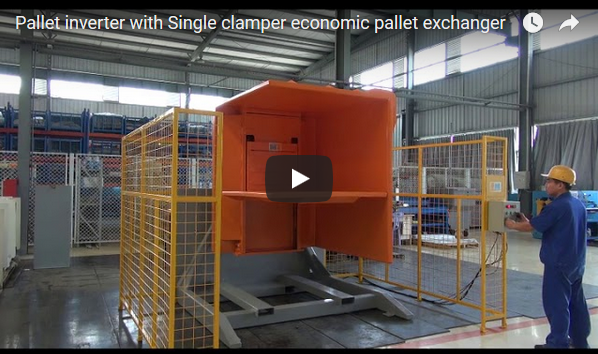
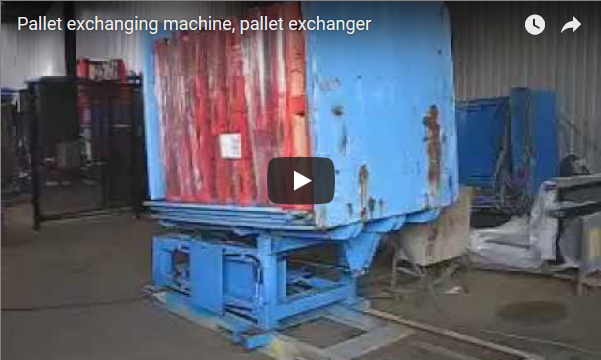
Our footage shows an online pallet inverter exchanging the pallet under a load in the conveyor line. It is a general demonstration, so load, pallet and cycle for your plant are confirmed with us per project.
Selection checklist
| Question | Confirm per project |
|---|---|
| Load range | footprint, height, weight |
| Pallet types | incoming and outgoing |
| Line fit | conveyor height and pace |
| Cycle need | exchange rate vs line speed |
| Guarding | zone layout and access |
| Electrical supply | voltage, phase and frequency on site |
Controls and safety
The inverter runs from its control panel and is set up for automatic line operation. Keep clear while a cycle runs. Routine checks cover the clamping platens, lifting and rotation drives, pallet presentation and the safety devices, and the unit is commissioned and maintained per the machine manual.
Engineering FAQ
Q: What does an online pallet inverter do? A: It clamps the load, rotates it and sets it down on a fresh pallet inside the conveyor line, without manual restacking.
Q: Why change the pallet at all? A: To put the load on the pallet the next stage needs, such as a clean outgoing pallet, without handling the product by hand.
Q: How are different load heights handled? A: The clamp adjusts to the pallet in front of it, so mixed load heights run without a setup stop, per project.
Q: Is it safe around people? A: Yes. Perimeter guarding covers the rotation envelope and emergency stops are reachable at the operator stations.
Q: Can it turn a steel coil? A: No. Coils are cylindrical loads handled without a pallet and need a dedicated coil upender, not a pallet inverter.
Next step
- Email us at info@fhopepack.com with your load range, pallet types and line layout.
- We send an inverter proposal and a layout drawing within 48 hours.
- We arrange a site survey to confirm conveyor and services.
Related reading
- Automatic pallet strapping machine for brick
- Automatic pallet strapping and wrapping machine from Shanghai, China
- Pallet stretch wrapping: technology and best practices
- FHOPE packing machinery product lines
Sources and standards
- ISO 12100:2010 Safety of machinery, general principles for design and risk assessment
- EN 415-10:2014 Safety of packaging machines, general requirements
- EN ISO 13849-1:2023 Safety of machinery, safety-related parts of control systems
FHOPE online pallet inverter demonstration video. Reviewed as a general demonstration; load, pallet and cycle confirmed per project.
Last reviewed: 2026-10-10