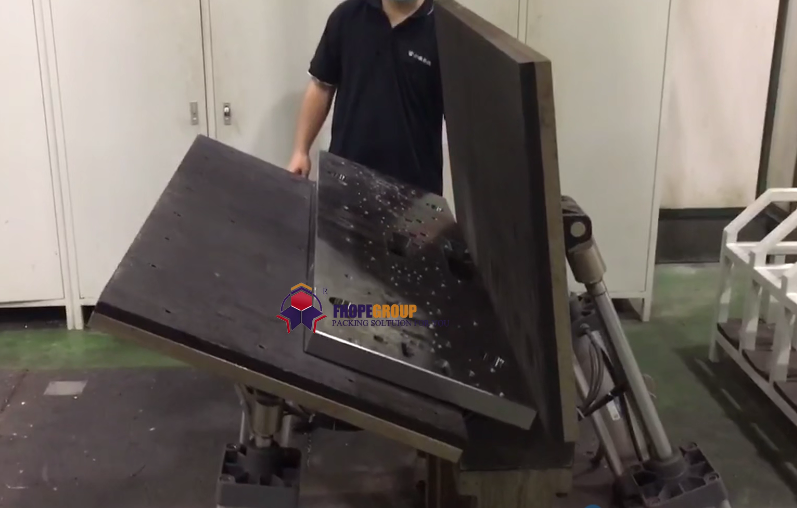
Executive summary The ROI of safety in a toolroom comes from turning heavy molds on the floor instead of in the air. Our 90-degree mold upender holds the mold on a table and turns it a quarter turn in about 60–90 s for the 10 t model. Models run from 3 t to 40 t, and the mold weight, footprint and turning direction decide the size.
Table of Contents
- How the upender turns a mold
- Upender or overhead crane
- Choosing the model
- The 10 t model table
- ROI worksheet
- Safety and standards
- Selection checklist
- Engineering FAQ
- Next step
- Related reading
- Sources
How the upender turns a mold
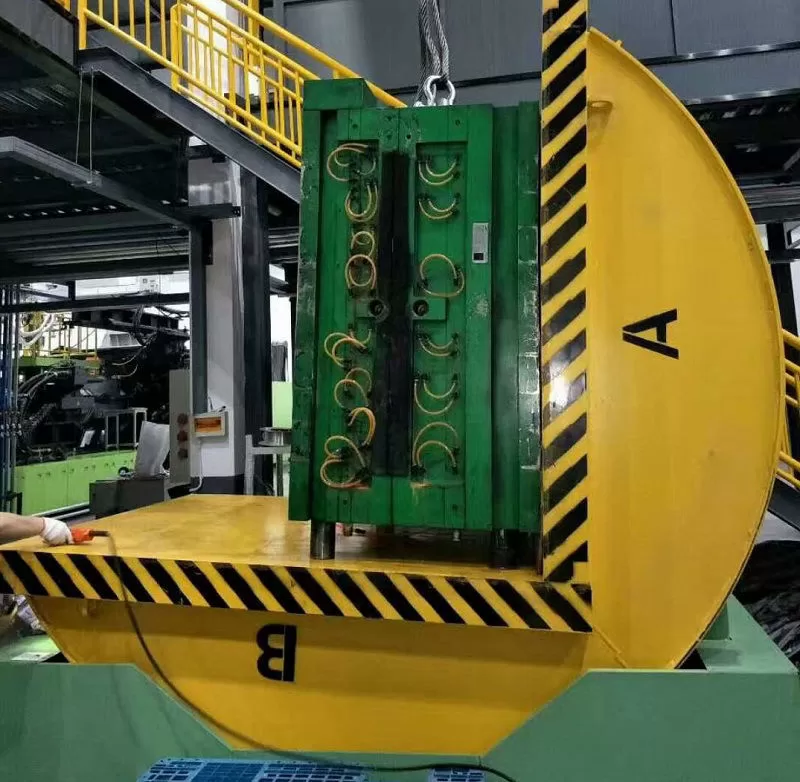
Our 90-degree mold upender holds the mold on an L-shaped table: a flat bed and a back plate at a right angle. Turning the table through 90 degrees moves the mold weight from the bed onto the back plate, so the mold ends up standing on what was its side face, supported the whole way. In our video, a steel die block marked 10T makes this quarter turn and back.
The die never leaves the machine during the turn, so no one has to guide a hanging load. The bellows cover on the side guards the turning mechanism, and the base carries the load on the floor.
Upender or overhead crane
Turning a mold with an overhead crane means rigging it, lifting it, letting it roll over on the slings and setting it down again. The load swings and shifts weight during the roll, and people stand close to guide it.
| Point | Crane flipping | 90-degree mold upender |
|---|---|---|
| Where the turn happens | in the air, on slings | on the machine table |
| Load control | load swings during roll-over | load stays supported through the turn |
| Operator position | close to the load to guide it | at the controls, away from the load |
| Crane time | crane busy for the whole flip | crane only loads and unloads |
| Repeatability | depends on rigging skill | the same quarter turn every time |
The crane is still needed to place the mold on the upender. What changes is the roll-over: it moves from the hook to a supported table.
Choosing the model
| Model | Max. load | Turning time |
|---|---|---|
| FPMT-03 | 3 t | 50–90 s |
| FPMT-05 | 5 t | 50–90 s |
| FPMT-10 | 10 t | 60–90 s |
| FPMT-20 | 20 t | 70–90 s |
| FPMT-30 | 30 t | 70–90 s |
| FPMT-40 | 40 t | 60–100 s |
Pick the model by your heaviest mold, then check the table size against its footprint. The working table is built to your mold size. Illustrative example: a toolroom with molds up to 8 t chooses the FPMT-10, which leaves margin for heavier molds later.
The 10 t model table
| Parameter | 90-degree mold upender 10T |
|---|---|
| Max. load | 10 t (10,000 kg) |
| Table length | 3,000 mm |
| Table width | 2,000 mm |
| Table height | 500 mm |
| Rotation | 90 degrees |
| Power and machine weight | confirmed in your proposal |
The mold footprint must sit on the 3,000 × 2,000 mm table with its centre of gravity close to the table centre. We check the centre of gravity of your heaviest and most uneven molds before we fix the table. With a 500 mm table height, we also agree the foundation and the crane access in the layout.
ROI worksheet
The return comes from crane time, labour time and avoided incidents. Fill in your own numbers:
- Flips per day. Count how many molds you turn in a day.
- Crane flip time. Time one flip from rigging to setting down, and count the crew.
- Upender flip time. Loading and unloading by crane, plus 60–90 s for the turn on a 10 t model.
- Time saved per day. (Crane flip time − upender flip time) × flips per day × crew size.
- Crane time freed. The crane is free during the turn, so it can serve other jobs.
- Risk. Add the cost of damaged molds and lost-time injuries from past flips.
We work through this worksheet with you during the site survey, using your flip counts.
Safety and standards
The upender keeps the operator at the controls and away from the load during the turn. The working table is designed for your mold, and the machine carries a 24-month warranty.
The standards that apply depend on the destination market. For CE markets, ISO 12100 sets the risk-assessment method and EN 415-10 sets general requirements for packaging machines. We confirm any further machine-specific standards in your proposal.
Selection checklist for a mold upender
- Heaviest mold weight and footprint.
- Centre of gravity of uneven molds.
- Turning angle: 90 degrees for this machine; a full turnover needs our 180-degree mold upender.
- Flips per day.
- Crane or forklift for loading.
- Floor space and foundation.
Engineering FAQ
Q: How long does a 90-degree turn take? A: 60–90 s on the FPMT-10, and 50–90 s on the 3 t and 5 t models.
Q: Which model fits an 8 t mold? A: The FPMT-10, with a 10 t max. load and a 3,000 × 2,000 mm table.
Q: Do we still need a crane? A: Yes, to load and unload the mold. The roll-over itself happens on the upender.
Q: Can the table fit a non-standard mold? A: Yes. The 10 t table is 3,000 × 2,000 mm as standard, and the working table is customized to your mold size.
Q: What is the warranty? A: 24 months.
Next step
We size your mold upender in three steps:
- Submit your layout drawing with mold weights, sizes and flips per day to info@fhopepack.com.
- Receive a proposal within 48 hours, with the model, table size and ROI worksheet.
- Book a site survey to fit the upender to your toolroom.
Related reading
- 90-degree mold upender 10T
- Mold upender range
- Die mould upender
- Coil upender tilter
- Upender with conveyor
Sources
- Model range, turning times, warranty: mold upender page
- 10 t table size and rotation: 90-degree mold upender 10T page
- Machine in action: our mold upender video on YouTube
- Standards scope: ISO 12100:2010, EN 415-10:2014
Last reviewed: 2026-10-04